viernes, 23 de agosto de 2013

La Colonialidad del Saber: eurocentrismo y ciencias sociales

Edgardo Lander (editor) La colonialidad del saber: eurocentrismo y ciencias sociales. Perspectivas latinoamericanas. Caracas, Facultad de Ciencias Económicas y Sociales (FACES-UCV), Instituto Internacional de la UNESCO para la Educación Superior en América Latina y el Caribe (IESALC), 2000.

"...en la mayoría del conjunto de textos que conforman La colonialidad del saber: eurocentrismo y ciencias sociales. Perspectivas latinoamericanas puede observarse un objetivo común: acabar con uno de los signos más claros de la limitación conceptual de las ciencias sociales, es decir, con la persistente negación del vínculo existente entre modernidad y colonialismo."Los autores consiguen su meta colectiva al vincular los mecanismos disciplinarios  que buscaban crear el perfil del homo economicusen América Latina a la dinámica de la constitución del capitalismo como sistema-mundo, es decir, al mostrar el proyecto de la modernidad como el ejercicio de una "violencia epistémica". -Arnaldo E. Varelo. Descarga aquí.

viernes, 17 de mayo de 2013

Campaña sobre el uso seguro de Internet

Con un portal web, una campaña radial y seminarios para padres y apoderados en todas las regiones del país, el Ministerio de Educación a través de Enlaces, busca crear conciencia sobre los riesgos y potencialidades de Internet. La iniciativa se enmarca en el Programa Escuela Segura.


Lo que se sube a Internet es como una huella imborrable: siempre queda una marca ya sea de la foto, el video o de lo que se escribe. Los adultos deben conversar con los niños sobre los peligros que existen en la red, igual como les enseñan a cruzar la calle o a no hablar con extraños. Este y otros temas son desarrollados en los seminarios “Ser Familia en la Era Digital”, iniciativa que tiene como objetivo orientar a los padres, apoderados y profesores sobre los riesgos y potencialidades de Internet, brindándoles la posibilidad de que asuman un rol de mediadores activos y “guías digitales” de sus hijos y alumnos en la navegación por la red.
Son 33 seminarios que se están realizando en todas las regiones del país. Enlaces invitó a participar en esta actividad a dos instituciones: Policía de Investigaciones (PDI) y Fundación Queveo, con el objetivo de entregar una mirada desde el tema legal y criminal y desde la sociedad civil.
En forma complementaria, se estrenó el portal www.internetsegura.cl, el cual entrega datos sobre buscadores infantiles, vínculos a sitios de estudio como www.yoestudio.cl, consejos para que niños y adolescentes hagan un uso seguro y responsable de esta tecnología y padres y profesores sepan cómo orientarlos en relación a este tema. Cuenta con distintos perfiles de acuerdo a las necesidades de cada usuario y reúne información propia del Ministerio y de distintos países e instituciones sobre el uso seguro de Internet.
Adicionalmente, desde el sitio Internet Segura se puede acceder al de los seminarios “Ser Familia en la Era Digital”, donde hay información sobre el calendario nacional y los videos de las presentaciones.
Otra estrategia para crear conciencia sobre este tema es la realización de una campaña que actualmente se está emitiendo en varias radios naciones y regionales.
Todo lo anterior se enmarca dentro del Programa Escuela Segura, que busca fortalecer en todos los colegios del país, las medidas para prevenir y proteger a los estudiantes, de todo tipo de riesgos.

martes, 7 de mayo de 2013

Various Cause Effects Of Video Games Psychology Essay


The most successful aspect of video games is that they provide a huge amount of human interaction through imagery and audio, thus encouraging the player to think and act quickly(Wolf, 2001, p15). This aspect makes video games different from any other forms of non-interactive media like television or radio. Video games give clear instructions about actions to be performed to reach particular levels in the game and instils a level of confidence and spirit of victory in its players. They also serve academic purposes and can be utilised as a powerful medium for educating children and youth in a very interesting and powerful manner. For example, video games involving driving can be used as a medium to teach players the traffic rules and penalties imposed if the rules are violated. Puzzle based video games give valuable practice lessons of time management, helps to sharpen specific skills needed to succeed in the game, encourages critical analysis and thought and improves cognitive abilities (Wolf, 2001, p17; Seller, 2006, p20).

Social

Video games have a part in influencing the social behaviour of young players especially children. The interactive gaming gives a virtual environment involving the player and his opponent which is essentially the computer system. In addition to promoting a level of healthy competition among players, the penalties imposed help to give due respect to fellow participants and encourages sportsman spirit to a great extent. Games which involve military contents can help to inculcate patriotism in youngsters as they are made to believe that they are protecting their country from rival attacks. Though there has been criticisms regarding the effect of video games in sparking criminal behaviour among youth, Jenkins (n.d.) observes that the hostile factors contributing to these acts are coming from unsound minds and disrupted families rather than interactive media. In fact, James Gee’s work highlights the benefits of using video games as effective media for logical problem solving and continuous improvement, thus improving the qualitative skills (Gee, 2001).

Psychological

Apart from providing relaxation and enjoyment, video games boost the player’s confidence level and raises curiosity as in most games, each level is exciting and cannot be seen unless the players pass all the previous stages. In children, the level of psychological development obtained leads to sharpening of memory and logical skills, increased mental development and simulation, making them tougher to face the challenges of the real world.


Vices

Contrary to the popular belief that video game players are just youngsters, Entertainment Software Association(ESA) has shown that 49% of game players are in the age range of 18-49 while the demographic statistics give 52% male and 48% female players (ESA, 2009, p3). The revenue obtained by video game sales in US was $11M in 2008 with Wii console games at the top according to NPD statistics (ESA, 2009, p10).

Though the video game industry has flourished and sales figures have been accelerating over the last few decades, a lot of negative publicity has affected the popularity of interactive games to a large extent. Though there are many pros, the bad effects are so obvious and derogatory that they outweigh the advantages to a large extent.


Medical

The increasing popularity of video games is making more and more youngsters spend considerable amount of time and money in front of the gaming console or computer which has harmful medical effects arising due to addiction (Gunter, 1998, p31). The addiction can lead to childhood obesity as children will find no time for outdoor games which are healthy and provides relaxation and exercise to brain, mind and body. The strain caused by continuous exposure to harmful radiation from television affects a significant number of youngsters by ending up having problems with their eyes. The adult players are even more in danger as the addiction causes a change in lifestyle which trigger a variety of fatal illnesses from high cholesterol to heart attacks in addition to causing spinal alignment problems due to wrong posture.


Psychological

Most of the video games depict violence and the motto is to kill and succeed. Young minds are particularly interested in games involving violent attacks, abusive language and homicide. Different researches have been conducted in psychological aspects due to violent video games. Anderson et al. (2007, p12-39, p40-60) has described about the different kinds of aggressive behaviour exhibited by children based on which an aggression model is created. 

The effects of violence can arise from thefts for buying video games to thrills obtained from imitation of the shootings and attacks on innocent subjects. Continuous exposure to violent media has a profound influence on the mental balance of the young player, giving a very wrong impression that ‘killing is winning’.


Social

Recent reports have shown that an average time spent by a child playing console, arcade or home video games is almost 11-13 hours/week (Gentile, 2004, p1; Olson et al.,2007, p1). It means that they get little time for social interactions, academic reading and outdoor games. 

Decrease in peer association hinders development of social etiquettes, family ties and character. The social and emotional commitments are disrupted by over indulgence in interactive media leading to a set of humans devoid of emotions, respect or self-esteem. The increasing amount of violence and destruction involved in most games and the lonely atmosphere provided acts as detrimental to good social conduct. Stromberg (n.d.) has shown that almost 50% of popular games depict either fantasy or human violence to the extent that they encourage players to become less caring and friendly. According to Gentile & Anderson (2003, p131-152), the tendency of aggressive behaviour is affected by repeated game play which often reward the players for violence.


Critical Analysis

Wirth et al. (2003) has given that the virtual environment created by video games is essential to establish a spatial presence. But the impression of world as given by games has very little relation with the original real circumstances or actions. The violence and plan of action depicted in these scenarios, if practised in actual circumstances give horrendous repercussions for both the doer and the society. Some researches show video game learning as better to classroom learning in terms of memory retention (Moreno & Meyer, 2000, p724) but it does not in any way substitute the knowledge obtained from books, classrooms or other interactive learning techniques but just complements them.

The reason for success of video games has been described as the level of “active control” involved (Greenfield, 1984, p102). Active control often enables the player to decide on the course of action to be taken to fight the circumstances which gives them an uneven control and pseudo confidence that may urge them to enact similarly in a real situation. Moreover, the points gained during shooting or killing tends to glorify the violence depicted in games. The addiction to video games often leads to fits of anger and rows between the children and parents. The first rehabilitation centre for teenagers addicted to video games has been set up in London following the urge of parents (Taylor, 2010, p9).

Parents have expressed concerns on the influence on video games on the psychological and social behaviour of children (Gunter, 1998, p35). Most video games have parental control through which the type, intensity and mode of play can be controlled by parents. But recent research has shown that only one-fifth of the parents are exercising their control over purchase of video games, with 55% of stores educating them on ratings (Walsh et al. 2003).
Lee et al. (2009, p562) have put forward that the technological aspect has an influence on violent psychological behaviour in a way that a game played using less sophisticated graphics and audio do less harm. But here also, time is the deciding factor as continuous exposure to the virtual world even in low resolution graphics can cause psychological imbalance and health problems.

Even though clear correlation between violent shooting attacks by teenagers and interactive gaming has not been established in all cases, the increase in vocal abuse and insensitiveness towards crime itself are appalling. American Health Association’s research has given results stating that time spend by teenagers belonging to lower socio-economic status playing games was almost five fold than those of their educated and rich counterparts (ScienceDaily, 2008). This shows that education, and not money is the judging factor for use of technology.


Read more: http://www.ukessays.com/

miércoles, 1 de mayo de 2013

Psicolojía del Pueblo Araucano - T. Guevara (1908)


“Este trabajo ha sido redactado con intención científica. No es, pues, labor de propaganda contra la raza indígena: seria eso pueril i sin ningún fin práctico. No es tampoco un idilio para ensalzar las cualidades de nuestros aborígenes, porque tal obra tendría el inconveniente de perturbar el criterio público i particular, por consiguiente, el plan de asimilación de los 70 u 80 mil indígenas que aun sobreviven."

"Tiene este libro otro interés de orden teórico: dar a conocer a la raza en aspectos que no pudieron estudiar los cronistas, i suministrar algunos datos sobre instituciones de conocimiento contemporáneo, como el tótem, el tabú, la majia y otras."

"Por lo demás, el plan de este libro es mui sencillo: va dividido en dos partes que dan a conocer el medio natural i social primero i el alma araucana en seguida; se estudia la evolución de las instituciones indígenas i se hace el análisis psicolójico de ciertos estados sociales."
El Autor.
Psicolojía del Pueblo Araucano
Autor: Tomas Guevara.
1a Ed. Santiago de Chile. 1908.

viernes, 19 de abril de 2013

Three are dead, hundreds injured, but the reasons remain a mystery


| BOSTON | The Economist.
TO HELP friends and family members find one another amid the crowds expected at this year’s Boston marathon, the organisers set up a series of meeting points in the streets around the finish line. The bright yellow and orange signs are still there, but most of the planned reunions were thwarted—and a few will never now take place—thanks to the two bombs that blew up on April 15th near the end of the course in the closing stages of the race.
The explosions, separated by 600 feet (180 metres) and 12 seconds, killed three people: an eight-year-old boy and two young women. Another 180 or so were injured. At least 13 people lost limbs. That makes the attack the most deadly act of terror in America since September 11th 2001, apart from mass shootings. To add to the alarm, the authorities intercepted two letters, one addressed to Barack Obama and another to Roger Wicker, a senator, which appeared to contain ricin, a lethal poison. A fire followed by an explosion at a fertiliser factory in west Texas on the night of April 17th, which killed at least five people, increased the sense of apocalypse. But as The Economist went to press there was still no indication that this was anything but a horrific accident.
Shortly after the Boston bombing Mr Obama vowed that “any responsible individuals, any responsible groups will feel the full weight of justice.” The FBI, sifting through the mass of video footage and photographs provided by broadcasters, security cameras and bystanders, homed in on shots of two individuals who officials believe may be responsible for the bombs. But their whereabouts, identity and motives remained a mystery. An aggrieved constituent of Mr Wicker was arrested on April 17th, suspected of sending the poisoned letters; but he has not been tied to the bombings.
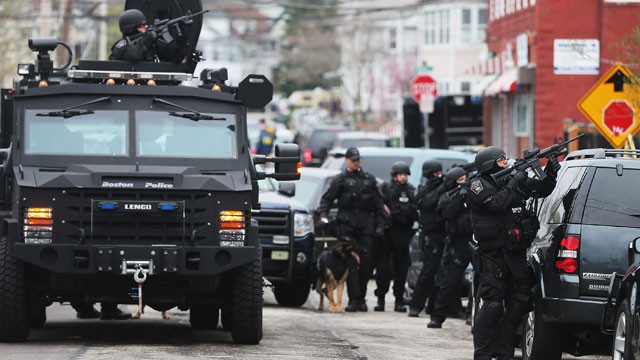
Boston is now flooded with police, soldiers and other security forces, both to ward off further attacks and to help with the investigation. State troopers stand watch outside metro stations; whole squadrons of national guardsmen march back and forth on Boston Common, a park a few blocks from the site of the bombings. Barricades festooned with flowers and notes of condolence block access to the immediate area of the blasts, as investigators pore over it in the hunt for evidence.
Fragments retrieved from the scene suggest that the bombs were constructed from six-litre pressure-cookers packed with gunpowder, a simple detonator and shrapnel in the form of nails and ball-bearings, intended to cause horrific injuries.
The simple but effective design of the bombs, which may have cost as little as $100 to make, is similar to countless improvised explosive devices (IEDs) that have inflicted casualties on civilians and Western troops in Afghanistan and Iraq. Instructions for building such bombs can be easily found on the internet. The bombs’ lack of sophistication suggests they were either the work of a lone individual or a small group with limited resources.
In 2010 an online magazine, Inspire, published by al-Qaeda in the Arabian Peninsula, ran an article entitled “How to make a bomb in the kitchen of your mom”. Inspire, aimed at aspiring young jihadists in America and Britain, was edited by Anwar al-Awlaki and Samir Khan. Both were American citizens who were killed by the same drone strike in Yemen in 2011.
However, the fact that pressure-cooker bombs are popular with al-Qaeda operatives is far from conclusive evidence that the Boston bomber had jihadist aims or connections. America has suffered several terrorist attacks by native-born extremists with domestic grievances, such as the IED set off near the Olympic stadium in Atlanta in 1996, or the bombing of a federal office building in Oklahoma City in 1995.
The bombings in Boston took place as locals celebrated (four days early) Patriots’ Day, the anniversary of the first skirmish in America’s war for independence. The date could be significant to the sort of radicals who believe the federal government is bent on the destruction of their liberties and the confiscation of their guns, especially as it coincides with the anniversaries of two violent episodes involving like-minded people: the end of the siege of the compound of a heavily armed cult in Waco, Texas, on April 19th 1993, and the Oklahoma City bombing exactly two years later. April 15th is also the day by which federal income-tax returns must be filed, another flashpoint for many.
Mr Obama’s re-election and his support for immigration reform and gun-control legislation, however ill-fated, have enraged this extremist fringe. The Southern Poverty Law Centre (SPLC), a civil-rights organisation that tracks and exposes the activities of right-wing extremists, says that outfits of this kind have proliferated during his presidency, from around 150 in 2008 to an all-time record of 1,360 last year (see chart).
The SPLC estimates that of those about 1,000 could be classified as “hard-core”, and thus by implication capable of violence. Among recent incidents, it points to the murder of six people at a Sikh temple in Wisconsin by a neo-Nazi gunman last August and the rounding up, also last year, of a murderous militia group based in Georgia, which included several active-duty soldiers. According to prosecutors, the group, which called itself FEAR (Forever Enduring, Always Ready), had stockpiled $87,000 worth of weapons and explosives, and was plotting to overthrow the government through a campaign of terror and assassinations.
If the perpetrator is identified it will have political ramifications. If the bomber is a jihadist, Mr Obama can expect to be taken to task for complacently declaring victory over al-Qaeda courtesy of his drone campaign. If it is a home-grown nut, Republicans can expect some blame for not stamping more firmly on the furious claims made about Mr Obama from the right’s wilder shores. And there is always the possibility that the bomber is an awkward combination of the two: a home-grown Islamic loner.
From the print edition: United States

The Psychology of a Boston Marathon Terrorist: 10 Questions for a Retired Marine


By Elaine M. Grossman | National Journal
Many of those who knew the two Boston Marathon bombing suspects, Tamerlan and Dzhokhar Tsarnaev, believed them to be talented students and athletes with promising careers ahead of them. So how could these seemingly “normal” young men have become terrorists -- and why?
The two brothers actually fit into an emerging trend, according toG.I. Wilson, a retired Marine Corps Reserve officer and militancy expert who specializes in counterterrorism, criminal behavior andforensic psychology.
“Terrorists are not psychotics or mentally disordered,” Wilson said on Friday. The study of terrorism over the past couple of decades has given experts “a greater appreciation of how normalcy is reflected in terrorists’ behavior,” he toldGlobal Security Newswire.
Like those implicated in the 9/11 attacks, the Tsarnaev brothers appear to have quickly assimilated from another nation into their local community and had no outwardly apparent radicalism, psychosis or inclination toward violence.
The pair of blasts near the marathon’s finish line on Monday resulted in three deaths and more than 175 injured.


Latest Global Security Posts:
Loading feed...
The two suspected perpetrators, whose identities were made public on Thursday, were reported to have moved to the Boston area more than five years ago from southern Russia, near the restive area of Chechnya.
Tamerlan Tsarnaev, 26, was described as a gifted amateur boxer who studied at Bunker Hill Community College part time between 2006 and 2008, and hoped to become an engineer. He was killed in a firefight with police Thursday night, according to news reports.
Dzhokhar Tsarnaev, 19, was described an all-star wrestler in high school and a student at University of Massachusetts Dartmouth. He was the focus of an epic manhunt in the Boston area on Friday and remained at large at press time.
Wilson, a former infantry colonel, said a sense of normalcy can pervade groups of extremists when individuals surround themselves with like-minded compatriots.
He recalled a segment on CBS News’ “60 Minutes” more than a decade ago about Yahya Ayyash, a Hamas bomb-maker who was nicknamed “the Engineer” and was ultimately assassinated by Israeli operatives in 1996.
“One of the Engineer’s followers was asked to describe how a terrorist could do such a terrible thing. His answer: ‘He’s a very normal person, just like us,’” Wilson said.
When the CBS interviewer took exception, the militant replied, “There thousands and thousands in our country that believe what we believe -- and not only in our country, in the rest of the Arab world and even in your country,” according to terrorism expert.
Wilson, who retired in 2006 after more than 30 years of uniformed service, responded to GSNquestions about terrorism and psychology in an e-mail exchange. Edited excerpts follow.
GSN: Based on your understanding of the criminal mind, what is going on now inside the head of an accused Boston terrorist on the loose amid a major manhunt, whose alleged co-conspirator brother was just killed?
Wilson: No one can read a criminal's or terrorist’s mind, but past behavior is an indicator of future behavior.
Psychiatrist Jerrold Post … contends we should not speak of a terrorist psychology in the singular, but rather of terrorist psychologies.
Ideology is central to the terrorist's psychology, no matter their ilk. They are therefore totally committed – [or] radicalized – and [this] tends to be expressed in all-or-nothing activities.
Watch for a very violent conclusion.
GSN: Reports are that the surviving suspect, Dzhokhar Tsarnaev, is a second-year medical student and came with his family to the United States about a decade ago from a Russian area near Chechnya, a region known for Islamic militancy and separatists. Any theories about why a young man like that would undertake a terrorist attack in the United States?
Wilson: Chechnya fighters -- [who typically refer to themselves as] "volunteers” -- have been seen in Iraq and Afghanistan. [It is a] matter of participating in jihad, which is an integral part of their belief system, ideology and psychology.
GSN: Specifically, news media is reporting that these young men seemed like "normal Americans," who like many in the nation are first-generation immigrants. What are we not seeing here, in terms of hidden psychological pathology?
Wilson: Appearing normal is the norm [for terrorists], and they often just blend in. [Stanford University’s Martha] Crenshaw … identifies normalcy as a characteristic feature of terrorists, rather than psychopathology or personality disturbance.
GSN: Is someone who carries out such a horrific attack necessarily a psychopath? Or could these be psychologically healthy individuals who are killing for a cause in which they deeply believe?
Wilson: Current data indicates terrorists and suicide bombers do not display any marked psychopathology. … Nevertheless, a trend and frequent perception has emerged asserting that terrorists possess traits of pathological personalities but do not possess the actual clinical disorders. This effectively paints terrorists with the psychological brush of pathology. 
Violence today may be a norm and the norm for such radicalized young people, whether it is on a wide scale or within a smaller community or family. It may come to be considered the normal response to achieve objectives. 
In fact, many terrorists view themselves as soldiers engaged in a just war. 
GSN: How could we do a better job at recognizing in society a person who has the potential to become a terrorist?
Wilson: [Counterterrorism expert Marc] Sageman found that about 70 percent of terrorists had joined while they were living as expatriates in other countries, looking for jobs and education. Prior to moving they were not strongly religious, but while in their new countries they visited mosques and moved in with other Islamic expatriates. Some of the latter were already members of terror organizations who then recruited them into those organizations.
GSN: Given what the FBI has revealed about the composition of the two pressure-cooker bombs and the way in which the suspects have operated, how likely do you think it is that they had the support of additional co-conspirators?
Wilson: While terrorists often operate in cells and are compartmented for operational security reasons, they often do need support. I would not rule out any co-conspirators or support personnel, be it intentional or unknowing support. Association with others must be looked into.
Terrorists use groups and networks for both logistical and psychological support. Groups afford a sense of belonging, a sense of purpose, perhaps even a sense of identity. 
GSN: When working with a fast-breaking case like this, how do you deal with the phenomenon of not knowing which incoming information is accurate, and which is inaccurate and leading you down false paths?
Wilson: Any operator will tell you your first information is neither your worst nor best, and generally is incomplete and inaccurate. That is very true here, as well. Every data point must be checked and verified. Never rely on single-source reporting. The best example of this was the deluge of reports of an arrest being made that were not accurate.
GSN: What would it take to plan the Boston attacks in terms of devising a plan, scoping out targets, assembling bomb materials and carrying out the logistics? Can you make sense, after all that planning, why the Boston bombers would have stuck around the area before being identified and then robbed a local convenience store?
Wilson: They lived [in the area] so they knew the "terrain" and blended in, which no doubt gave them the opportunity to do surveillance and reconnaissance.
GSN: What are one or two things you have learned from past terrorist attacks around the globe that you've thought this week might be applied to this episode?
Wilson: Their capability to adapt so very quickly using our very own system of laws and technology against us. [They employ] simplicity, sophistication, and global networks, much like third-generation street gangs. 
They have a very fast, adaptive [and] complex orientation-decision-action cycle, leveraging the physical -- for example, operationalizing IEDs and suicide bombers -- with the moral-mental aspects – for example, radicalized ideology concordant with the psychology of terrorism. [They are intent on] creating widespread global fear, giving [the] impression that governments cannot protect their people. Cartels and gangs in Mexico do much the same.
GSN: What are a couple of key questions on your mind now as the details of this episode unravel?
Wilson: Today we are recognizing many of the misconceptions regarding terrorists and their profiling. Terrorists are not psychotics or mentally disordered. Terrorists do not suffer markedly formed personality disorders nor does data support terrorism finding its genesis in personal frustration, economic deprivation, or psychological coercion.
We do have a better idea today of what is and is not psychologically related to terrorism and a greater appreciation of how normalcy is reflected in terrorists’ behavior.

jueves, 18 de abril de 2013

Sir Ken Robinson - Los Secretos de la Creatividad (Redes N°89)

Todos poseemos un talento, todos tenemos la capacidad de ser creativos, y la mayoría vivimos sin saberlo, convencidos muchas veces de que el creativo es aquel que sabe componer melodías, o escribir una poesía. Ken Robinson reclama en este capítulo de Redes la necesidad de que en nuestra sociedad existan entornos donde cada uno pueda encontrar la inspiración necesaria para desarrollar su creatividad.