Mostrando entradas con la etiqueta Education. Mostrar todas las entradas

martes, 7 de mayo de 2013

Various Cause Effects Of Video Games Psychology Essay


The most successful aspect of video games is that they provide a huge amount of human interaction through imagery and audio, thus encouraging the player to think and act quickly(Wolf, 2001, p15). This aspect makes video games different from any other forms of non-interactive media like television or radio. Video games give clear instructions about actions to be performed to reach particular levels in the game and instils a level of confidence and spirit of victory in its players. They also serve academic purposes and can be utilised as a powerful medium for educating children and youth in a very interesting and powerful manner. For example, video games involving driving can be used as a medium to teach players the traffic rules and penalties imposed if the rules are violated. Puzzle based video games give valuable practice lessons of time management, helps to sharpen specific skills needed to succeed in the game, encourages critical analysis and thought and improves cognitive abilities (Wolf, 2001, p17; Seller, 2006, p20).

Social

Video games have a part in influencing the social behaviour of young players especially children. The interactive gaming gives a virtual environment involving the player and his opponent which is essentially the computer system. In addition to promoting a level of healthy competition among players, the penalties imposed help to give due respect to fellow participants and encourages sportsman spirit to a great extent. Games which involve military contents can help to inculcate patriotism in youngsters as they are made to believe that they are protecting their country from rival attacks. Though there has been criticisms regarding the effect of video games in sparking criminal behaviour among youth, Jenkins (n.d.) observes that the hostile factors contributing to these acts are coming from unsound minds and disrupted families rather than interactive media. In fact, James Gee’s work highlights the benefits of using video games as effective media for logical problem solving and continuous improvement, thus improving the qualitative skills (Gee, 2001).

Psychological

Apart from providing relaxation and enjoyment, video games boost the player’s confidence level and raises curiosity as in most games, each level is exciting and cannot be seen unless the players pass all the previous stages. In children, the level of psychological development obtained leads to sharpening of memory and logical skills, increased mental development and simulation, making them tougher to face the challenges of the real world.


Vices

Contrary to the popular belief that video game players are just youngsters, Entertainment Software Association(ESA) has shown that 49% of game players are in the age range of 18-49 while the demographic statistics give 52% male and 48% female players (ESA, 2009, p3). The revenue obtained by video game sales in US was $11M in 2008 with Wii console games at the top according to NPD statistics (ESA, 2009, p10).

Though the video game industry has flourished and sales figures have been accelerating over the last few decades, a lot of negative publicity has affected the popularity of interactive games to a large extent. Though there are many pros, the bad effects are so obvious and derogatory that they outweigh the advantages to a large extent.


Medical

The increasing popularity of video games is making more and more youngsters spend considerable amount of time and money in front of the gaming console or computer which has harmful medical effects arising due to addiction (Gunter, 1998, p31). The addiction can lead to childhood obesity as children will find no time for outdoor games which are healthy and provides relaxation and exercise to brain, mind and body. The strain caused by continuous exposure to harmful radiation from television affects a significant number of youngsters by ending up having problems with their eyes. The adult players are even more in danger as the addiction causes a change in lifestyle which trigger a variety of fatal illnesses from high cholesterol to heart attacks in addition to causing spinal alignment problems due to wrong posture.


Psychological

Most of the video games depict violence and the motto is to kill and succeed. Young minds are particularly interested in games involving violent attacks, abusive language and homicide. Different researches have been conducted in psychological aspects due to violent video games. Anderson et al. (2007, p12-39, p40-60) has described about the different kinds of aggressive behaviour exhibited by children based on which an aggression model is created. 

The effects of violence can arise from thefts for buying video games to thrills obtained from imitation of the shootings and attacks on innocent subjects. Continuous exposure to violent media has a profound influence on the mental balance of the young player, giving a very wrong impression that ‘killing is winning’.


Social

Recent reports have shown that an average time spent by a child playing console, arcade or home video games is almost 11-13 hours/week (Gentile, 2004, p1; Olson et al.,2007, p1). It means that they get little time for social interactions, academic reading and outdoor games. 

Decrease in peer association hinders development of social etiquettes, family ties and character. The social and emotional commitments are disrupted by over indulgence in interactive media leading to a set of humans devoid of emotions, respect or self-esteem. The increasing amount of violence and destruction involved in most games and the lonely atmosphere provided acts as detrimental to good social conduct. Stromberg (n.d.) has shown that almost 50% of popular games depict either fantasy or human violence to the extent that they encourage players to become less caring and friendly. According to Gentile & Anderson (2003, p131-152), the tendency of aggressive behaviour is affected by repeated game play which often reward the players for violence.


Critical Analysis

Wirth et al. (2003) has given that the virtual environment created by video games is essential to establish a spatial presence. But the impression of world as given by games has very little relation with the original real circumstances or actions. The violence and plan of action depicted in these scenarios, if practised in actual circumstances give horrendous repercussions for both the doer and the society. Some researches show video game learning as better to classroom learning in terms of memory retention (Moreno & Meyer, 2000, p724) but it does not in any way substitute the knowledge obtained from books, classrooms or other interactive learning techniques but just complements them.

The reason for success of video games has been described as the level of “active control” involved (Greenfield, 1984, p102). Active control often enables the player to decide on the course of action to be taken to fight the circumstances which gives them an uneven control and pseudo confidence that may urge them to enact similarly in a real situation. Moreover, the points gained during shooting or killing tends to glorify the violence depicted in games. The addiction to video games often leads to fits of anger and rows between the children and parents. The first rehabilitation centre for teenagers addicted to video games has been set up in London following the urge of parents (Taylor, 2010, p9).

Parents have expressed concerns on the influence on video games on the psychological and social behaviour of children (Gunter, 1998, p35). Most video games have parental control through which the type, intensity and mode of play can be controlled by parents. But recent research has shown that only one-fifth of the parents are exercising their control over purchase of video games, with 55% of stores educating them on ratings (Walsh et al. 2003).
Lee et al. (2009, p562) have put forward that the technological aspect has an influence on violent psychological behaviour in a way that a game played using less sophisticated graphics and audio do less harm. But here also, time is the deciding factor as continuous exposure to the virtual world even in low resolution graphics can cause psychological imbalance and health problems.

Even though clear correlation between violent shooting attacks by teenagers and interactive gaming has not been established in all cases, the increase in vocal abuse and insensitiveness towards crime itself are appalling. American Health Association’s research has given results stating that time spend by teenagers belonging to lower socio-economic status playing games was almost five fold than those of their educated and rich counterparts (ScienceDaily, 2008). This shows that education, and not money is the judging factor for use of technology.


Read more: http://www.ukessays.com/

miércoles, 20 de febrero de 2013

21 de febrero: Día Internacional de la Lengua Materna

Cartel
El Día Internacional de la Lengua Materna, fue proclamado por la Conferencia General de la Organización de las Naciones Unidas para la Educación, la Ciencia y la Cultura (UNESCO) en noviembre de 1999 (30C/DR.35 Documento PDF).
El 16 de mayo de 2007, la Asamblea General en su resolución A/RES/61/266 exhorta a los Estados Miembros y a la Secretaría a «promover la preservación y protección de todos los idiomas que emplean los pueblos del mundo». En la misma resolución, la Asamblea General proclamó 2008 Año Internacional de los Idiomas, para promover la unidad en la diversidad y la comprensión internacional, a través del multilingüismo y el multiculturalismo.
El Día Internacional se ha observado cada año, desde febrero de 2000 para promover la diversidad lingüística y cultural y el multilingüismo. La fecha representa el día en 1952, cuando estudiantes que se manifestaban por el reconocimiento de su lengua, Bangla, como uno de los dos idiomas nacionales de la entonces Pakistán, fueron muertos a tiros por la policía de Dhaka, la capital de lo que hoy es Bangladesh.
Las lenguas son los instrumentos más poderosos para la preservación y el desarrollo de nuestro patrimonio cultural tangible e intangible. Toda iniciativa para promover la difusión de las lenguas maternas servirá no sólo para incentivar la diversidad lingüística y la educación multilingüe, sino también para crear mayor conciencia sobre las tradiciones lingüísticas y culturales alrededor del mundo e inspirar a la solidaridad basada en el entendimiento, la tolerancia y el diálogo.

Mensaje de la Directora General de la UNESCO, Irina Bokova

El Día Internacional de la Lengua Materna es una excelente ocasión para subrayar la importancia que tienen las lenguas para la identidad de los grupos y de las personas, como base de la vida social, económica y cultural.
El plurilingüismo constituye una fuerza y una oportunidad para la humanidad. Encarna nuestra diversidad cultural y fomenta el intercambio de puntos de vista, la renovación de las ideas y la ampliación de nuestra imaginación. El diálogo verdadero pasa por el respeto de las lenguas, y por este motivo la UNESCO trabaja para promover la utilización de las lenguas como motor del entendimiento mutuo. Alentamos la enseñanza en la lengua materna, que permite luchar mejor contra el analfabetismo y contribuye a una educación de calidad. La protección de las lenguas garantiza también la salvaguardia y la transmisión de los saberes singulares o autóctonos. Puede ser la vía para dotar a todas las personas de los medios para hacerse oír y para hacerse respetar, y es una fuerza de inclusión social.
Este año, la UNESCO ha decidido examinar los lazos entre la lengua y el libro. Los libros son una fuerza de paz y desarrollo que hay que poner al alcance de todos. Son también herramientas esenciales de expresión que participan en el enriquecimiento de las lenguas, al tiempo que preservan la huella de la evolución de las lenguas en el transcurso del tiempo. En la época de las nuevas tecnologías, los libros siguen siendo instrumentos preciosos, manejables, resistentes, prácticos para el intercambio de conocimientos, la comprensión mutua y la apertura al mundo. Son pilares de las sociedades del saber y están a la vanguardia de la promoción de la libertad de expresión y de la educación para todos.
La vitalidad de las lenguas depende tanto de la palabra compartida por los hablantes como de la producción abundante de material pedagógico y textos impresos. En algunos países, la falta de libros y manuales escolares escritos en las lenguas locales constituye un obstáculo para el desarrollo y la inclusión social. Es también de hecho una privación elemental del derecho a la libertad de expresión. Las herramientas digitales permiten en ocasiones suplir esta carencia, pero no bastan, y debemos hacer todo lo posible para garantizar una difusión más equitativa de los materiales y los libros que todas las personas, sobre todo los niños, podrán leer en la lengua que elijan, incluida su lengua materna. La facilitación de estos recursos es una forma de acelerar el cumplimiento de los objetivos de la Educación para Todos hasta 2015. También es importante la traducción al servicio de esta gran empresa, ya que tiende puentes hacia nuevos públicos.
En esta 14ª celebración del Día Internacional de la Lengua Materna, hago un llamamiento a todos los asociados de la UNESCO, los autores y los docentes de todo el mundo, en las universidades, las cátedras y las escuelas asociadas, para que colaboren en aras del reconocimiento de la importancia de la diversidad lingüística y cultural y de la educación en la lengua materna.
Irina Bokova

viernes, 16 de noviembre de 2012

A psychologist with schizophrenia talks about what helps him function effectively


Taken from the book: “Abnormal Psychology” by David Homes.  Harpers Collins. ©1991.

Frederick J. Frese III is a psychologist who has struggled with schizophrenia for over 20 years. He described the onset of his symptoms and talked about his occasional “breakdowns”. Most of the time, however, he functions effectively, and in the following comments he describes some of the things that help. Dr. Frese believes it is important that the person whit schizophrenia be aware of the nature of the problem in order to develop effective coping strategies. He said:

Person whit schizophrenia needs to carefully study how they function. Until they can identify their deficits, it is very difficult to start building compensatory mechanisms that will enable them to function better… persons recovering from schizophrenia should be able to identify, and be on the lookout for, the sorts of persons, places, and things that can cause the type of stress that may precipitate their breakdowns. They should know to get to environments that are helpful.

Just as a diabetic must take action to control his or her blood-sugar level, persons recovering from schizophrenia must learn to monitor and take measures to counteract an imbalance in subcortical neurochemical activity. But unlike diabetes, schizophrenia seriously interferes with rational processes, and once the irrationality begins, the person may have great difficulty in acting in a rational or responsible manner.

To overcome the irrationality, Dr. Frese also emphasizes the importance of feedback from others:

Because of our disability, it is very difficult for us to know what we do that normal do not understand. Therefore, it is very helpful to have a trustworthy normal around to let us know what it is about our thoughts that perhaps it would be better not to share with everyone else. In my case, my wife constantly gives me feedback whenever I am saying or doing things that normal people may consider bizarre or offensive. Some things are rather obvious. If you are hearing voices, it is generally best not to talk back to them while normal are around. If your thoughts are dominated by the importance of the colors or similar sounds in the environment, you probably do not want to reveal too much about this to others.

Whit help, other disabled persons learn to compensate for their disabilities and frequently lead dignified, productive lives. The blind learn to use canes and seeing-eye dogs; those with limited use of their legs learn to use crutches and wheelchairs. For the mentally ill, however, the parameters of our disability are often not easily defined. We need help and feedback so we can understand exactly the nature of our disability.

Whit regard to the results of psychological testing, Dr. Frese said:

Assessment results that us we have “gross pathology”, “extreme confusion” or “diffuse brain damage” are not really helpful. We need very specific information. Perhaps new assessment instruments need to be developed, possibly with input from us, so that we can better learn how it is that we are different from others or where our psychological blind spots are.

Unfortunately, feedback is not always enough. Sometimes the symptoms overwhelm the person, who then loses the ability to function. When that occurs, some flexibility on the part of other people in the environment is necessary. Dr. Frese commented:

Schizophrenia tends to be an episodic disorder. We are going to have periodic breakdowns. This makes holding employment very difficult because the usual practice is to terminate employees who require frequent periods of leave. Work for us should be structured so that our disabilities are taken into account. Many of us are well educated and/or have useful skills when we are not having episodes. Why can´t jobs be structured for us so that our episodic breakdowns do not automatically result in our loss of employments? As with those in the general population, we like and needs to be a little more flexible in understanding that we are going to behave strangely from time and there are going to be time when we do not function well at all.

"Abnormal Psychology" by David Holmes. Part 4, p. 303. Case study 15.1.

lunes, 28 de mayo de 2012

Ritalin use for ADHD children soars fourfold

Pupils as young as three are at risk from untested drug cocktails, warn experts as prescriptions soar.

More youngsters are being prescribed Ritalin for ADHD despite clinical guidelines to the contrary, say child psychologists.
Jamie Doward and Emma Craig. The Observer, May 2012. The Guardian U.K.
Prescriptions of Ritalin for attention deficit hyperactivity disorder have quadrupled in a decade, prompting fears it is being pushed on childrenat the expense of alternative treatments and without appreciation of long-term effects.
Figures released by the NHS business services authority to the Liberal Democrat MP Tessa Munt reveal the number of prescriptions of methylphenidate hydrochloride, the generic name for Ritalin, rose in England from 158,000 in 1999 to 661,463 in 2010.
Ritalin is a psychostimulant drug most commonly approved for treatment of ADHD in children. It is also used to treat conditions such as narcolepsy and in certain cases may also be prescribed for lethargy, depression and obesity.
The Association of Educational Psychologists said its members were reporting an increase in children with behavioural difficulties being prescribed the drug in conjunction with antidepressants, despite the fact there was "little to no evidence about the effect which these cocktails ofdrugs are having on the development of children's brains".
The association claims clinical studies show the "beneficial effects of psychostimulant medication are not sustained over the long term, necessitating stronger and stronger dosages to be prescribed over time" and that it is "becoming a common practice for children to be prescribed stronger dosages than recommended in the morning as a 'top-up' or 'kickstart' dose so that medication lasts the full school day".
Munt, who until recently sat on the education select committee, said there were natural alternatives that could help combat ADHD. She highlighted a report commissioned by the RSPB that suggested activities in a natural environment appear to improve children's symptoms by 30% compared with urban outdoor activities, and threefold compared to playing indoors. But Munt said many young people were prevented from enjoying the outdoors because of reasons such as lack of school playing fields and the distractions posed by video games, smartphones and social networking.
"It is extremely alarming that in the decade up to 2010, prescriptions for Ritalin quadrupled," she said. "Statistics show that 90% of prescriptions for this powerful drug in 2004 were used to combat behavioural problems in school-age children. I am shocked that there has been such a huge explosion in use."
ADHD is believed to affect between 5% and 10% of schoolchildren in the UK. Symptoms include overactive and impulsive behaviour and difficulty paying attention. The increase in Ritalin prescriptions appears to mirror the US where there was an 83% increase in sales of the drug between 2006 and 2010.
How many children are being prescribed the drug is difficult to quantify from official data. Munt said: "Unless the Department of Health collects vital statistical data about prescribing habits, no one will know what is happening.
"We hear teachers tell of their students' lack of ability to concentrate, from police about increasingly disruptive and antisocial behaviour, and from parents unable to control the actions of young family members. We need to show young people how to deal with the normal stresses and strains of growing up. Resorting to powerful drugs only stores up trouble for the future."
The Association of Educational Psychologists said it believed guidelines were not being followed. The guidelines recommend that ADHD medication should not be prescribed to pre-school children for the long term.nor in isolation from other therapeutic interventions, without consultation But the association said it was aware of a substantial increase in the number of children aged under six, and in some cases as young as three, being prescribed ADHD drugs. It said an informal survey of educational psychology practitioners across the West Midlands had revealed there were more than 100 children under six on the medication in the area. "This is reaffirmed across the country by our members," the association said.

sábado, 21 de enero de 2012

3 Social Learning Trends to Watch in 2012


3 Social Learning Trends to Watch in 2012

3 Social Learning Trends to Watch in 2012
By Sharlyn Lauby, January, 2012. Open Forum.
 Investments in training appear to be on the rise. Many experts expect that training will be a major focus for organizations in the upcoming year. It makes sense. As our economy continues to move in a positive direction, consumers will demand better service.
This translates to a need for customer-service training, as well as management and leadership training. These are all poised for increases in 2012.
The amount spent on training jumped about 13 percent from 2010, according to the 2011 Training Industry Report. The expenditures included increases in overall training budgets and payroll, and spending on outside products and services.
Along with the increased attention on training, a conversation about value and retention is happening. Ways to engage participants and enhance the value of training are part of that discussion, as new tools and methods emerge.
Here are three areas that combine social development with learning. Consider integrating them in your business during this year.
1. Social learning
Tony Bingham, president and CEO of the American Society for Training and Development (ASTD), is helping, is helping define social learning.
“Social learning is learning with and from others, often—but not always—with social media tools," Bingham says. "Social learning is a powerful approach to sharing and discovering a whole array of options. [It leads] to more informed decision-making and a more intimate, expansive and dynamic understanding of the culture and context in which we work.”
There are many benefits to incorporating social learning into an organization.
“Incorporating social learning creates networks of knowledgeable people to work across time and space to make informed decisions and solve complex problems," Bingham says. "Learning happens more quickly and broadly. Innovation happens faster. And tacit knowledge can be retained and reused.”
Companies are paying attention to the benefits. ASTD’s research report, "Transforming Learning with Web 2.0 Technologies," indicates that 87 percent of respondents predict that their companies are more likely to use Web 2.0 technologies in the next three years than they currently do. Bingham offers several examples of how companies are applying social learning in his book, The New Social Learning.
2. Social networking techniques
Defining social learning is still a work in progress. Many trainers use social networking platforms to create activities and exercises for their programs. Jane Bozarth, e-learning coordinator for the State of North Carolina and author of Social Media for Trainers, explains how using social networks can enhance training.
“Social media tools help to amplify the social and informal learning already going on in organizations all the time, every day, and make the learning available on a much larger scale," says Bozarth. "They provide ways to connect talent pools and expertise in an organization or within a practice area, and can offer just-in-time solutions to problems and performance issues.”
The reaction from participants is very positive.
“Participants are happy to engage with one another using social media tools for training purposes," says Bozarth. "They find it convenient, useful for learning at the moment of need, and [it helps them] develop a greater sense of control over their learning.”
Trainers shouldn’t fear adding a social component to their programs. Bozarth says it’s pretty easy to do.
“Social media tools are just tools. [They] can be effectively employed to support the gamut of training activities, from introductions to role plays to discussions of video clips, and anything in between,” she says.
Bozarth hopes "learning and development practitioners [will move] toward partnering with learners and away from feeling their role is to direct them.”
3. Gamification
A frequent training request is make subjects fun. What better way to learn a new topic than by playing a game?
“Studies indicate that games, when designed properly, motivate learners, improve learner retention and encourage students who aren’t typically ‘academic’ to partake in the learning process," says Karl M. Kapp, professor of instructional technology at Bloomsburg University and author of The Gamification of Training: Game-based Methods and Strategies for Learning and Instruction. "There is no reason learning has to always be hard or difficult.”
It’s important to note that not all games are created equal when it comes to learning.
“Some people see gamification simply as the process of adding points, badges or rewards to the learning process and instantly creating engagement, interactivity and motivation for learning, says Kapp. "This view is wrong.”
Look at the real reasons why games are popular, says Kapp, and apply those elements to the process. “When done correctly, gamification provides an experience that is inherently engaging and, most importantly, promotes learning. The elements of games that make for effective gamification are … storytelling (which provides a context), challenge, immediate feedback, sense of curiosity, problem-solving, a sense of accomplishment, autonomy and mastery.”
Adding social networks and games to training programs has the potential to shake up the learning experience. It can create constant learning opportunities, real-time knowledge-sharing and improved participant engagement.

viernes, 11 de noviembre de 2011

Thomas Suarez - iPhone Application Developer. . .and 6th Grader


Thomas Suarez - iPhone Application Developer... and 6th Grader


Thomas Suarez is a 6th grade student at a middle school in the South Bay. Tom been fascinated by computers and technology since before kindergarten. Recently, he's been focused on the development of applications for the iPhone, and has established his own company, CarrotCorp. His most successful ap is one he terms "an anti-Justin-Bieber game" called "Bustin Jieber". "It's is a variation on the Whac-a-Mole theme," he explains.


In the spirit of ideas worth spreading, TED has created a program called TEDx. TEDx is a program of local, self-organized events that bring people together to share a TED-like experience. Our event is called TEDxManhattanBeach, where x = independently organized TED event. At our TEDxManhattanBeach event, TEDTalks video and live speakers will combine to spark deep discussion and connection in a small group. The TED Conference provides general guidance for the TEDx program, but individual TEDx events, including ours, are self-organized.

jueves, 10 de noviembre de 2011

Multiplatform E-Learning Systems and Technologies

Cover

Multiplatform E-Learning Systems and Technologies.

Mobile Devices for Ubiquitous ICT-Based Education

Multiplatform e-learning systems are emerging technologies that provide integrated learning content to various accessing devices.

Multiplatform E-Learning Systems and Technologies: Mobile Devices for Ubiquitous ICT-Based Educationaddresses technical challenges, design frameworks, and development experiences of the future that integrate multiple mobile devices into a single multiplatform e-learning system. With expert international contributions, this collection benefits researchers, academicians, and practitioners interested in this growing field.

Using Moodle Second Edition

Using Moodle book

using moodle 2.jpg
Using Moodle - Teaching with the Popular Open Source Course Management System by Jason Cole and Helen Foster is published by O'Reilly as part of the Community Press series.
The first edition of the book, written by Jason Cole and released in July 2005, is based on Moodle 1.4. The second edition, released in November 2007, has been updated to cover all the features in Moodle 1.8, such as the new roles and permissions systemblogsmessagingand the database module.

Open publication - Free publishing - More book

Book download

The second edition of Using Moodle is freely available online to enjoy, share and modify under a Creative Commons Attribution-NonCommercial-ShareAlike 2.0 License.
See Talk:Using Moodle book for download links for the first edition.

Atari Founder Challenges U.S. Education System

nolan_bushnell

Atari Founder Challenges U.S. Education System

By Ben Strauss. Industrygamers.

Atari founder and gaming guru Nolan Bushnell believes that educational video games are a potential form of synergy that could revolutionize the educational system in the United States.  Bushnell remains confident enough to proclaim that if implemented correctly, the average high school curriculum would only take one year to complete, rather than four years. 

"I've been working on an education project for about ten years now, and it turns out that educating children and computers go together," he said. "We've been in hundreds of classrooms with 40,000 kids. We are currently teaching subjects ten times faster."

"We believe that when we roll this up to full curriculum we'll be able to teach a full career of high school in less than a year. And we think we'll be able to do that by the end of the next year."

Bushnell has an inherent problem with the educational system in the U.S.  Simply put, “It’s a disaster.”

"It's creating an underclass that will erode the foundation of our society,” says Bushnell.  "If you go into a class of fifth graders - let's say there's 30 of them - and they all have computers, I guarantee you that ten to 15 percent of these computers do not work. They're virus-infected nightmares.”

Bushnell has a solution in the form of Speed to Learn, an educational system that promotes rapid growth with digital technology.

"In cloud gaming you disconnect the system's administration from the computer to the cloud…it's going to be an important step for allowing technology into the classroom."

martes, 8 de noviembre de 2011

Video gaming children 'more creative'


Video gaming children 'more creative'

Children who play video games are more creative than those who don't, according to a new study.

Children playing video games: UK to implement PEGI system for video games classification
Researchers at Michigan State University, in the United States, found that playing video games was linked to greater creativity, regardless of the type of game played.
Linda Jackson, the professor of psychology at Michigan State who led the research, said that the findings should encourage game designers to try to discover what it is about video games that stimulates creativity.
She said: "Once they do that, video games can be designed to optimize the development of creativity while retaining their entertainment values such that a new generation of video games will blur the distinction between education and entertainment."
Boys play more video games than girls, the study found, and they are more likely to prefer violent games or sport games, while girls tend to prefer games involving interaction.
The study tested almost 500 12-year-olds against the Torrance Tests of Creative Thinking, which examine problem-solving and story-telling skills.
While video games were linked to increased creativity, general computer use and the use of mobile phones and the internet do not lead to increased creativity, the researchers found.
Jackson added: "We are the first to look at creativity and technology use, finding that no other technologies except video games was positively related to creativity."
Researchers also found that children who play video games have better 'visual-spatial' skills, which are considered important in developing skills in science and engineering disciplines in later life.
The study, which has been published online, will appear next year in the journal Computers in Human Behaviour.

Relationships in the Age of Web 3.0


Relationships in the Age of Web 3.0

A.P.A. 119th Annual Convention. Washington D.C., August 4-7 2011

Gian C. Gonzaga, Ph.D
Relationships 3.0Dr. Gonzaga was introduced by Heather Patrick, Ph.D. (NIH). Dr. Gonzaga is the director of Research & Development for the online dating service, eHarmony, but will be addressing the nature of compatibility and sustained relationships in general. Considered an expert in the area of "relationship science", Dr. Gongaza will share with us some observations about "the changing face of relationships" and some of the findings which have emerged from his research into the dynamics and predictors of healthy, enduring relationships.

Dr. Gonzaga began with a disclaimer, namely his being "unconditionally biased" when it comes to eHarmony. He heads the laboratory research projects and believes in the findings of his and other studies. However, other than to describe his line of research into relationships, and provide some context, he assured us that this was not going to be a commercial pitch, and his talk today would be on "theoretical and scientific evidence" in support of his relationship research, as well as eHarmony's real-world (and laboratory) efficacy studies.

In the world of dating, especially...

"Technology is changing the way relationships are formed," 

Relationships don't just happen, nor do they last without some necessary ingredients. (As he avoids being a commercial, I'll now avoid referring to 'chemistry'.)

Dr. Gonzaga's research has led him to look not only at the matching process in terms of leading to an initial date, but at the elements of enduring and rewarding relationships: "the way they're maintained and the way they're improved."

To begin with, Gonzaga noted that 'Technology changes relationships' - it impacts on how relationships are (1) formed (2) maintained; and (3) researched.

In terms of where married couples first meet, a graph onscreen reveals an increasing trend upward, since 2008, towards meeting online (in general, along with another line showing the eHarmony numbers). Work and friends are big sources too, but like school, have trended down as online meetings trend up. Today there are all varieties of destinations and "platforms in technology" which allow applications to run. There is constant evolution.

A little web history

Web 1.0 - it was "driven around content that came from the top down"

Imagine: a guy goes into a music store and asks what they have. "Anything ever released." Once but a fantasy, along came iTunes. It happened.

Web 2.0 - Around 2003. "A big change. It was no longer top down. It's the era of Facebook. The era of YouTube." It leveled the field. It's 'open'. It's 'bottom up'. It's focused on relationships between individuals rather than delivering information.

Web 3.0 - Actually it is still forming, but has been evolving since 2000. "It's about open source and pliable interface. " It is both top down and bottom up. And it is a "web that learns". One of the best examples is Amazon.com. "It gives you recommendations based on your input." That, he said, is where eHarmony began, along with other user-tailored services, such as NetFlix.

From a relationship point of view, as a slide summarizes, Web 1.0 was all about information (e.g., Psych Info) while Web 2.0 allowed such things such as dating services offering "personalized introductions". And then there was Facebook, making it easy to make contacts and find friends. Web 3.0 allowed eHarmony to way to collaborate and to contribute to what he referred to as The Changing Landscape - in terms of the way one can form relationships, maintain a relationship, and also research relationships.

A little eHarmony History

Onscreen is the declaration: An Insight Started eHarmony: Many marriages face a significant handicap from the start.

Dr. Gonzaga explains: "A lot of marriages are to the wrong person!"

As it happens, his company founder was a clinical psychologist with 35 years experience of responding to patients' marital struggles. He saw the situation as one where he only came into the picture "after the relationship was ruined".

[There must be something real here! One of the world's most renowned social psychologists, 
Martin Seligman also has spoken - here, 4 hours ago! - about marriage therapy being thankless and ineffective: too little too late. Of course, in contrast there are 'positive' and active relationship styles and Seligman encourages using strengths and channeling the positive; Dr. Gonzaga's goal is to try to proactively 'match' compatible couples based on strong evidence.]

There are many reasons, Dr. Gonzaga continued, that people end up with the wrong partner. There are fewer opportunities to find a partner, and to get to know a partner. And people get married too quickly, and for the wrong reasons. For example: "People sacrifice long-term compatibility for short-term attraction"

From this formed the original idea for trying to improve the odds of compatibility. And although this may sound like an advertisement - Gonzaga joked that he's aware we've all been bombarded with ads featuring idyllic and ecstatic couples who met through eHarmony - the research which supports the concepts about compatibility is applicable to all relationships, particularly meeting and dating of course.
The original idea was that there are predictable things that couples share - that when they have things in common there's a better chance of compatibility. Shared values, shared ideals.

Also, "we like to be right... If others share our views, we like them. The more similar, the easier to understand each other: One of the basic components of building intimacy." You're similar.

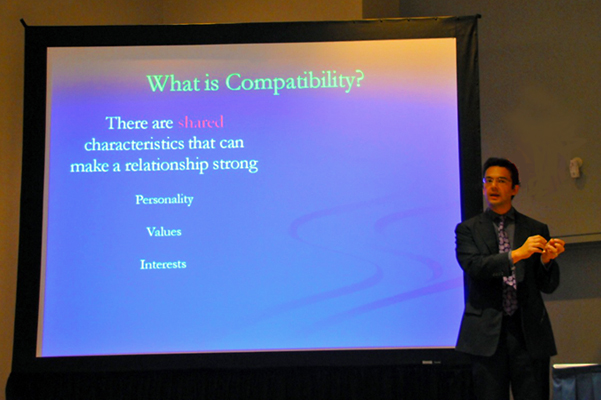
What is Compatibilty? 

( We are now seeing the slide you can see above. )

The eHarmony model of compatibility assumes:

"There are shared characteristics that can make a relationship strong" - notably personality, values and interests.

Conducting research on initial compatibly and long-term relationship [marriage] success can get "a little tricky".
To begin with, "you need to let people get married to see how it works. And, at the beginning of marriage everyone is happy." Only with time do we see underlying stressors and compatibility issues placing a relationship at greater risk. Of course, even in a great long-term relationship, conflict is inevitable - but it gets worked out, even if it can take an hour before figuring wht the conflict is about. Sometimes, over the years, misunderstanding can grow...

Dr. Gonzaga presented several on screen references to frame the history of compatibility research. First came the empirical evidence that "similarity between relationship partners predicts relationship quality" (Gaunt, 2006, Russel & Wells, 1991). Next we can see how similarity "provides consensual validation of attitudes and beliefs which promote attraction." (Byrne, 1971; LaFrance & Ickes, 1981). Finally, "Similarity promotes better understanding and effective communication between partners "(Burleson & Denton, 1992; Keltner & Kring, 1998). And it "coordinates a couple's responses responses to the environment". (Hatfield, Cacioppo, & Rapson, 1994; Kemper, 1991).

The list of references continues, underscoring how enduring couples are "more similar than average" and how they may set about to elect similar partners ("assortative mating") . And how "couples may converge, or become more alike over time." (e.g., Anderson, Keltner, & John, 2003).

An important note, big and bold onscreen: No study has prospectively investigated assortative mating in psychological characteristics
Gonzago noted that he takes comfort in eHarmony's low [known] divorce rate (even if nobody can 'prove' the key to long-lasting love).

With that Dr. Gonzago presented three recent studies, on (1) Personality matching (2) Proximal Processes; and (3) the Potentiation Effect

Study #1 

Prior to eHarmony, said Gonzago, nobody else had focused on personality characteristics.

Four hundred seventeen married couples who met via eHarmony.com and later married participated in this study. At the time of assessment, they'd been married an average of 32 months (range 26-56 months). Apologizing again and understanding we are seeing an awful lot of their 'deliriously happy couples' in advertisements these days, he noted that they now have helped bring together 40,000 couples.

To assess 'relationship satisfaction' eHarmony used what they found to be best, the Dyadic Assessment Scale (Spanier, 1976). Each couple completed the eHarmony relationship questionnare 3 times, assessing such things as Personality (e.g., warm, clever), Emotional tendencies (e.g., happy, anxious), and Interests (e.g., movies, shopping).

The results suggest that similarity can predict how satisfied one will be 3-4 years down the road.

[I do believe author Malcolm Gladwell has some thoughts on this as well, worth reading : Blink. It changed the conceptions of many psychologists! He cited research demonstrating that we can predict within only minutes whether couples are likely to be together years in the future.]

eHarmony has extensive data on match choices and their research affirms that "people tend to pick partners more similar to themselves." Do couples 'assort'? "We all tend to be alike" and may share a 'stereotyped personality". But again, what might predict long-term compatibility?

Gonzago has become convinced that "similarity is the lynch pin". Citing a study by Anderson, Keltner et al, 2003, he noted the adaptive function served by social interactions, and how for example "validation is best communicated directly... and how understanding is most relevant during discussions We know how our intensity during arguments is greater than in neutral discussions. What fuels this social interaction effect? Two possible reasons for this effect were identified:

* The Proximal Process: "Similarity in broad traits promotes similarity in interactive experience"

* Potentiation: "Similarity in broad traits enhances the positive effects of good relationship skills"


Study #2:
Similarity in Personality and Emotions in Married Couples (Gonzaga, Campos, & Bradbury, 2007)


Now we look at one of the venerable topics within personality theory: traits. We know from mountains of research that traits influence emotion and that variations can be seen between different groups, for example extroverts being more prone to exhibit positive affect.

This second study involved 172 married couples. The question was: Are couples similar in personality? In emotional experience? What they found is that "personalities were more alike than was their emotional similarity. Yet there were some qualitative aspects too, and the question was raised as to whether emotional similarity may be a 'mediating factor' in a triangle, between personality similarity and relationship satisfaction. Overall it was found that "relationship satisfaction is positively related to similarity".


The Proximal Process Model 

Similarity in broad traits predicts similarity in emotional quality in the moment 
  • Traits influence emotional experience 

    • Extroversion predicts positive affect
    • Neuroticism predicts negative affect
  • Emotions facilitate smooth social interactions

    • Communicate important messages about internal states
    • Evoke coordinated emotional responses from a partner
    • Elicit behaviors from partner to adjust to environmental conditions
  • Social Interactions act as building blocks for relationships (Gonzaga et al., 2006; Keltner et. al, 1998)


Study #3:
Social Interactions and Relationship Functioning in Married Couples (Setrakian & Gonzaga, in prep)


According to the Potentiation Model, relationships move from early connection through shared personality and interest factors - similarity - to an emotional connection which is mutually pleasurable, and then... how do shared social interactions grow into building blocks for lasting relationships?


Potentiation Model:

Similarity in broad traits predicts similarity in emotions
  • Emotions facilitate smooth social interactions 

    • Communicate important messages about internal states
    • Evoke coordinated emotional responses from a partner
    • Elicit behaviors from partner to adjust to environmental conditions
  • Social Interactions act as building blocks for relationships (Gonzaga et al., 2006; Keltner et. al, 1998) 

Increased understanding should enhance the effect of good social skills


Here we approach the foundation-building for healthy and happy long-term relationships. How to harness the shared personality/temperament factors and use our emotional and social skills to maintain the relationship:

Two hundred married couples, first marriage no children, wife under age 35, minimum 10th grade education, greater L.A. area.

Time's almost up, and these methods are hard to explain quickly (and now!) but...

Couples have a discussion under one of two conditions, social support vs. capitalization - experienced respectively as either supportive (Partner provided comfort) or using "Capitalization" (partner responded enthusiasticallly towards my good event - again exactly as Seligman just described - as the 'active/supportive' communication.)

This was a controlled laboratory study, though it was pointed out that "Lab ideas don't always work in the field".
Their results were analyzed through the filter of whether similarity, which we know to be a big factor, can moderate the perceived 'responsiveness effect' - that is the impact of capitalization, conflict resolution, and support elicitation. Their findings were described as 'robust though with mixed results in mediating the main factor, similarity.

CONCLUSIONS:

"Similarity", Gonzaga said, "doesn't make you a better partner. On the other hand, does it moderate attitudes? Yes. In males."

We know that Responsiveness matters in social interactions, that Similarity does not predict improved responsiveness, and that Similarity moderates the effect of responsiveness in males (but not females)."

In sum:

*Similarity is a powerful predictor of relationship success

* There are two potential routes: proximal process and potentiation

* Social interactions are critical in how similarity effects relationships

* Relationships deepen through increased understanding

* Partner selection is important because convergence is minimal.

And one more thing - oops, time is up! - Quickly then: Use the web as a tool!

-- Technology provided a platform for the application of basic research, BUT
-- The ideas that work in the laboratory don't always work in the field
-- The type of system he promotes is 1) Robust 2) Scalable 3) Palatable

Finally: "Technology can help facilitate a new era of research"

No doubt!

For me, anyway the 'takeaway' is: Similarity is a key factor in easy 'understanding' and resonating/reflecting similar feeling [tone], and revving up pleasure with shared activities and interests. Basic personality compatibility is the starting point, a foundation. Proximal process is about our personality 'similarity' basically, how alike we are and how we can use our collective attitudes and attributes to enjoy situations when together. Once a relationship is growing more intimate, the Potentiation Process begins.

It's no longer just about personalities matching on 'broad traits' at first, but also how they potentiate - bring out - the mutual joy. (or not) With broad similarity and shared world views, it is easier to 'be yourself' because you're feeling understood and veering towards that state of thinking in terms of 'we' very easily, as there is ongoing connection at several levels, emotionally. That's the perfect scenario. A well-functioning, happy couple is similar in personality and mutually reinforce the good feelings of emotional and personal connectedness, across situations. And that is my synopsis and take-away. YMMV. ['your mileage may vary']

I'll bet you weren't expecting to hear terms like proximal and potentiation in a talk about relationships and Love! But this may be the real thing. The new language of love. The pherenome of explanations as to why we initially attract, connect, and maintain healthy relationships.