Mostrando entradas con la etiqueta news. Mostrar todas las entradas

viernes, 19 de abril de 2013

Three are dead, hundreds injured, but the reasons remain a mystery


BOSTON | The Economist.
TO HELP friends and family members find one another amid the crowds expected at this year’s Boston marathon, the organisers set up a series of meeting points in the streets around the finish line. The bright yellow and orange signs are still there, but most of the planned reunions were thwarted—and a few will never now take place—thanks to the two bombs that blew up on April 15th near the end of the course in the closing stages of the race.
The explosions, separated by 600 feet (180 metres) and 12 seconds, killed three people: an eight-year-old boy and two young women. Another 180 or so were injured. At least 13 people lost limbs. That makes the attack the most deadly act of terror in America since September 11th 2001, apart from mass shootings. To add to the alarm, the authorities intercepted two letters, one addressed to Barack Obama and another to Roger Wicker, a senator, which appeared to contain ricin, a lethal poison. A fire followed by an explosion at a fertiliser factory in west Texas on the night of April 17th, which killed at least five people, increased the sense of apocalypse. But as The Economist went to press there was still no indication that this was anything but a horrific accident.
Shortly after the Boston bombing Mr Obama vowed that “any responsible individuals, any responsible groups will feel the full weight of justice.” The FBI, sifting through the mass of video footage and photographs provided by broadcasters, security cameras and bystanders, homed in on shots of two individuals who officials believe may be responsible for the bombs. But their whereabouts, identity and motives remained a mystery. An aggrieved constituent of Mr Wicker was arrested on April 17th, suspected of sending the poisoned letters; but he has not been tied to the bombings.
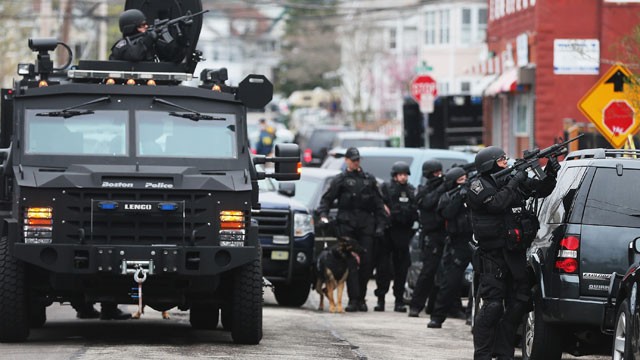
Boston is now flooded with police, soldiers and other security forces, both to ward off further attacks and to help with the investigation. State troopers stand watch outside metro stations; whole squadrons of national guardsmen march back and forth on Boston Common, a park a few blocks from the site of the bombings. Barricades festooned with flowers and notes of condolence block access to the immediate area of the blasts, as investigators pore over it in the hunt for evidence.
Fragments retrieved from the scene suggest that the bombs were constructed from six-litre pressure-cookers packed with gunpowder, a simple detonator and shrapnel in the form of nails and ball-bearings, intended to cause horrific injuries.
The simple but effective design of the bombs, which may have cost as little as $100 to make, is similar to countless improvised explosive devices (IEDs) that have inflicted casualties on civilians and Western troops in Afghanistan and Iraq. Instructions for building such bombs can be easily found on the internet. The bombs’ lack of sophistication suggests they were either the work of a lone individual or a small group with limited resources.
In 2010 an online magazine, Inspire, published by al-Qaeda in the Arabian Peninsula, ran an article entitled “How to make a bomb in the kitchen of your mom”. Inspire, aimed at aspiring young jihadists in America and Britain, was edited by Anwar al-Awlaki and Samir Khan. Both were American citizens who were killed by the same drone strike in Yemen in 2011.
However, the fact that pressure-cooker bombs are popular with al-Qaeda operatives is far from conclusive evidence that the Boston bomber had jihadist aims or connections. America has suffered several terrorist attacks by native-born extremists with domestic grievances, such as the IED set off near the Olympic stadium in Atlanta in 1996, or the bombing of a federal office building in Oklahoma City in 1995.
The bombings in Boston took place as locals celebrated (four days early) Patriots’ Day, the anniversary of the first skirmish in America’s war for independence. The date could be significant to the sort of radicals who believe the federal government is bent on the destruction of their liberties and the confiscation of their guns, especially as it coincides with the anniversaries of two violent episodes involving like-minded people: the end of the siege of the compound of a heavily armed cult in Waco, Texas, on April 19th 1993, and the Oklahoma City bombing exactly two years later. April 15th is also the day by which federal income-tax returns must be filed, another flashpoint for many.
Mr Obama’s re-election and his support for immigration reform and gun-control legislation, however ill-fated, have enraged this extremist fringe. The Southern Poverty Law Centre (SPLC), a civil-rights organisation that tracks and exposes the activities of right-wing extremists, says that outfits of this kind have proliferated during his presidency, from around 150 in 2008 to an all-time record of 1,360 last year (see chart).
The SPLC estimates that of those about 1,000 could be classified as “hard-core”, and thus by implication capable of violence. Among recent incidents, it points to the murder of six people at a Sikh temple in Wisconsin by a neo-Nazi gunman last August and the rounding up, also last year, of a murderous militia group based in Georgia, which included several active-duty soldiers. According to prosecutors, the group, which called itself FEAR (Forever Enduring, Always Ready), had stockpiled $87,000 worth of weapons and explosives, and was plotting to overthrow the government through a campaign of terror and assassinations.
If the perpetrator is identified it will have political ramifications. If the bomber is a jihadist, Mr Obama can expect to be taken to task for complacently declaring victory over al-Qaeda courtesy of his drone campaign. If it is a home-grown nut, Republicans can expect some blame for not stamping more firmly on the furious claims made about Mr Obama from the right’s wilder shores. And there is always the possibility that the bomber is an awkward combination of the two: a home-grown Islamic loner.
From the print edition: United States

The Psychology of a Boston Marathon Terrorist: 10 Questions for a Retired Marine


By Elaine M. Grossman | National Journal
Many of those who knew the two Boston Marathon bombing suspects, Tamerlan and Dzhokhar Tsarnaev, believed them to be talented students and athletes with promising careers ahead of them. So how could these seemingly “normal” young men have become terrorists -- and why?
The two brothers actually fit into an emerging trend, according toG.I. Wilson, a retired Marine Corps Reserve officer and militancy expert who specializes in counterterrorism, criminal behavior andforensic psychology.
“Terrorists are not psychotics or mentally disordered,” Wilson said on Friday. The study of terrorism over the past couple of decades has given experts “a greater appreciation of how normalcy is reflected in terrorists’ behavior,” he toldGlobal Security Newswire.
Like those implicated in the 9/11 attacks, the Tsarnaev brothers appear to have quickly assimilated from another nation into their local community and had no outwardly apparent radicalism, psychosis or inclination toward violence.
The pair of blasts near the marathon’s finish line on Monday resulted in three deaths and more than 175 injured.


Latest Global Security Posts:
Loading feed...
The two suspected perpetrators, whose identities were made public on Thursday, were reported to have moved to the Boston area more than five years ago from southern Russia, near the restive area of Chechnya.
Tamerlan Tsarnaev, 26, was described as a gifted amateur boxer who studied at Bunker Hill Community College part time between 2006 and 2008, and hoped to become an engineer. He was killed in a firefight with police Thursday night, according to news reports.
Dzhokhar Tsarnaev, 19, was described an all-star wrestler in high school and a student at University of Massachusetts Dartmouth. He was the focus of an epic manhunt in the Boston area on Friday and remained at large at press time.
Wilson, a former infantry colonel, said a sense of normalcy can pervade groups of extremists when individuals surround themselves with like-minded compatriots.
He recalled a segment on CBS News’ “60 Minutes” more than a decade ago about Yahya Ayyash, a Hamas bomb-maker who was nicknamed “the Engineer” and was ultimately assassinated by Israeli operatives in 1996.
“One of the Engineer’s followers was asked to describe how a terrorist could do such a terrible thing. His answer: ‘He’s a very normal person, just like us,’” Wilson said.
When the CBS interviewer took exception, the militant replied, “There thousands and thousands in our country that believe what we believe -- and not only in our country, in the rest of the Arab world and even in your country,” according to terrorism expert.
Wilson, who retired in 2006 after more than 30 years of uniformed service, responded to GSNquestions about terrorism and psychology in an e-mail exchange. Edited excerpts follow.
GSN: Based on your understanding of the criminal mind, what is going on now inside the head of an accused Boston terrorist on the loose amid a major manhunt, whose alleged co-conspirator brother was just killed?
Wilson: No one can read a criminal's or terrorist’s mind, but past behavior is an indicator of future behavior.
Psychiatrist Jerrold Post … contends we should not speak of a terrorist psychology in the singular, but rather of terrorist psychologies.
Ideology is central to the terrorist's psychology, no matter their ilk. They are therefore totally committed – [or] radicalized – and [this] tends to be expressed in all-or-nothing activities.
Watch for a very violent conclusion.
GSN: Reports are that the surviving suspect, Dzhokhar Tsarnaev, is a second-year medical student and came with his family to the United States about a decade ago from a Russian area near Chechnya, a region known for Islamic militancy and separatists. Any theories about why a young man like that would undertake a terrorist attack in the United States?
Wilson: Chechnya fighters -- [who typically refer to themselves as] "volunteers” -- have been seen in Iraq and Afghanistan. [It is a] matter of participating in jihad, which is an integral part of their belief system, ideology and psychology.
GSN: Specifically, news media is reporting that these young men seemed like "normal Americans," who like many in the nation are first-generation immigrants. What are we not seeing here, in terms of hidden psychological pathology?
Wilson: Appearing normal is the norm [for terrorists], and they often just blend in. [Stanford University’s Martha] Crenshaw … identifies normalcy as a characteristic feature of terrorists, rather than psychopathology or personality disturbance.
GSN: Is someone who carries out such a horrific attack necessarily a psychopath? Or could these be psychologically healthy individuals who are killing for a cause in which they deeply believe?
Wilson: Current data indicates terrorists and suicide bombers do not display any marked psychopathology. … Nevertheless, a trend and frequent perception has emerged asserting that terrorists possess traits of pathological personalities but do not possess the actual clinical disorders. This effectively paints terrorists with the psychological brush of pathology. 
Violence today may be a norm and the norm for such radicalized young people, whether it is on a wide scale or within a smaller community or family. It may come to be considered the normal response to achieve objectives. 
In fact, many terrorists view themselves as soldiers engaged in a just war. 
GSN: How could we do a better job at recognizing in society a person who has the potential to become a terrorist?
Wilson: [Counterterrorism expert Marc] Sageman found that about 70 percent of terrorists had joined while they were living as expatriates in other countries, looking for jobs and education. Prior to moving they were not strongly religious, but while in their new countries they visited mosques and moved in with other Islamic expatriates. Some of the latter were already members of terror organizations who then recruited them into those organizations.
GSN: Given what the FBI has revealed about the composition of the two pressure-cooker bombs and the way in which the suspects have operated, how likely do you think it is that they had the support of additional co-conspirators?
Wilson: While terrorists often operate in cells and are compartmented for operational security reasons, they often do need support. I would not rule out any co-conspirators or support personnel, be it intentional or unknowing support. Association with others must be looked into.
Terrorists use groups and networks for both logistical and psychological support. Groups afford a sense of belonging, a sense of purpose, perhaps even a sense of identity. 
GSN: When working with a fast-breaking case like this, how do you deal with the phenomenon of not knowing which incoming information is accurate, and which is inaccurate and leading you down false paths?
Wilson: Any operator will tell you your first information is neither your worst nor best, and generally is incomplete and inaccurate. That is very true here, as well. Every data point must be checked and verified. Never rely on single-source reporting. The best example of this was the deluge of reports of an arrest being made that were not accurate.
GSN: What would it take to plan the Boston attacks in terms of devising a plan, scoping out targets, assembling bomb materials and carrying out the logistics? Can you make sense, after all that planning, why the Boston bombers would have stuck around the area before being identified and then robbed a local convenience store?
Wilson: They lived [in the area] so they knew the "terrain" and blended in, which no doubt gave them the opportunity to do surveillance and reconnaissance.
GSN: What are one or two things you have learned from past terrorist attacks around the globe that you've thought this week might be applied to this episode?
Wilson: Their capability to adapt so very quickly using our very own system of laws and technology against us. [They employ] simplicity, sophistication, and global networks, much like third-generation street gangs. 
They have a very fast, adaptive [and] complex orientation-decision-action cycle, leveraging the physical -- for example, operationalizing IEDs and suicide bombers -- with the moral-mental aspects – for example, radicalized ideology concordant with the psychology of terrorism. [They are intent on] creating widespread global fear, giving [the] impression that governments cannot protect their people. Cartels and gangs in Mexico do much the same.
GSN: What are a couple of key questions on your mind now as the details of this episode unravel?
Wilson: Today we are recognizing many of the misconceptions regarding terrorists and their profiling. Terrorists are not psychotics or mentally disordered. Terrorists do not suffer markedly formed personality disorders nor does data support terrorism finding its genesis in personal frustration, economic deprivation, or psychological coercion.
We do have a better idea today of what is and is not psychologically related to terrorism and a greater appreciation of how normalcy is reflected in terrorists’ behavior.

miércoles, 26 de diciembre de 2012

La psicología del regalo

En noche de regalos es bueno saber algunas características de las personas detrás de los obsequios. Por ejemplo los individuos narcisistas compran grandes regalos para sentirse "únicos".

Los científicos han estudiado la psicología que hay detrás de la costumbre navideña de regalar. Y han descubierto, entre otras cosas, que los individuos narcisistas compran grandes regalos, tanto para los demás como para sí mismos, con el fin de destacar entre la multitud y hacer sentir a los demás que "son únicos". 

De ahí que sean más propensos a adquirir y osbsequiar a sus familiares y amigos con productos de ediciones limitadas, tal y como explica Aiden Gregg, de la Universidad Southampton (Reino Unido), coautor de un reciente estudio al respecto. “Es como si, al regalar, los narcisistas intentaran que los que le rodean fueran tan especiales como se consideran ellos”.

Por otro lado, una reciente investigación estadounidense publicada en Journal of Consumer Research revelaba que, cuando se trata de regalar, más no significa mejor. En concreto, si en un paquete agregamos un obsequio barato a uno más caro –algo que suelen preferir quienes regalan si tiene poder adquisitivo- se reduce el efecto positivo del segundo en quien lo recibe. Los destinatarios de un presente apreciarán más un regalo más caro si es el único que reciben. 

Montevideo, Uruguay
UNoticias
Fuente. Muy Interesante
VA

martes, 25 de diciembre de 2012

Reappraisal Defuses Strong Emotional Responses to Israel-Palestine Conflict


Reappraisal is a widely-used cognitive strategy that can help people to regulate their reactions to emotionally charged events. Now, new research suggests that reappraisal may even be effective in changing people’s emotional responses in the context of one of the most intractable conflicts worldwide: the Israeli-Palestinian conflict.
“Negative intergroup emotions play a crucial role in decisions that perpetuate intractable conflicts,” observes lead researcher Eran Halperin of the New School of Psychology at the Interdisciplinary Center in Israel.
With this in mind, Halperin and his colleagues wondered whether cognitive reappraisal, a strategy that involves changing the meaning of a situation to change the emotional response to it, might be effective in diminishing such negative intergroup emotions.
Their research is published in Psychological Science, a journal of the Association for Psychological Science.
In the first study, 39 Jewish Israeli participants viewed a series of photos that were deliberately selected to induce anger. Some of the participants were trained in cognitive reappraisal — they were taught to respond to the images like scientists, considering them objectively, analytically, and in a cold and detached manner. The other participants received no instructions.
Then all of the participants watched an anger-inducing presentation. The four-minute presentation — with pictures, text, and music — described Israel’s disengagement from the Gaza Strip and the Palestinian response, including the launching of rockets, the election of Hamas, and the kidnapping of an Israeli soldier. Before watching, participants were asked to apply the reappraisal technique they had learned.
Halperin and colleagues found that participants who were taught to reappraise their emotional responses expressed less anger towards Palestinians, greater support for conciliatory policies, and less support for aggressive policies than the participants who received no training. The results suggest that the increase in support for conciliatory policies could be explained — at least in part — by decreased intergroup anger.
To examine whether these findings would extend to conflict-related events as they occurred in the real world, Halperin and colleagues conducted a second study.
The researchers knew that Palestinian president Mahmoud Abbas would be presenting a bid to the United Nations seeking full UN membership for Palestine in September 2011. They recruited 60 Jewish Israelis to participate in a study and, six days before the UN bid, they asked the participants to rate their current positive and negative emotions and their general support for different types of policies.
Once again, the researchers trained half of the participants to use cognitive reappraisal. Over the course of the following week, the participants received three text message reminders to use the technique they had learned. A week after the training and two days after the bid, the researchers assessed participants’ emotional and political reactions.
As Halperin and colleagues expected, there was no difference in negative emotions among the participants before training took place. A week after training, however, the reappraisal participants reported lower levels of negative emotions toward Palestinians. The data suggest that the reappraisal actually made them more supportive of conciliatory policies and less supportive of aggressive policies, effects which could be attributed to a decrease in negative emotions.
Even more surprising, however, was the fact that these results held up five months later when the participants were asked to complete a brief questionnaire by an unfamiliar experimenter.
“We consider our findings to be preliminary yet provocative,” write Halperin and colleagues. “Political positions in conflict situations are considered rigid, well entrenched, and driven mainly by ideological rather than emotional considerations. It is therefore surprising to see shifts in these attitudes based on such minimal interventions.”
These results provide evidence that emotion regulation strategies like reappraisal can influence intergroup emotions, not just intrapersonal emotions, and can even shape political reactions.
The researchers believe that this research could eventually lead to interventions that incorporate cognitive reappraisal as a way of increasing support for peace in long-term conflicts.
Study co-authors include Roni Porat of The Hebrew University and Interdisciplinary Center – Herzliya (Israel); Maya Tamir of The Hebrew University (Israel); and James Gross of Stanford University.
###
For more information about this study, please contact: Eran Halperin at eran.halperin@idc.ac.il.
The APS journal Psychological Science is the highest ranked empirical journal in psychology. For a copy of the article "Can Emotion Regulation Change Political Attitudes in Intractable Conflicts? From the Laboratory to the Field" and access to other Psychological Science research findings, please contact Anna Mikulak at 202-293-9300 or amikulak@psychologicalscience.org.

sábado, 31 de marzo de 2012

La hora del planeta, ¿cómo ayuda?

La hora del planeta, ¿cómo ayuda?

Noticias Terra. 31/03/2012.
La Hora del Planeta es una iniciativa que busca generar consciencia para conservar la Tierra.

La idea es que la gente se preocupe sobre la sostenibilidad. Pero hay más detrás de apagar las luces durante una hora, una vez al año. Se trata de alentar a las personas a trabajar para crear un futuro mejor en el mundo.

La Hora del Planeta reduce la contaminación lumínica y contrarresta el cambio climático. Según los organizadores, la reducción en el consumo energético contribuye a disminuir emisiones de dióxido de carbono (CO2).

La importancia de reducir las emisiones de carbono, es no aumentar aún más el calentamiento global. Si no se detienen las emisiones de CO2 en la atmósfera los océanos y los bosques pagarán las consecuencias.

Las altas emisiones de dióxido de carbono traen como consecuencia la disminución de los glaciares, la elevación del nivel de los mares y cambios meteorológicos. Asimismo, puede influir en las actividades humanas y en los ecosistemas. Mientras, algunas especies pueden ser forzadas a emigrar de sus hábitats para evitar su extinción debido a las condiciones cambiantes de la atmósfera.

Otro de los efectos del cambio climático es el aumento de las precipitaciones, lo cual causa más erosión. En términos simples busca evitar inundaciones, sequías, tsunamis, tornados, contaminación del agua, incendios forestales, entre otros males provocados por la falta de conciencia ecológica. El ahorro de energía disminuye el impacto negativo del cambio climático.

No obstante, para entender la aportación de La Hora del Planeta es importante ver resultados. En Tailandia se ahorraron 73.34 megavatios de energía en 2010, lo que equivale a 41.6 toneladas menos de CO2 en el ecosistema. En Filipinas usaron 78.63 megavatios menos de lo que se consume diariamente. Toronto utilizó un 8.7 por ciento menos de energía. En Estados Unidos monumentos y lugares turísticos apagaron sus luces.

El edificio Empire State de Nueva York, el puente Golden Gate de San Francisco, la ciudad de Las Vegas, se unieron a La Hora del Planeta. Oscuridad que se observó en casi 4,000 ciudades del mundo. Estos números aumentan año a año, dado que se suman más países y más personas.

¿Qué es la Hora del Planeta?

Es tan simple como apretar un botón y apagar la luz. La Hora del Planeta es la mayor campaña ambiental en la historia. Consiste en apagar las luces y cualquier aparato eléctrico prescindible durante una hora, para demostrar así que cada uno de nosotros podemos tener un impacto positivo en la reducción del consumo mundial de energía y en la lucha frente al cambio climático.

'Es uno de los movimientos sociales más grandes jamás vistos por la humanidad', según palabras de Desmond Tutu, Premio Nobel de la Paz 1984.

Lo que empezó como una campaña dirigida a que los pobladores de Sydney, Australia, apaguen sus luces ha crecido hasta convertirse en la iniciativa más grande del mundo frente al cambio climático.

La Hora del Planeta empezó en el 2007, en Sydney, Australia y participaron 2,2 millones de hogares y comercios apagando sus luces por una hora. Un año después este evento ya se había convertido en un movimiento global de 100 millones de personas en 35 países.

Lugares emblemáticos como el puente Golden Gate en San Francisco, el Coliseo Romano y el anuncio de Coca Cola en Times Square, Nueva York, estuvieron en oscuridad, como símbolo de esperanza por una causa global que se vuelve más urgente cada hora. La Hora del Planeta es un mensaje de esperanza y de acción.

lunes, 19 de marzo de 2012

Ley de Tolerancia (y efectividad) Cero por Ley de Alcoholes

Ley de Tolerancia (y efectividad) Cero
El Mostrador Tv.
Acaba de entrar en vigencia la nueva y controversial Ley de Alcoholes (o de Tolerancia Cero) que promete modificar la conducta y cultura de los ciudadanos y automovilistas. Sin embargo, no son pocos los que cuestionan la real eficacia que tenga la normativa en disminuir la tasa de accidentes. Un de ellos –y siendo autoridad en el tema– es Francisco Fresard, experto en prevención de accidentes, ingeniero e investigador PUC. Él nos entrega mayores referencias y perspectivas, y sostiene que la nueva ley “es pura pirotecnia” y que “lo más efectivo, es el control de la velocidad. Bajaríamos inmediatamente un 20% de los accidentes”.

martes, 14 de febrero de 2012

Científicos explican el origen neurológico del amor

Científicos explican el origen neurológico del amor

biobiochile 14/02/2012
¿De dónde proviene el amor? Es una pregunta que los científicos han logrado responder gracias a los diversos avances en el campo de la neuroimagen.
Éstos, han concedido a los estudiosos la posibilidad de tomar una «radiografía del amor» y determinar qué moléculas y cuáles zonas del cerebro se activan ante esta “emoción”.
Según lo consignado por ABC, son doce áreas cerebrales las que entran en juego cuando las personas “sentimos amor”.
Sin embargo, continúa siendo un misterio para los investigadores el factor que determina que nos enamoremos de algunas personas y no de otras.
El cerebro humano tiene la capacidad de vincularnos a otra persona en tan sólo un segundo, esto es lo que popularmente se conoce como un “flechazo” o amor a primera vista. Esto sucede cuando se liberan sustancias como la adrenalina, dopamina, serotonina, oxitocina y vasopresina, las que van directo al torrente sanguíneo.
Lo anterior, provoca que nuestro corazón se acelere al pensar en esa persona especial -efecto de la adrenalina-, nos centremos en ella -dopamina- y que ocupe nuestros pensamientos -serotonina- de forma temporal, mientras dura el “enamoramiento”. Los lazos posteriores a ese periodo, que debieran ser duraderos se crean gracias a la oxitocina y la vasopresina.
Las moléculas anteriormente mencionadas actúan también como hormonas, motivo por el cual el hipotálamo (regulador hormonal) entra en funcionamiento cuando sentimos amor. Y éstas explican muchas cosas que sentimos durante este periodo.
El incremento en la frecuencia cardíaca, la contracción de vasos sanguíneos y la dilatación de los conductos de aire son efectos provocados por la adrenalina; Mientras tanto, en la dopamina se encuentra la clave del mantenimiento de la atención y es la encargada de regular el dolor.
Es por esto que para prevenir enfermedades cardiovasculares, debemos no sólo cuidar nuestro colesterol y los niveles de tensión, sino que también debemos preocuparnos de tener sentimientos positivos, según explicó el vicesecretario de la Sociedad Española de Cardiología, Miguel Ángel García Fernández.
A continuación se muestran los aspectos a lo que afecta cada hormona hace a nivel físico y psicológico, más que neuronal como explicamos anteriormente.
La dopamina:
Esta es la responsable de que prestemos atención completa -y que nuestro mundo se reduzca- a la persona amada. Además bloquea todo aquello que pueda inducirnos a realizar un juicio crítico y objetivo de alguna sensación que involucre la relación.
La oxitocina:
El cariño se explica en esta hormona. A ella responden los cuidados, los cariños y las caricias. Tiene la cualidad de liberarse durante el parto y también en el orgasmo.
La oxitocina además es responsable tanto del amor como del odio, pues -como diversos estudios han demostrado- las zonas cerebrales que se activan cuando amamos y odiamos son casi las mismas.
La vasopresina:
En el cerebro de los hombres, principalmente cumple una función de buscar vínculos sociales, mientras que en el femenino esta acción se basa en la hormona anterior.

domingo, 30 de octubre de 2011

Atacama Solar: Energías Renovables desde Pica - Tarapacá

Atacama Solar: Energías Renovables desde Pica, Región de Tarapacá.
Presentación de Rodrigo Cánovas, Director de Atacama Solar en ENEI Tarapacá 2011

Presentacion Rodrigo Canovas Atacama Solar
Descarga

lunes, 10 de octubre de 2011

¿Qué es "realidad virtual" en territorio de las TICs?


¿Qué es "realidad virtual" en territorio de las TICs?

Por Manuel Barrera. elquintopoder.cl - 28/10/2011.

En una entrevista periodística, el arquitecto chileno Enrique Browne afirmó: “Para Le Corbusier, el ícono cultural de su época fue la máquina…”
El entrevistador le preguntó enseguida:
¿Cuál sería el ícono ahora?
Browne respondió:
“La virtualidad. Cómo hacer calzar el mundo virtual con el mundo real, porque este sigue existiendo”
Ese es justamente un tema intelectual y psicológico muy importante en nuestra relación con las TICs. Estamos inmersos en el mundo virtual, pero el mundo real sigue estando ahí. ¿Cómo compatibilizarlos? ¿Cómo evitar las confusiones en la mente de niños, jóvenes, adultos, adultos mayores?
En 1994 Paul Milgram y Fumio Kishino definieron el concepto de realidad mixta como cualquier espacio entre los extremos del continuo de la virtualidad. Este continuo se extiende desde el mundo completamente real hasta el entorno completamente virtual, encontrándose entre medio de éstos la realidad aumentada y la realidad virtual.
El adjetivo ‘virtual’ ha alcanzado una gran importancia en los campos de la informática y las telecomunicaciones, entre los que destacan la memoria virtual, el circuito virtual y la realidad virtual. Afirma Mowshowitz que estos fenómenos tienen una gran significación teórica y empírica en el diseño e implementación de sistemas informáticos, en las redes y en la interacción persona-ordenador, respectivamente.
La realidad virtual tiende a eliminar la frontera existente entre realidad e irrealidad. No se trata en este caso de la imposibilidad de separación entre lo real y aquello que no lo es, sino la extensión o difusión de los límites que los separan. La amplia variedad de posibilidades que esta ofrece, ha facilitado el establecimiento de un status de realidad, sustentado en el hecho de que la realidad virtual es compartida con otras personas y tiene una estrecha relación con el mundo físico dada su interrelación e influencia mutuas. Además, la realidad virtual está interconectada con la producción artística, una experiencia que ha acompañado a la especie humana desde siempre.
De lo anterior surge la posibilidad de que la realidad virtual se constituya en un territorio fértil para la creación o reconstrucción de la propia identidad de los participantes. En efecto, la realidad virtual favorece la construcción de una identidad sustentada en la creación de más de un yo, es decir, de identidades múltiples. O se constituye en una “sala de espera” respecto de la construcción de una identidad más definitiva. Es lo que ocurre en la adolescencia, cuando el sujeto tiene experiencias a modo de pruebas antes de definir su contorno identitario más definitivo. El psicólogo norteamericano Erik Erikson, en sus estudios sobre la identidad del adolescente, creó la expresión de “moratoria psicosocial” para referirse a este fenómeno. La adolescencia sería un periodo donde “probar cosas” (drogas, orientación sexual por ejemplo) se constituiría en experiencias previas, preparatorias para la constitución de la identidad. Los entornos virtuales, y más concretamente la realidad virtual, han generado un espacio de moratoria para la construcción de la identidad sustentada en la creación de más de un yo. No es raro encontrar a muchos cibernautas con “alias”, es decir con identidades ficticias, navegando por el ciberespacio.
De modo que realidad virtual sería una representación de las cosas a través de medios electrónicos. La realidad no se nos presenta. Lo que aparece frente a nosotros es su representación. Imágenes, palabras, sonidos que nos dan la sensación de estar en una situación real en la que podemos interactuar con lo que nos rodea. Es así como la frontera existente entre la realidad y la irrealidad se ha desvanecido. Los límites se han hecho difusos. Actualmente Internet nos provee con medios para reunirnos con diferentes personas en el mismo espacio virtual. En este sentido Internet tiende a ser un mecanismo de tele-presencia. Lo que se omite en la realidad virtual es lo presencial a favor de lo virtual, algo que no es, pero que parece que fuera. La distancia, es decir, el espacio real, desaparece. Este medio nos brinda con realidades que físicamente no existen pero que, sin embargo, actualmente y cada vez más, forman parte de nuestras vidas.

New Media & Society - Vol.12. N°4, 2010.


New Media & Society

New Media & Society is a top-ranked, peer-reviewed, international journal that publishes key research from communication, media and cultural studies, as well as sociology, geography, anthropology, economics, the political and information sciences and the humanities. It is committed to high-quality research that explores the relationship between theory, policy and practice.

lunes, 29 de agosto de 2011

Inteligencia Artificial: 2 chat-bots sostienen extraña conversación entre sí


Inteligencia Artificial: 2 chat-bots sostienen extraña conversación entre sí.


29/08/2011. BioBioChile. Desde la década del 60, los investigadores han tratado de crear programas dotados de inteligencia artificial, esto es, la capacidad de comprender, razonar e incluso interactuar con los seres humanos.
Una muestra relativamente común hoy en día son los chat-bots, software que, a través de texto o de voz, le permite a una persona sostener una conversación relativamente lógica con una computadora.
Pero… ¿qué pasa si ponemos a dos chat-bots a conversar entre ellos?
(Puedes requerir un poco de inglés para comprender mejor el video).


martes, 23 de agosto de 2011

Niño de 13 años descubre una forma eficiente de ubicar los paneles solares

www.marlexsystems.org/ 23/08/2011.


Aidan Dwyer, de 13 años, un chico de Nueva York, Estados Unidos, descubrió una forma de ubicar eficientemente los paneles solares que podría revolucionar la capacidad de los mismos para conseguir energía, observando sólo la forma en la que estaban ubicadas las ramas de los árboles debido a que éstos deben estar ubicados en una posición en específico para conseguir mayor luz y así realizar una mejor fotosíntesis.
Imagen:Aidan Dwyyer | Museo Americano de Historia Nacional
La gracia de Dwyer es que encontró que replicando esta misma idea en una ubicación en específico de paneles solares, podría conseguir más eficiencia al momento de obtener energía con paneles solares utilizando la secuencia de Fibonacci, que es en teoría cómo se ubican las ramas de los árboles en la naturaleza -sí, hasta la naturaleza es matemática-.
Ejemplo de ubicación de los Paneles solares de Dwyer
De acuerdo con los datos obtenidos por Dwyer, al ubicar las láminas de paneles solares de una manera similar a como están las ramas de un árbol se puede conseguir hasta un 50% más de energía en comparación a ubicarlas tal cual como se hace en la actualidad con los techos de las casas, donde se recibe energía de una forma directa, mientras que en el formato árbol, todas las ramas recibirán energía en algún minuto, teniendo cada una un ángulo de recepción que aumenta en absoluto la cantidad de energía cuando ésta golpea directamente sobre las láminas fotosintéticas
Los resultados son bastante concluyentes -que puedes verlos en la imagen de más arriba donde se comparan los dos casos de cómo ubicar los paneles solares: como árbol (tree) y de la manera tradicional (standard) además de haber hecho dos tests- y podrán abrir novedades para quienes estén interesados en el campo de la energía solar, además de empresas y organizaciones que, de seguro estarán interesados en los estudios que hizo el pequeño. Impactante que sólo observando se puedan conseguir esas ideas, ¿no?
Datos recopilados del estudio de Dwyer
El final de esta historia es el previsible. Aidan ha conseguido un reconocimiento por su descubrimiento, otorgado por el Museo Americano de Historia Natural, se ha registrado una patente, y más de cuatro investigadores “serios” deben estar dando cabezazos contra la pared. Y notros, por supuesto, esperamos que el trabajo de este avispado niño nos permita en algún momento del futuro cercano independizarnos de la energía generada quemando combustibles fósiles

viernes, 12 de agosto de 2011

Psicólogo que no será investigado por torturas desató polémica en EE.UU.


Psicólogo que no será investigado por torturas desató polémica en EE.UU.

John Leso fue demandado por prestar asesorías en técnicas "abusivas y dañinas".
Jueza determinó que el Estado no tiene jurisdicción sobre las actividades del profesional.


Grupos de defensa de los derechos civiles en Estados Unidos criticaron este viernes la decisión de la jueza de Nueva York Saliann Scarpulla de no investigar si John Leso, un psicólogo implicado en el desarrollo detécnicas abusivas en los interrogatorios a detenidos de Guantánamo, violó su código de ética profesional.

Imagen

"El dictamen es desafortunado", indicaron elCentro de Justicia y Responsabilidad (CJA, por su sigla en inglés) y la American Civil Liberties Union (ACLU), en un comunicado de prensa conjunto.
Ambos grupos respaldaron la demanda presentada por el también psicólogo Steven Reisner contra John Leso por haber asesorado a las autoridades de Guantánamo sobre técnicas "abusivas y dañinas" como privación de sueño o alimentos, o el uso de grilletes, celdas de aislamiento y perros para sacar información a los reos.
Reisner primero intentó que el estado de Nueva York retirara a Leso la licencia para ejercer como psicólogo, y cuando esa moción fue rechazada por la autoridad competente, entonces acudió de nuevo a los tribunales para pedir una investigación.
Sin embargo, la jueza Scarpulla determinó que no se puede obligar al Estado a realizar las pesquisas al considerar que no tiene jurisdicción sobre las actividades del psicólogo en Guantánamo.
cooperativa.cl 13/08/2011