Mostrando entradas con la etiqueta connectivism. Mostrar todas las entradas

martes, 7 de mayo de 2013

Various Cause Effects Of Video Games Psychology Essay


The most successful aspect of video games is that they provide a huge amount of human interaction through imagery and audio, thus encouraging the player to think and act quickly(Wolf, 2001, p15). This aspect makes video games different from any other forms of non-interactive media like television or radio. Video games give clear instructions about actions to be performed to reach particular levels in the game and instils a level of confidence and spirit of victory in its players. They also serve academic purposes and can be utilised as a powerful medium for educating children and youth in a very interesting and powerful manner. For example, video games involving driving can be used as a medium to teach players the traffic rules and penalties imposed if the rules are violated. Puzzle based video games give valuable practice lessons of time management, helps to sharpen specific skills needed to succeed in the game, encourages critical analysis and thought and improves cognitive abilities (Wolf, 2001, p17; Seller, 2006, p20).

Social

Video games have a part in influencing the social behaviour of young players especially children. The interactive gaming gives a virtual environment involving the player and his opponent which is essentially the computer system. In addition to promoting a level of healthy competition among players, the penalties imposed help to give due respect to fellow participants and encourages sportsman spirit to a great extent. Games which involve military contents can help to inculcate patriotism in youngsters as they are made to believe that they are protecting their country from rival attacks. Though there has been criticisms regarding the effect of video games in sparking criminal behaviour among youth, Jenkins (n.d.) observes that the hostile factors contributing to these acts are coming from unsound minds and disrupted families rather than interactive media. In fact, James Gee’s work highlights the benefits of using video games as effective media for logical problem solving and continuous improvement, thus improving the qualitative skills (Gee, 2001).

Psychological

Apart from providing relaxation and enjoyment, video games boost the player’s confidence level and raises curiosity as in most games, each level is exciting and cannot be seen unless the players pass all the previous stages. In children, the level of psychological development obtained leads to sharpening of memory and logical skills, increased mental development and simulation, making them tougher to face the challenges of the real world.


Vices

Contrary to the popular belief that video game players are just youngsters, Entertainment Software Association(ESA) has shown that 49% of game players are in the age range of 18-49 while the demographic statistics give 52% male and 48% female players (ESA, 2009, p3). The revenue obtained by video game sales in US was $11M in 2008 with Wii console games at the top according to NPD statistics (ESA, 2009, p10).

Though the video game industry has flourished and sales figures have been accelerating over the last few decades, a lot of negative publicity has affected the popularity of interactive games to a large extent. Though there are many pros, the bad effects are so obvious and derogatory that they outweigh the advantages to a large extent.


Medical

The increasing popularity of video games is making more and more youngsters spend considerable amount of time and money in front of the gaming console or computer which has harmful medical effects arising due to addiction (Gunter, 1998, p31). The addiction can lead to childhood obesity as children will find no time for outdoor games which are healthy and provides relaxation and exercise to brain, mind and body. The strain caused by continuous exposure to harmful radiation from television affects a significant number of youngsters by ending up having problems with their eyes. The adult players are even more in danger as the addiction causes a change in lifestyle which trigger a variety of fatal illnesses from high cholesterol to heart attacks in addition to causing spinal alignment problems due to wrong posture.


Psychological

Most of the video games depict violence and the motto is to kill and succeed. Young minds are particularly interested in games involving violent attacks, abusive language and homicide. Different researches have been conducted in psychological aspects due to violent video games. Anderson et al. (2007, p12-39, p40-60) has described about the different kinds of aggressive behaviour exhibited by children based on which an aggression model is created. 

The effects of violence can arise from thefts for buying video games to thrills obtained from imitation of the shootings and attacks on innocent subjects. Continuous exposure to violent media has a profound influence on the mental balance of the young player, giving a very wrong impression that ‘killing is winning’.


Social

Recent reports have shown that an average time spent by a child playing console, arcade or home video games is almost 11-13 hours/week (Gentile, 2004, p1; Olson et al.,2007, p1). It means that they get little time for social interactions, academic reading and outdoor games. 

Decrease in peer association hinders development of social etiquettes, family ties and character. The social and emotional commitments are disrupted by over indulgence in interactive media leading to a set of humans devoid of emotions, respect or self-esteem. The increasing amount of violence and destruction involved in most games and the lonely atmosphere provided acts as detrimental to good social conduct. Stromberg (n.d.) has shown that almost 50% of popular games depict either fantasy or human violence to the extent that they encourage players to become less caring and friendly. According to Gentile & Anderson (2003, p131-152), the tendency of aggressive behaviour is affected by repeated game play which often reward the players for violence.


Critical Analysis

Wirth et al. (2003) has given that the virtual environment created by video games is essential to establish a spatial presence. But the impression of world as given by games has very little relation with the original real circumstances or actions. The violence and plan of action depicted in these scenarios, if practised in actual circumstances give horrendous repercussions for both the doer and the society. Some researches show video game learning as better to classroom learning in terms of memory retention (Moreno & Meyer, 2000, p724) but it does not in any way substitute the knowledge obtained from books, classrooms or other interactive learning techniques but just complements them.

The reason for success of video games has been described as the level of “active control” involved (Greenfield, 1984, p102). Active control often enables the player to decide on the course of action to be taken to fight the circumstances which gives them an uneven control and pseudo confidence that may urge them to enact similarly in a real situation. Moreover, the points gained during shooting or killing tends to glorify the violence depicted in games. The addiction to video games often leads to fits of anger and rows between the children and parents. The first rehabilitation centre for teenagers addicted to video games has been set up in London following the urge of parents (Taylor, 2010, p9).

Parents have expressed concerns on the influence on video games on the psychological and social behaviour of children (Gunter, 1998, p35). Most video games have parental control through which the type, intensity and mode of play can be controlled by parents. But recent research has shown that only one-fifth of the parents are exercising their control over purchase of video games, with 55% of stores educating them on ratings (Walsh et al. 2003).
Lee et al. (2009, p562) have put forward that the technological aspect has an influence on violent psychological behaviour in a way that a game played using less sophisticated graphics and audio do less harm. But here also, time is the deciding factor as continuous exposure to the virtual world even in low resolution graphics can cause psychological imbalance and health problems.

Even though clear correlation between violent shooting attacks by teenagers and interactive gaming has not been established in all cases, the increase in vocal abuse and insensitiveness towards crime itself are appalling. American Health Association’s research has given results stating that time spend by teenagers belonging to lower socio-economic status playing games was almost five fold than those of their educated and rich counterparts (ScienceDaily, 2008). This shows that education, and not money is the judging factor for use of technology.


Read more: http://www.ukessays.com/

martes, 16 de abril de 2013

Touchscreen interface for seamless data transfer between the real and virtual worlds


Diginfo.tv - 15 april, 2013.
Fujitsu Laboratories has developed a next generation user interface which can accurately detect the users finger and what it is touching, creating an interactive touchscreen-like system, using objects in the real word.
"We think paper and many other objects could be manipulated by touching them, as with a touchscreen. This system doesn't use any special hardware; it consists of just a device like an ordinary webcam, plus a commercial projector. Its capabilities are achieved by image processing technology."
Using this technology, information can be imported from a document as data, by selecting the necessary parts with your finger.
This technology measures the shape of real-world objects, and automatically adjusts the coordinate systems for the camera, projector, and real world. In this way, it can coordinate the display with touching, not only for flat surfaces like tables and paper, but also for the curved surfaces of objects such as books.
"Until now, gesturing has often been used to operate PCs and other devices. But with this interface, we're not operating a PC, but touching actual objects directly, and combining them with ICT equipment."
"The system is designed not to react when you make ordinary motions on a table. It can be operated when you point with one finger. What this means is, the system serves as an interface combining analog operations and digital devices."
To detect touch accurately, the system needs to detect fingertip height accurately. In particular, with the low-resolution camera used here (320 x 180), if fingertip detection is off by a single pixel, the height changes by 1 cm. So, the system requires technology for recognizing fingertips with high precision.
"Using a low-res webcam gives a fuzzy picture, but the system calculates 3D positions with high precision, by compensating through image processing."
This system also includes technology for controlling color and brightness, in line with the ambient light, and correcting for individual differences in hand color. In this way, it can identify fingertips consistently, with little influence from the environment or individual differences.
Also, in situations that don't use touch, the system can be operated by gesturing. In this demo, when you move your fist, you can manipulate the viewpoint for 3D CAD data. So, there could be applications for this touch system by combining it with current gesture systems.
"For example, we think this system could be used to show detailed information at a travel agent's counter, or when you need to fill in forms at City Hall."
"We aim to develop a commercial version of this system by fiscal 2014. It's still at the demonstration level, so it's not been used in actual settings. Next, we'd like to get people to use it for actual tasks, see what issues arise, and evaluate usability. We want to reflect such feedback in this system."
Posted By Don Kennedy and Ryo Osuga

lunes, 9 de enero de 2012

Social Media and the Hedgehog's Dilemma


Social Media and the Hedgehog's Dilemma

Finding the right distance when working and living online
One cold winter's day, a group of hedgehogs crowded together for warmth so as not to freeze to death. However, the pain from the mass of spines soon caused them to separate again, until the cold forced them back together, and thus they continued, moving from one source of discomfort to another, until they found a distance that allowed them to live but without the benefits of the full warmth of community.


Philosopher Arthur Schopenhauer, in the middle of the nineteenth century, published the parable of the hedgehogs (also translated as porcupines) as a way to describe the dilemma faced by human beings as we simultaneously crave and reject connection. In 1921, Sigmund Freud referenced the parable in Group Psychology and the Analysis of the Egoin his discussion of the "ambivalence of feeling" inherent in long-term relationships. A character in the episode "The Hedgehog's Dilemma" of the popular anime series Neon Genesis Evangelion sums up the problem: "The nearer we get, the deeper we hurt each other." And so we back away.


In the twenty-first century, we can see the hedgehog's dilemma play out online, especially in the world of social media.

The Lure of Social Media
I'm a morning person and always have been, up before the sun, 4:45 a.m. every day, wide awake when many people have yet to enter their last cycle of REM sleep. It is my best, most alert, and most productive time of the day. Whatever work I do in those first two or three hours is what I do most efficiently.

So, how do I spend this precious time? All too often, I read and answer email (and delete spam), check Facebook (where I read about and see photos of what other people are doing), tweet and retweet, and read and comment on a few of my favorite blogs.

Do I then close all those open tabs and focus on my own work and writing?
No. I usually start the process over again.
We can think of the call of social media as a standing invitation to a virtual sitting-room. For writers and others who require long, uninterrupted time in which to create and a comfortable relationship with themselves that allows them to be alone, the problem is akin to what Virginia Woolf described in her classic essay, "A Room of One's Own":
"If a woman wrote, she would have to write in the common sitting-room. And, as Miss Nightingale was so vehemently to complain,—'women never have an half hour . . . that they can call their own'- she was always interrupted.... Jane Austen wrote like that to the end of her days. 'How she was able to effect all this', her nephew writes in his Memoir, 'is surprising, for she had no separate study to repair to, and most of the work must have been done in the general sitting-room, subject to all kinds of casual interruptions.'"
Unlike Jane Austen, however, we enter social media's virtual sitting-room of our own accord, and we often stay far longer than we had planned. We tell ourselves that the distractions we find there are part of our work, that we are networking or building our platforms. There is some truth in this. Writers today, for example, are told to have an online presence in the form of websites, blogs, Twitter accounts, and Facebook pages. Before they can approach a publisher, even first-time authors are expected to have built a readership to which they can market their book.

So far, so good. But we tend to forget the opportunity cost, which is often the solitary writing practice, free from all kinds of casual interruptions, that we need in order to finish the book we hope one day to finish in the first place.

Will You Opt In or Opt Out?
I am continually trying to wrap my head around social media, working to figure out the most comfortable combination, fit, level of involvement, and boundaries so as both to enjoy the process and to meet my own goals. I use the word "comfortable" deliberately. For anyone for whom social media is part personal and part professional, the ever increasing social media options—from Twitter to LinkedIn, Goodreads to Google+—can very quickly be a source of discomfort at the same time that they are useful and informative and oh so much fun. This discomfort is especially keen for introverts and others who are overwhelmed by crowds and noise and competing distractions, virtual or otherwise.

I am no Luddite, nor do I wish for a return to the days before the internet. On a nearly daily basis, I am amazed by and appreciative of the options both informational and communal that my 20-year-old son and the college students in my classroom take for granted. Social media can lead to very real connections. Last year, for example, I realized through a Facebook status by a Milwaukee writer whom I first met through blogging, that not only did our sons share many years together in a local children's theater company, but our husbands have known each other and worked together for 25 years. Our "circles" intersect in a Venn diagram illuminated by our online networking, making eventual face-to-face meeting even more meaningful.

My problem is not with social media, but with myself and how I use it. Until now, my default position has been one of "opting out," to borrow a marketing term. Opting out is a "tacit yes" to everything, unless we give permission to opt out in specific areas.

It's time for me to switch to "opting in," checking only those social media boxes that work best for me, with a tacit no to all the rest.

Nicholas Carr writes in The Shallows of how, when he began writing the book, he "wrote in disconnected spurts," similar to blogging, and that, in order to finish the book, he needed to disconnect almost completely, to opt in:
"There was no cell phone service at our new home, and the Internet arrived through a relatively poky DSL connection. I canceled my Twitter account, put my Facebook membership on hiatus, and mothballed my blog. I shut down my RSS reader and curtailed my skyping and instant messaging. Most important, I throttled back my e-mail application. It had long been set to check for new messages every minute. I reset it to check only once an hour, and when that created too much of a distraction, I began keeping the program closed much of the day."
Interestingly, Carr found that after he finished the book, he quickly returned to his old multi-tasking and email habits, showing just how difficult it is to resist the online siren song. Like Schopenhauer, Carr, in the end, is a pessimist. I would like to think we have more control over our attention and time and choices than he proposes.

The Challenge: Finding the Place of Stillness
Lev Grossman's TIME magazine article on best-selling novelist Jonathan Franzen is worth reading for anyone on a personal quest to create a new, more balanced relationship with modern technology and social media:
"Franzen works in a rented office that he has stripped of all distractions. He uses a heavy, obsolete Dell laptop from which he has scoured any trace of hearts and solitaire, down to the level of the operating system. Because Franzen believes you can't write serious fiction on a computer that's connected to the Internet, he not only removed the Dell's wireless card but also permanently blocked its Ethernet port. 'What you have to do,' he explains, 'is you plug in an Ethernet cable with superglue, and then you saw off the little head of it.."
Grossman continues:
"Reading, in its quietness and sustained concentration, is the opposite of busyness. 'We are so distracted by and engulfed by the technologies we've created, and by the constant barrage of so-called information that comes our way, that more than ever to immerse yourself in an involving book seems socially useful,' Franzen says. 'The place of stillness that you have to go to to write, but also to read seriously, is the point where you can actually make responsible decisions, where you can actually engage productively with an otherwise scary and unmanageable world..'"
The important question posed by the hedgehog's dilemma for working and living online may be to what extent we use social media as the middle, safe distance to avoid having not only closer, unplugged relationships with others, but quieter and deeper relationships with ourselves. Today's early adopters may be those who find creative ways to incorporate less of the newest technology in their lives rather than more. Finding that place of stillness is not always easy in today's world. Not easy, but also not impossible.

What is your experience of the hedgehog's dilemma as it relates to working and living online? Let's share what works.

jueves, 1 de diciembre de 2011

Cyber Culture and Psychology


Cyber Culture and Psychology
By Erika Torres. Nov.20, 2011.
With the advent of new technology come new oppotunities and responsibilities. As a researcher, educator and therapist, I have become fascinated by the role that technology plays in our lives. From social media networks such as facebook and twitter, to skype and google chat. The way we communicate with others (or fail to communicate) is greatly shaped by the cyber culture we currently live in. As a therapist and future psychologist who strives to be culturally humble and aware, I am intrigued by the ways in which we can use cultural trends to enhance our daily lives and for treatment with our clients.
Personally, I am intrigued by the use of technology in our daily lives. For example, how many of us text or post messages on facebook for our loved ones even when they may be in the other room? To some this may seem unusual or even unhealthy. The answer is much more complex than a simple good or bad. Technology can certainly be used to enhance communication with our significant others on a daily basis. For example, we can send a text during lunch time wishing our loved ones a good day. And, as an older sister of a young woman, texting is the best way for me to communicate with her.
At the same time, if we take this to the extreme and we only communicate with others using technology, this may become problematic. Often the lines of communication can be stunted by technology because we may be spending too much time in front of the computer or on the phone. We may have little to say to others in person or maybe distracted by a text conversation while having dinner with someone else. Where the line is drawn depends on our interpersonal skills and ability to bring balance to our lives. All in moderation!
One great example of this potential problem are the new generation of teenagers whose main mode of communication is through texting or posting messages on social media forums. On the one hand, their brains may become flexible in new ways that we have not yet been able to study. On the other, a more concerning perspective, teenagers may not be exposed to direct face-to-face communication. While, this may not be detrimental, and in fact, may have an evolutionary value within their cohort, as adults, they may lack the social skills needed to build meaningful relationships. This may have serious ramifications when applying to college, interviewing for a job and potentially finding a mate.
Thus, as therapists, when working with clients, especiallly, but not limited to the new generation, it is important that we assess their level of interpersonal skills and screen for potential problematic technology use. This will allow us to gain a better understanding of our clients’ experiences and we may be better able to serve them. This basic assessment should become an essential part of our treatment modality.
Furthermore, technology-informed therapy can be an effective way to connect with our clients. What do I mean by technology-informed therapy? Like any other form of culturally-attuned treatment, technology-informed therapy attempts to understand individuals’ relationship to technology; both the positive and harmful aspects of it.
Furthermore, technology can be used in session as a tool to create rapport and understanding for the other’s experience. By this I don’t necessarily mean we should friend your clients on facebook, text or skype with them (though some therapists are using technology to provide psychotherapy). What I am mainly referring to is using technology in session both literally and symbolically as a way to connect with our clients. For example, when I worked with teenagers, a number of my clients wanted to share youtube videos, online gaming sites, links to an interesting articles, etc. These experiences allowed us to connect in a different way and begin the conversation about interpersonal skill building. Shying away from meeting clients where they are (technologically speaking or otherwise) will inevitably lead to a poor relationship and therapeutic outcome.
I am not suggesting we make radical changes in the way we perceive the world, but, it is important to catch up with the times and become interested in the way that current cyber culture shapes our world view and those of the people we serve.

jueves, 10 de noviembre de 2011

Multiplatform E-Learning Systems and Technologies

Cover

Multiplatform E-Learning Systems and Technologies.

Mobile Devices for Ubiquitous ICT-Based Education

Multiplatform e-learning systems are emerging technologies that provide integrated learning content to various accessing devices.

Multiplatform E-Learning Systems and Technologies: Mobile Devices for Ubiquitous ICT-Based Educationaddresses technical challenges, design frameworks, and development experiences of the future that integrate multiple mobile devices into a single multiplatform e-learning system. With expert international contributions, this collection benefits researchers, academicians, and practitioners interested in this growing field.

martes, 8 de noviembre de 2011

Relationships in the Age of Web 3.0


Relationships in the Age of Web 3.0

A.P.A. 119th Annual Convention. Washington D.C., August 4-7 2011

Gian C. Gonzaga, Ph.D
Relationships 3.0Dr. Gonzaga was introduced by Heather Patrick, Ph.D. (NIH). Dr. Gonzaga is the director of Research & Development for the online dating service, eHarmony, but will be addressing the nature of compatibility and sustained relationships in general. Considered an expert in the area of "relationship science", Dr. Gongaza will share with us some observations about "the changing face of relationships" and some of the findings which have emerged from his research into the dynamics and predictors of healthy, enduring relationships.

Dr. Gonzaga began with a disclaimer, namely his being "unconditionally biased" when it comes to eHarmony. He heads the laboratory research projects and believes in the findings of his and other studies. However, other than to describe his line of research into relationships, and provide some context, he assured us that this was not going to be a commercial pitch, and his talk today would be on "theoretical and scientific evidence" in support of his relationship research, as well as eHarmony's real-world (and laboratory) efficacy studies.

In the world of dating, especially...

"Technology is changing the way relationships are formed," 

Relationships don't just happen, nor do they last without some necessary ingredients. (As he avoids being a commercial, I'll now avoid referring to 'chemistry'.)

Dr. Gonzaga's research has led him to look not only at the matching process in terms of leading to an initial date, but at the elements of enduring and rewarding relationships: "the way they're maintained and the way they're improved."

To begin with, Gonzaga noted that 'Technology changes relationships' - it impacts on how relationships are (1) formed (2) maintained; and (3) researched.

In terms of where married couples first meet, a graph onscreen reveals an increasing trend upward, since 2008, towards meeting online (in general, along with another line showing the eHarmony numbers). Work and friends are big sources too, but like school, have trended down as online meetings trend up. Today there are all varieties of destinations and "platforms in technology" which allow applications to run. There is constant evolution.

A little web history

Web 1.0 - it was "driven around content that came from the top down"

Imagine: a guy goes into a music store and asks what they have. "Anything ever released." Once but a fantasy, along came iTunes. It happened.

Web 2.0 - Around 2003. "A big change. It was no longer top down. It's the era of Facebook. The era of YouTube." It leveled the field. It's 'open'. It's 'bottom up'. It's focused on relationships between individuals rather than delivering information.

Web 3.0 - Actually it is still forming, but has been evolving since 2000. "It's about open source and pliable interface. " It is both top down and bottom up. And it is a "web that learns". One of the best examples is Amazon.com. "It gives you recommendations based on your input." That, he said, is where eHarmony began, along with other user-tailored services, such as NetFlix.

From a relationship point of view, as a slide summarizes, Web 1.0 was all about information (e.g., Psych Info) while Web 2.0 allowed such things such as dating services offering "personalized introductions". And then there was Facebook, making it easy to make contacts and find friends. Web 3.0 allowed eHarmony to way to collaborate and to contribute to what he referred to as The Changing Landscape - in terms of the way one can form relationships, maintain a relationship, and also research relationships.

A little eHarmony History

Onscreen is the declaration: An Insight Started eHarmony: Many marriages face a significant handicap from the start.

Dr. Gonzaga explains: "A lot of marriages are to the wrong person!"

As it happens, his company founder was a clinical psychologist with 35 years experience of responding to patients' marital struggles. He saw the situation as one where he only came into the picture "after the relationship was ruined".

[There must be something real here! One of the world's most renowned social psychologists, 
Martin Seligman also has spoken - here, 4 hours ago! - about marriage therapy being thankless and ineffective: too little too late. Of course, in contrast there are 'positive' and active relationship styles and Seligman encourages using strengths and channeling the positive; Dr. Gonzaga's goal is to try to proactively 'match' compatible couples based on strong evidence.]

There are many reasons, Dr. Gonzaga continued, that people end up with the wrong partner. There are fewer opportunities to find a partner, and to get to know a partner. And people get married too quickly, and for the wrong reasons. For example: "People sacrifice long-term compatibility for short-term attraction"

From this formed the original idea for trying to improve the odds of compatibility. And although this may sound like an advertisement - Gonzaga joked that he's aware we've all been bombarded with ads featuring idyllic and ecstatic couples who met through eHarmony - the research which supports the concepts about compatibility is applicable to all relationships, particularly meeting and dating of course.
The original idea was that there are predictable things that couples share - that when they have things in common there's a better chance of compatibility. Shared values, shared ideals.

Also, "we like to be right... If others share our views, we like them. The more similar, the easier to understand each other: One of the basic components of building intimacy." You're similar.

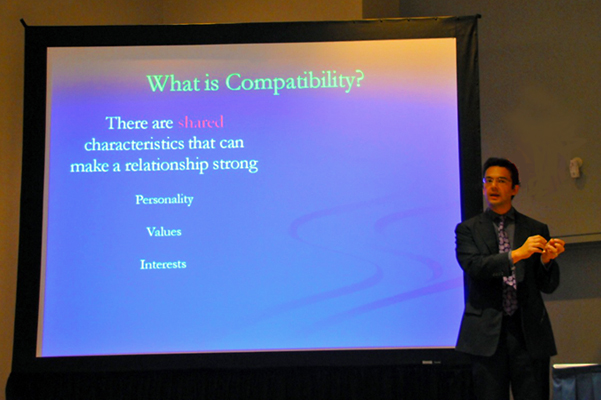
What is Compatibilty? 

( We are now seeing the slide you can see above. )

The eHarmony model of compatibility assumes:

"There are shared characteristics that can make a relationship strong" - notably personality, values and interests.

Conducting research on initial compatibly and long-term relationship [marriage] success can get "a little tricky".
To begin with, "you need to let people get married to see how it works. And, at the beginning of marriage everyone is happy." Only with time do we see underlying stressors and compatibility issues placing a relationship at greater risk. Of course, even in a great long-term relationship, conflict is inevitable - but it gets worked out, even if it can take an hour before figuring wht the conflict is about. Sometimes, over the years, misunderstanding can grow...

Dr. Gonzaga presented several on screen references to frame the history of compatibility research. First came the empirical evidence that "similarity between relationship partners predicts relationship quality" (Gaunt, 2006, Russel & Wells, 1991). Next we can see how similarity "provides consensual validation of attitudes and beliefs which promote attraction." (Byrne, 1971; LaFrance & Ickes, 1981). Finally, "Similarity promotes better understanding and effective communication between partners "(Burleson & Denton, 1992; Keltner & Kring, 1998). And it "coordinates a couple's responses responses to the environment". (Hatfield, Cacioppo, & Rapson, 1994; Kemper, 1991).

The list of references continues, underscoring how enduring couples are "more similar than average" and how they may set about to elect similar partners ("assortative mating") . And how "couples may converge, or become more alike over time." (e.g., Anderson, Keltner, & John, 2003).

An important note, big and bold onscreen: No study has prospectively investigated assortative mating in psychological characteristics
Gonzago noted that he takes comfort in eHarmony's low [known] divorce rate (even if nobody can 'prove' the key to long-lasting love).

With that Dr. Gonzago presented three recent studies, on (1) Personality matching (2) Proximal Processes; and (3) the Potentiation Effect

Study #1 

Prior to eHarmony, said Gonzago, nobody else had focused on personality characteristics.

Four hundred seventeen married couples who met via eHarmony.com and later married participated in this study. At the time of assessment, they'd been married an average of 32 months (range 26-56 months). Apologizing again and understanding we are seeing an awful lot of their 'deliriously happy couples' in advertisements these days, he noted that they now have helped bring together 40,000 couples.

To assess 'relationship satisfaction' eHarmony used what they found to be best, the Dyadic Assessment Scale (Spanier, 1976). Each couple completed the eHarmony relationship questionnare 3 times, assessing such things as Personality (e.g., warm, clever), Emotional tendencies (e.g., happy, anxious), and Interests (e.g., movies, shopping).

The results suggest that similarity can predict how satisfied one will be 3-4 years down the road.

[I do believe author Malcolm Gladwell has some thoughts on this as well, worth reading : Blink. It changed the conceptions of many psychologists! He cited research demonstrating that we can predict within only minutes whether couples are likely to be together years in the future.]

eHarmony has extensive data on match choices and their research affirms that "people tend to pick partners more similar to themselves." Do couples 'assort'? "We all tend to be alike" and may share a 'stereotyped personality". But again, what might predict long-term compatibility?

Gonzago has become convinced that "similarity is the lynch pin". Citing a study by Anderson, Keltner et al, 2003, he noted the adaptive function served by social interactions, and how for example "validation is best communicated directly... and how understanding is most relevant during discussions We know how our intensity during arguments is greater than in neutral discussions. What fuels this social interaction effect? Two possible reasons for this effect were identified:

* The Proximal Process: "Similarity in broad traits promotes similarity in interactive experience"

* Potentiation: "Similarity in broad traits enhances the positive effects of good relationship skills"


Study #2:
Similarity in Personality and Emotions in Married Couples (Gonzaga, Campos, & Bradbury, 2007)


Now we look at one of the venerable topics within personality theory: traits. We know from mountains of research that traits influence emotion and that variations can be seen between different groups, for example extroverts being more prone to exhibit positive affect.

This second study involved 172 married couples. The question was: Are couples similar in personality? In emotional experience? What they found is that "personalities were more alike than was their emotional similarity. Yet there were some qualitative aspects too, and the question was raised as to whether emotional similarity may be a 'mediating factor' in a triangle, between personality similarity and relationship satisfaction. Overall it was found that "relationship satisfaction is positively related to similarity".


The Proximal Process Model 

Similarity in broad traits predicts similarity in emotional quality in the moment 
  • Traits influence emotional experience 

    • Extroversion predicts positive affect
    • Neuroticism predicts negative affect
  • Emotions facilitate smooth social interactions

    • Communicate important messages about internal states
    • Evoke coordinated emotional responses from a partner
    • Elicit behaviors from partner to adjust to environmental conditions
  • Social Interactions act as building blocks for relationships (Gonzaga et al., 2006; Keltner et. al, 1998)


Study #3:
Social Interactions and Relationship Functioning in Married Couples (Setrakian & Gonzaga, in prep)


According to the Potentiation Model, relationships move from early connection through shared personality and interest factors - similarity - to an emotional connection which is mutually pleasurable, and then... how do shared social interactions grow into building blocks for lasting relationships?


Potentiation Model:

Similarity in broad traits predicts similarity in emotions
  • Emotions facilitate smooth social interactions 

    • Communicate important messages about internal states
    • Evoke coordinated emotional responses from a partner
    • Elicit behaviors from partner to adjust to environmental conditions
  • Social Interactions act as building blocks for relationships (Gonzaga et al., 2006; Keltner et. al, 1998) 

Increased understanding should enhance the effect of good social skills


Here we approach the foundation-building for healthy and happy long-term relationships. How to harness the shared personality/temperament factors and use our emotional and social skills to maintain the relationship:

Two hundred married couples, first marriage no children, wife under age 35, minimum 10th grade education, greater L.A. area.

Time's almost up, and these methods are hard to explain quickly (and now!) but...

Couples have a discussion under one of two conditions, social support vs. capitalization - experienced respectively as either supportive (Partner provided comfort) or using "Capitalization" (partner responded enthusiasticallly towards my good event - again exactly as Seligman just described - as the 'active/supportive' communication.)

This was a controlled laboratory study, though it was pointed out that "Lab ideas don't always work in the field".
Their results were analyzed through the filter of whether similarity, which we know to be a big factor, can moderate the perceived 'responsiveness effect' - that is the impact of capitalization, conflict resolution, and support elicitation. Their findings were described as 'robust though with mixed results in mediating the main factor, similarity.

CONCLUSIONS:

"Similarity", Gonzaga said, "doesn't make you a better partner. On the other hand, does it moderate attitudes? Yes. In males."

We know that Responsiveness matters in social interactions, that Similarity does not predict improved responsiveness, and that Similarity moderates the effect of responsiveness in males (but not females)."

In sum:

*Similarity is a powerful predictor of relationship success

* There are two potential routes: proximal process and potentiation

* Social interactions are critical in how similarity effects relationships

* Relationships deepen through increased understanding

* Partner selection is important because convergence is minimal.

And one more thing - oops, time is up! - Quickly then: Use the web as a tool!

-- Technology provided a platform for the application of basic research, BUT
-- The ideas that work in the laboratory don't always work in the field
-- The type of system he promotes is 1) Robust 2) Scalable 3) Palatable

Finally: "Technology can help facilitate a new era of research"

No doubt!

For me, anyway the 'takeaway' is: Similarity is a key factor in easy 'understanding' and resonating/reflecting similar feeling [tone], and revving up pleasure with shared activities and interests. Basic personality compatibility is the starting point, a foundation. Proximal process is about our personality 'similarity' basically, how alike we are and how we can use our collective attitudes and attributes to enjoy situations when together. Once a relationship is growing more intimate, the Potentiation Process begins.

It's no longer just about personalities matching on 'broad traits' at first, but also how they potentiate - bring out - the mutual joy. (or not) With broad similarity and shared world views, it is easier to 'be yourself' because you're feeling understood and veering towards that state of thinking in terms of 'we' very easily, as there is ongoing connection at several levels, emotionally. That's the perfect scenario. A well-functioning, happy couple is similar in personality and mutually reinforce the good feelings of emotional and personal connectedness, across situations. And that is my synopsis and take-away. YMMV. ['your mileage may vary']

I'll bet you weren't expecting to hear terms like proximal and potentiation in a talk about relationships and Love! But this may be the real thing. The new language of love. The pherenome of explanations as to why we initially attract, connect, and maintain healthy relationships. 

Social Media Users In Love: Romance Update [INFOGRAPHIC]


Social Media Users In Love: Romance Update [INFOGRAPHIC]


How do you meet people you’d like to get to know better? How do you treat each other once you’re together? Social media turns out to be a great accelerator for exposing you to potential mates, but does that change the basic way people interact with each other?
The infographic and research experts at Lab42 set out to take the pulse of today’s relationship hunters as well as established lovers, conducting a survey between Oct. 27 and Oct. 30 where they asked 500 social network users over age 18 some rather personal questions about meeting people, cheating, communication and more.
Is your romantic life similar to that of most other social networkers, or do you play the game your own way? Find out by checking out the fresh results of this infographic:

World on Wi-Fire by Nial Ferguson


World on Wi-Fire

Feel the chaos? Technology is feeding mind-boggling volatility everywhere.


Niall FergusonThe human race is interconnected as never before. Is that a good thing? Ask the Lords of the Internet—the men running the companies Eric Schmidt of Google recently called “the Four Horsemen”: Amazon, Apple, Facebook, and Google—and you’ll get an unequivocal “yes.” But is it true? In view of the extraordinary economic and political instability of recent months, it’s worth asking if the Netlords are the Four Horsemen of a new kind of information apocalypse.
Don’t get me wrong. I love all that these companies have achieved. I order practically everything except haircuts from Amazon. I write this column on a MacBook Pro. I communicate with my kids via Facebook. It’s 6:55 a.m., and I’ve already run six searches on Google. Did I forget to mention that I’ve already received 29 emails and sent 14?
I also really like the Netlords. They are among the smartest guys on the planet. Yet they are also self-deprecating and sometimes very funny. (OK, not Steve Jobs.) So my question for them is a real question, not some kind of Luddite rant: does the incredible network you have created, with its unprecedented scale and speed, not contain a vulnerability? I’m not talking here about the danger of its exploitation by Islamist extremists or its incapacitation by Chinese cyberwarriors, though I worry about those things too. No, I mean the possibility that the global computer network formed by technologically unified human minds is inherently unstable—and that it is ushering in an era of intolerable volatility.
The communications revolution we are living through has been driven by two great forces. One is Gordon E. Moore’s “law” (which he first proposed in 1965) that the number of transistors that can be placed inexpensively on an integrated circuit doubles approximately every 18 months. In its simplified form, Moore’s Law says that computing power will double every two years, implying a roughly 30-fold increase in 10 years. This exponential trend has now continued for more than half a century and is expected by the techies to continue until at least 2015 or 2020.
The other force is the exponential growth of human networks. The first email was sent at the Massachusetts Institute of Technology in the same year Moore’s Law was born. In 2006 people sent 50 billion emails; last year it was 300 billion. The Internet was born in 1982. As recently as 1993 only 1 percent of two-way telecommunication went through it. By 2000 it was 51 percent. Now it’s 97 percent. Facebook was dreamed up by an über-nerd at my university in 2004. It has 800 million active users today—eight times the number of three years ago.
technology-poltics-co01-ferguson
Illustration by Oliver Munday
Russian venture capitalist Yuri Milner sees this trend as our friend (it has certainly been his). As the number of people online doubles from 2 billion to 4 billion over the next 10 years and the number of Internet-linked devices quadruples from 5 billion to 20 billion, mankind collectively gets more knowledge—and gets smarter. Speaking at a conference in Ukraine in mid-September, Milner asserted that data equivalent to the total volume of information created from the beginning of human civilization until 2003 can now be generated in the space of just two days. To cope with this information overload, he looks forward to “the emergence of the global brain, which consists of all the humans connected to each other and to the machine and interacting in a very unique and profound way, creating an intelligence that does not belong to any single human being or computer.”
In the future as imagined by Google, this global brain will do much of our thinking for us, telling us (through our handheld devices) which of our friends is just around the next corner and where we can buy that new suit we need for the best price. And if the best price is on Amazon, we’ll just click once and look forward to its next-day delivery. Maybe it’ll already be there when we get home.
That’s the kind of sci-fi scenario that gets a true nerd out of bed in the morning. But is it just a bit too utopian?
Computer networks combine and amplify the primeval emotions of fear, love, and hate.
Exhibit one for a contrarian view is the recent behavior of global financial markets, the area of human activity furthest down the road of computerization and automation. According to math wonk Kevin Slavin, algorithms with names like the “Boston Shuffler” are the new masters of the financial universe. Whole tower blocks have been hollowed out to accommodate the computing power required by high-frequency (and very high-speed) trading. So how is this brave new world of robot traders doing?
Well, the VIX index of volatility—Wall Street’s so-called fear gauge, which infers the expected volatility of the U.S. stock market from options prices—reached an all-time high of 80 in the aftermath of Lehman Brothers’ failure and surged back up above 30 in early 2010 and again this summer. Part of this is just a good old-fashioned, man-made financial crisis, of course. But some of the volatility we’ve seen in the past four years is surely attributable to technology: think only of the “flash crash” of May 6 last year, when the Dow Jones industrial average plummeted 9 percent and then rallied in a matter of minutes.
Could the same kind of volatility spread into other markets as these become as wired and as integrated as Planet Finance? The answer must be yes. Consider how Greece’s fiscal woes have destabilized markets across Europe and around the world in recent months. Then there’s the market for consumer durables. We know that the speed with which new technologies have been adopted by American households has increased around eightfold over the past hundred years. But that speed of adoption has its obverse in the speed of obsolescence. Consumers are becoming ever more fickle. Millions bought RIM’s BlackBerry after its advent in 1999. But today the iPhone is the hotter handheld device, and I am far from alone in having a dead BlackBerry in my bottom desk drawer. In late September Amazon launched the Kindle Fire in a bid to challenge the iPad’s dominance of the tablet market. The name is appropriate. The market for such devices is on fire. The whole world is on wi-fire.
In politics, too, online electorates are becoming more volatile. The current race to find a Republican candidate for the presidency is a case in point. Only the other day Sarah Palin was a serious contender. Then Mitt Romney was a shoe-in. Until Rick Perry came along. Until Chris Christie came along. Meanwhile, the number of independent voters who have uncoupled themselves from the traditional parties has reached a historic high of 37 percent. Floating voters are the high-frequency traders of the political market.
Computing power has grown exponentially. So has the human network. But the brain of Homo sapiens remains pretty much the same organ that evolved in the heads of African hunter-gatherers 200,000 years ago. And that brain has a tendency to swing in its mood, from greed to fear and from love to hate.
The reality may be that by joining us all together and deluging us with data, the Netlords have ushered in a new Age of Volatility, in which our primeval emotions are combined and amplified as never before.
We are LinkedIn, but StressedOut. And that “cloud” of downloadable data may yet turn out to be a thundercloud.
Niall Ferguson is a professor of history at Harvard University and a professor of business administration at Harvard Business School. He is also a senior research fellow at Jesus College, Oxford University, and a senior fellow at the Hoover Institution, Stanford University. His Latest book, Civilization: The West and the Rest, will be published in November.