Mostrando entradas con la etiqueta google. Mostrar todas las entradas

viernes, 11 de noviembre de 2011

Cuando la Educación le Dice no a la Tecnología


Cuando la Educación le dice no a la Tecnología.
10/11/2011. Vuelodigital.
Un colegio privado de Sillicon Valley decidió no utilizar computadoras en sus clases de la escuela primaria para permitir que los niños desarrollen sus aptitudes sociales y emocionales de una manera más natural, antes de ingresar al mundo tecnológico. Paradoja de paradojas: a dicho establecimiento concurren hijos de empleados y dirigentes de empresas líderes en tecnología, como Google, Apple, Yahoo y Hewltt-Packard.

Se trata de la escuela Waldorf School of the Peninsula, la cual se maneja con la filosofía educativa del profesor Rudolf Steiner que pregona que el uso de la tecnología sólo es viable una vez que los alumnos estén listos para ello, y no, como se suele creer más conveniente, desde un principio en su desarrollo educativo. Esta teoría tiene casi un siglo de puesta en práctica.
Alan Eagle, de 50 años, cuyos hijos concurren al establecimiento de Sillicon Valley, aseveró “Rechazo fundamentalmente la noción de que se necesita de ayuda tecnológica en la gramática (…) La idea de que un app de iPad puede enseñarle de una manera más eficaz a mis hijos a leer o a aprender aritmética me parece ridícula.” Eagle tiene un título en Ciencias Informáticas de Darmouth y trabaja en Comunicaciones Ejecutivas de Google. Asegura que su hija que está en quinto grado no tiene ni la más mínima idea de cómo utilizar el buscador y su hijo, tres años más grande, recién está empezando a aprender. Otros padres están de acuerdo cuando Eagle afirma que “la tecnología tiene su tiempo y lugar”.
El gran miedo del colegio es que los niños dependan de las máquinas. El enfoque que implementaron para no ceder a su mayor temor no ha sido bien recibido en todos lados. Recientemente, en un artículo del diario New York Times, la directora de tecnología de la educación para la National School Boards Association, Ann Flynn, replicó que si los colegios tienen los medios y el dinero necesario para asegurarle a los niños diferentes herramientas pero no hacen uso de ellas, están engañándolos. El principio de la escuela es el de NO a las computadoras hasta los 12 años.

martes, 8 de noviembre de 2011

Relationships in the Age of Web 3.0


Relationships in the Age of Web 3.0

A.P.A. 119th Annual Convention. Washington D.C., August 4-7 2011

Gian C. Gonzaga, Ph.D
Relationships 3.0Dr. Gonzaga was introduced by Heather Patrick, Ph.D. (NIH). Dr. Gonzaga is the director of Research & Development for the online dating service, eHarmony, but will be addressing the nature of compatibility and sustained relationships in general. Considered an expert in the area of "relationship science", Dr. Gongaza will share with us some observations about "the changing face of relationships" and some of the findings which have emerged from his research into the dynamics and predictors of healthy, enduring relationships.

Dr. Gonzaga began with a disclaimer, namely his being "unconditionally biased" when it comes to eHarmony. He heads the laboratory research projects and believes in the findings of his and other studies. However, other than to describe his line of research into relationships, and provide some context, he assured us that this was not going to be a commercial pitch, and his talk today would be on "theoretical and scientific evidence" in support of his relationship research, as well as eHarmony's real-world (and laboratory) efficacy studies.

In the world of dating, especially...

"Technology is changing the way relationships are formed," 

Relationships don't just happen, nor do they last without some necessary ingredients. (As he avoids being a commercial, I'll now avoid referring to 'chemistry'.)

Dr. Gonzaga's research has led him to look not only at the matching process in terms of leading to an initial date, but at the elements of enduring and rewarding relationships: "the way they're maintained and the way they're improved."

To begin with, Gonzaga noted that 'Technology changes relationships' - it impacts on how relationships are (1) formed (2) maintained; and (3) researched.

In terms of where married couples first meet, a graph onscreen reveals an increasing trend upward, since 2008, towards meeting online (in general, along with another line showing the eHarmony numbers). Work and friends are big sources too, but like school, have trended down as online meetings trend up. Today there are all varieties of destinations and "platforms in technology" which allow applications to run. There is constant evolution.

A little web history

Web 1.0 - it was "driven around content that came from the top down"

Imagine: a guy goes into a music store and asks what they have. "Anything ever released." Once but a fantasy, along came iTunes. It happened.

Web 2.0 - Around 2003. "A big change. It was no longer top down. It's the era of Facebook. The era of YouTube." It leveled the field. It's 'open'. It's 'bottom up'. It's focused on relationships between individuals rather than delivering information.

Web 3.0 - Actually it is still forming, but has been evolving since 2000. "It's about open source and pliable interface. " It is both top down and bottom up. And it is a "web that learns". One of the best examples is Amazon.com. "It gives you recommendations based on your input." That, he said, is where eHarmony began, along with other user-tailored services, such as NetFlix.

From a relationship point of view, as a slide summarizes, Web 1.0 was all about information (e.g., Psych Info) while Web 2.0 allowed such things such as dating services offering "personalized introductions". And then there was Facebook, making it easy to make contacts and find friends. Web 3.0 allowed eHarmony to way to collaborate and to contribute to what he referred to as The Changing Landscape - in terms of the way one can form relationships, maintain a relationship, and also research relationships.

A little eHarmony History

Onscreen is the declaration: An Insight Started eHarmony: Many marriages face a significant handicap from the start.

Dr. Gonzaga explains: "A lot of marriages are to the wrong person!"

As it happens, his company founder was a clinical psychologist with 35 years experience of responding to patients' marital struggles. He saw the situation as one where he only came into the picture "after the relationship was ruined".

[There must be something real here! One of the world's most renowned social psychologists, 
Martin Seligman also has spoken - here, 4 hours ago! - about marriage therapy being thankless and ineffective: too little too late. Of course, in contrast there are 'positive' and active relationship styles and Seligman encourages using strengths and channeling the positive; Dr. Gonzaga's goal is to try to proactively 'match' compatible couples based on strong evidence.]

There are many reasons, Dr. Gonzaga continued, that people end up with the wrong partner. There are fewer opportunities to find a partner, and to get to know a partner. And people get married too quickly, and for the wrong reasons. For example: "People sacrifice long-term compatibility for short-term attraction"

From this formed the original idea for trying to improve the odds of compatibility. And although this may sound like an advertisement - Gonzaga joked that he's aware we've all been bombarded with ads featuring idyllic and ecstatic couples who met through eHarmony - the research which supports the concepts about compatibility is applicable to all relationships, particularly meeting and dating of course.
The original idea was that there are predictable things that couples share - that when they have things in common there's a better chance of compatibility. Shared values, shared ideals.

Also, "we like to be right... If others share our views, we like them. The more similar, the easier to understand each other: One of the basic components of building intimacy." You're similar.

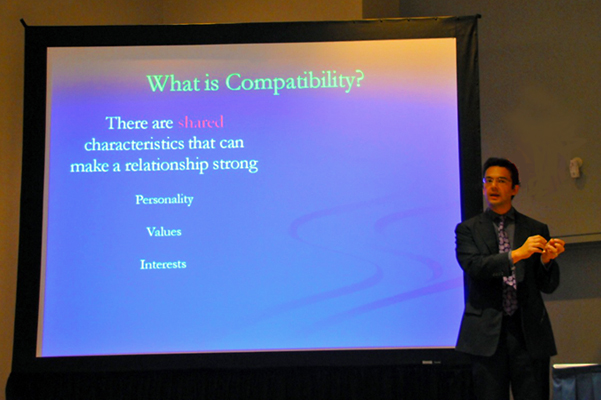
What is Compatibilty? 

( We are now seeing the slide you can see above. )

The eHarmony model of compatibility assumes:

"There are shared characteristics that can make a relationship strong" - notably personality, values and interests.

Conducting research on initial compatibly and long-term relationship [marriage] success can get "a little tricky".
To begin with, "you need to let people get married to see how it works. And, at the beginning of marriage everyone is happy." Only with time do we see underlying stressors and compatibility issues placing a relationship at greater risk. Of course, even in a great long-term relationship, conflict is inevitable - but it gets worked out, even if it can take an hour before figuring wht the conflict is about. Sometimes, over the years, misunderstanding can grow...

Dr. Gonzaga presented several on screen references to frame the history of compatibility research. First came the empirical evidence that "similarity between relationship partners predicts relationship quality" (Gaunt, 2006, Russel & Wells, 1991). Next we can see how similarity "provides consensual validation of attitudes and beliefs which promote attraction." (Byrne, 1971; LaFrance & Ickes, 1981). Finally, "Similarity promotes better understanding and effective communication between partners "(Burleson & Denton, 1992; Keltner & Kring, 1998). And it "coordinates a couple's responses responses to the environment". (Hatfield, Cacioppo, & Rapson, 1994; Kemper, 1991).

The list of references continues, underscoring how enduring couples are "more similar than average" and how they may set about to elect similar partners ("assortative mating") . And how "couples may converge, or become more alike over time." (e.g., Anderson, Keltner, & John, 2003).

An important note, big and bold onscreen: No study has prospectively investigated assortative mating in psychological characteristics
Gonzago noted that he takes comfort in eHarmony's low [known] divorce rate (even if nobody can 'prove' the key to long-lasting love).

With that Dr. Gonzago presented three recent studies, on (1) Personality matching (2) Proximal Processes; and (3) the Potentiation Effect

Study #1 

Prior to eHarmony, said Gonzago, nobody else had focused on personality characteristics.

Four hundred seventeen married couples who met via eHarmony.com and later married participated in this study. At the time of assessment, they'd been married an average of 32 months (range 26-56 months). Apologizing again and understanding we are seeing an awful lot of their 'deliriously happy couples' in advertisements these days, he noted that they now have helped bring together 40,000 couples.

To assess 'relationship satisfaction' eHarmony used what they found to be best, the Dyadic Assessment Scale (Spanier, 1976). Each couple completed the eHarmony relationship questionnare 3 times, assessing such things as Personality (e.g., warm, clever), Emotional tendencies (e.g., happy, anxious), and Interests (e.g., movies, shopping).

The results suggest that similarity can predict how satisfied one will be 3-4 years down the road.

[I do believe author Malcolm Gladwell has some thoughts on this as well, worth reading : Blink. It changed the conceptions of many psychologists! He cited research demonstrating that we can predict within only minutes whether couples are likely to be together years in the future.]

eHarmony has extensive data on match choices and their research affirms that "people tend to pick partners more similar to themselves." Do couples 'assort'? "We all tend to be alike" and may share a 'stereotyped personality". But again, what might predict long-term compatibility?

Gonzago has become convinced that "similarity is the lynch pin". Citing a study by Anderson, Keltner et al, 2003, he noted the adaptive function served by social interactions, and how for example "validation is best communicated directly... and how understanding is most relevant during discussions We know how our intensity during arguments is greater than in neutral discussions. What fuels this social interaction effect? Two possible reasons for this effect were identified:

* The Proximal Process: "Similarity in broad traits promotes similarity in interactive experience"

* Potentiation: "Similarity in broad traits enhances the positive effects of good relationship skills"


Study #2:
Similarity in Personality and Emotions in Married Couples (Gonzaga, Campos, & Bradbury, 2007)


Now we look at one of the venerable topics within personality theory: traits. We know from mountains of research that traits influence emotion and that variations can be seen between different groups, for example extroverts being more prone to exhibit positive affect.

This second study involved 172 married couples. The question was: Are couples similar in personality? In emotional experience? What they found is that "personalities were more alike than was their emotional similarity. Yet there were some qualitative aspects too, and the question was raised as to whether emotional similarity may be a 'mediating factor' in a triangle, between personality similarity and relationship satisfaction. Overall it was found that "relationship satisfaction is positively related to similarity".


The Proximal Process Model 

Similarity in broad traits predicts similarity in emotional quality in the moment 
  • Traits influence emotional experience 

    • Extroversion predicts positive affect
    • Neuroticism predicts negative affect
  • Emotions facilitate smooth social interactions

    • Communicate important messages about internal states
    • Evoke coordinated emotional responses from a partner
    • Elicit behaviors from partner to adjust to environmental conditions
  • Social Interactions act as building blocks for relationships (Gonzaga et al., 2006; Keltner et. al, 1998)


Study #3:
Social Interactions and Relationship Functioning in Married Couples (Setrakian & Gonzaga, in prep)


According to the Potentiation Model, relationships move from early connection through shared personality and interest factors - similarity - to an emotional connection which is mutually pleasurable, and then... how do shared social interactions grow into building blocks for lasting relationships?


Potentiation Model:

Similarity in broad traits predicts similarity in emotions
  • Emotions facilitate smooth social interactions 

    • Communicate important messages about internal states
    • Evoke coordinated emotional responses from a partner
    • Elicit behaviors from partner to adjust to environmental conditions
  • Social Interactions act as building blocks for relationships (Gonzaga et al., 2006; Keltner et. al, 1998) 

Increased understanding should enhance the effect of good social skills


Here we approach the foundation-building for healthy and happy long-term relationships. How to harness the shared personality/temperament factors and use our emotional and social skills to maintain the relationship:

Two hundred married couples, first marriage no children, wife under age 35, minimum 10th grade education, greater L.A. area.

Time's almost up, and these methods are hard to explain quickly (and now!) but...

Couples have a discussion under one of two conditions, social support vs. capitalization - experienced respectively as either supportive (Partner provided comfort) or using "Capitalization" (partner responded enthusiasticallly towards my good event - again exactly as Seligman just described - as the 'active/supportive' communication.)

This was a controlled laboratory study, though it was pointed out that "Lab ideas don't always work in the field".
Their results were analyzed through the filter of whether similarity, which we know to be a big factor, can moderate the perceived 'responsiveness effect' - that is the impact of capitalization, conflict resolution, and support elicitation. Their findings were described as 'robust though with mixed results in mediating the main factor, similarity.

CONCLUSIONS:

"Similarity", Gonzaga said, "doesn't make you a better partner. On the other hand, does it moderate attitudes? Yes. In males."

We know that Responsiveness matters in social interactions, that Similarity does not predict improved responsiveness, and that Similarity moderates the effect of responsiveness in males (but not females)."

In sum:

*Similarity is a powerful predictor of relationship success

* There are two potential routes: proximal process and potentiation

* Social interactions are critical in how similarity effects relationships

* Relationships deepen through increased understanding

* Partner selection is important because convergence is minimal.

And one more thing - oops, time is up! - Quickly then: Use the web as a tool!

-- Technology provided a platform for the application of basic research, BUT
-- The ideas that work in the laboratory don't always work in the field
-- The type of system he promotes is 1) Robust 2) Scalable 3) Palatable

Finally: "Technology can help facilitate a new era of research"

No doubt!

For me, anyway the 'takeaway' is: Similarity is a key factor in easy 'understanding' and resonating/reflecting similar feeling [tone], and revving up pleasure with shared activities and interests. Basic personality compatibility is the starting point, a foundation. Proximal process is about our personality 'similarity' basically, how alike we are and how we can use our collective attitudes and attributes to enjoy situations when together. Once a relationship is growing more intimate, the Potentiation Process begins.

It's no longer just about personalities matching on 'broad traits' at first, but also how they potentiate - bring out - the mutual joy. (or not) With broad similarity and shared world views, it is easier to 'be yourself' because you're feeling understood and veering towards that state of thinking in terms of 'we' very easily, as there is ongoing connection at several levels, emotionally. That's the perfect scenario. A well-functioning, happy couple is similar in personality and mutually reinforce the good feelings of emotional and personal connectedness, across situations. And that is my synopsis and take-away. YMMV. ['your mileage may vary']

I'll bet you weren't expecting to hear terms like proximal and potentiation in a talk about relationships and Love! But this may be the real thing. The new language of love. The pherenome of explanations as to why we initially attract, connect, and maintain healthy relationships. 

Social Media Users In Love: Romance Update [INFOGRAPHIC]


Social Media Users In Love: Romance Update [INFOGRAPHIC]


How do you meet people you’d like to get to know better? How do you treat each other once you’re together? Social media turns out to be a great accelerator for exposing you to potential mates, but does that change the basic way people interact with each other?
The infographic and research experts at Lab42 set out to take the pulse of today’s relationship hunters as well as established lovers, conducting a survey between Oct. 27 and Oct. 30 where they asked 500 social network users over age 18 some rather personal questions about meeting people, cheating, communication and more.
Is your romantic life similar to that of most other social networkers, or do you play the game your own way? Find out by checking out the fresh results of this infographic:

miércoles, 27 de julio de 2011

Google Is Like a 'Mental Prosthetic'

Google Is Like a 'Mental Prosthetic'

By Rachelle Dragani. TechNewsWorld. 07/15/11
Google Is Like a 'Mental Prosthetic'The prevalence of online search engines and the ease with which information can be looked up on the Internet may be changing the way our brains work, according to recent research. Knowing that information can be accessed later changes the way our brains remember it. Instead of having a dumbing-down effect on overall cognition, though, it may actually be helpful.

The way search engines like Google (Nasdaq: GOOG) make it almost effortless to find the answers to any question with a few taps of the fingertips could be changing the way our memory works, according to a study published recently in the research journal Science.

The report, co-authored by Betsy Sparrow, an assistant professor in the department of psychology at Columbia University; Jenny Liu at the University of Wisconsin Madison; and Daniel Wegner at Harvard, suggests that the brain is much less likely to recall information when it knows it can find the information quickly online. Instead, the brain will more often remember where the information can be retrieved, rather than what the information actually is.

The study was conducted in four experiments.

Volunteers, all college students, were asked to answer a series of questions or perform cognitive tasks. In one experiment, the students were asked trivia questions and asked to type their answers. Half the volunteers thought their information would be saved, the other thought it would be erased. Sparrow said the students who believed their data would disappear remembered the answers better than the other group.

In another experiment, the volunteers were told their information was being saved in general folders such as "FACTS" and "NAMES." The students remembered where there data was stored more often than they remembered the data itself.

The research suggests that someone who feels they have access to information later, like many people do with the Internet, are less likely to memorize small pieces of information since it is so often readily available.

Memory Doomsday?

This doesn't necessarily mean that memory or cognition is deteriorating in the information age. People have always relied on other tools to remember certain bits of information, and with the advent of search engines, the Internet has become the latest resource.

The research, according to Daniel Wegner, professor of psychology at Harvard and one of the co-authors of the study, was prompted in part by a theory he and his wife developed in the '80s called "transactive memory." The widely studied theory suggests that people in a group such as a married couple or close friends depend on each other to remember alternate pieces of information.
For instance, a husband may rely on his wife to remember what time dinner reservations are, or someone might turn to their history buff friend to recall what year Lincoln issued the Emancipation Proclamation.
"Thinking with computers is a natural extension of that. In the same way you depend on a friend, now you depend on Google," Wegner told TechNewsWorld.

Growing Capabilities

Dependence on Google or other resources may indeed be an indication of an expansion of mental capability and potential rather than a dumbing-down effect on cognition.

"We're a lot smarter now, and that's why we use it. We've become somewhat addicted because it really extends mental capacities. It's kind of like a mental prosthetic device that's better than what you've had before," Wegner said.

In fact, our brain is wisely strategizing, according to Paul Reber, professor and director of brain, behavior and cognition at Northwestern University.

"It indicates an impressive amount of effective strategic memory use. It's not hard to overwhelm our memory abilities -- if you have a large amount of information to try to learn, you'll need to spend a long time at it or you are going to lose or forget some items. If some of those items can be looked up again easily, it makes a lot of sense to focus our attention and resources on the other items to remember," Reber told TechNewsWorld.

With more data, images and information to process, our brains are actually opening up to create room for more analyzing capability rather than useless storage.

"There's no evidence we are forgetting things more rapidly now than before the Internet. It seems likely that with a much larger amount of information generally around, we are probably trying to remember more. In addition to studying what we forget, it would be important to look at how much we remember," Reber said.

That influx of information from technology can co-exist with mental cognition without damaging it.
"More information makes us smarter, not stupider," said Reber.

martes, 19 de julio de 2011

What’s In A Check-In? ~ The Psychology Of Geosocial

What’s In A Check-In? ~ The Psychology Of Geosocial

By Jamie Lipson. 16/07/2011- involver.com.
From Foursquare to Facebook Places to Twitter’s Location functionality, check-ins seem to be all the rage. However, while geosocial is a constant buzz in the social media space, it has failed to gain mainstream traction. Why is this the case? Why wouldn’t people want to know where their friends are on a Friday night? Is there a social risk attached to geosocial? Are there privacy concerns? To grabble with these questions, this post will take the form of a psychological analysis, showing how prevailing social media conventions have resulted in geosocial’s lackluster mainstream adoption.
Locations vs. Places
There is a difference between a location and a place. Locations are simply coordinates, whereas a place has social value, it can create engagement. 31º14’06″N/115º48’40″W doesn’t resonate with people, but checking in at a wedding or a funeral does (this may not be proper etiquette, however becoming the Foursquare mayor of your local cemetery can be mighty tempting).
The psychological thought process of checking in on your favorite geosocial application is informed by the psychology surrounding our social identity. The amplification effects of sharing content on social networks is so potentially massive, that we all abstract our behavior to some extent (consciously or subconsciously). People share content because it gives them social capital, and we all want to preserve and bolster our social identities.
Where Social Identity & Reality Collide
The tendency to not use geosocial applications is an extension of our need to maintain the social identities that we have all created for ourselves. The need to maintain our social identity trickles down and influences where we check in and where we don’t. Checking in to a boring (or even embarrassing) place does not bolster ones social graph, and as a result people tend to forgo the check-in process altogether.
Imagine that you really just want to go to McDonalds, but you know that the gastropub down the street would result in greater engagement with your social network. Resisting the temptation for a $20 burger, you enjoy your Big Mac in private. Of course this is not to say that no one is proud to eat at McDonalds, it depends on the person. The point is that if a place sends signals that will resonate with your social network, you’ll be more likely to check in. If not, you won’t check in at all. Whatever your food preferences may be (or for that matter preferences for anything), our social identities always prevents us from utilizing geosocial applications 100% of the time.
People check in to places for many reasons. Perhaps they can get a discount, or maybe they want a Foursquare badge. But in more instances than not, people will utilize a geosocial application in the hopes of creating engagement and bettering their social identity. The fear is not that people will know where they are at all times, its that no one will care or give accolades to where they actually go. Primal human insecurity is at the root of geosocial’s sluggish mainstream adoption, as people are choosing simply not to play for fear of compromising their finely cultivated social identities.

lunes, 11 de julio de 2011

e-Energy 2012 - Conference on Energy-Efficient Computing and Networking

e-Energy 2012. Conference on Energy-Efficient Computing and Networking.
9-11 May 2012, Madrid, Spain.

e-Energy, is the 3rd International Conference on Energy-Efficient Computing and Networking, which is organized annually since 2010. Due to the increasing significance of power consumption in computing and networking, the goal of e-Energy is to bring together researchers, developers and practitioners working in this area to discuss recent and innovative results, as well as identify future directions and challenges. The continuing spread of Information and Communication Technology (ICT) has contributed much to the reduction of energy consumption in many areas of everyday life. Nevertheless ICT infrastructure continues to expand in capacity and reach, and needs to be more energy-efficient itself. Additionally, ICT can be used to optimize the production, transport and consumption of energy in other setups.

e-energyThe conference addresses the varied fields of servers and communication infrastructures, services in data centers, end-systems in home and office environments, broadband access networks, sensor networks, cloud computing, smart grids and future networks such as The Internet of Things.

The 3rd e-Energy Conference will be held from May 9th to 11th, 2012 and will be organized by Institute IMDEA Networks and the University Carlos III of Madrid. The first edition of e-Energy was held in 2010, in Passau (Germany), with more than 100 participants, and the second edition will take place this year, from May 30th to June 1st, at Columbia University of New York City (USA).


The topics of interest for the 2012 e-Energy Conference include, but are not limited to:
  • Instrumentation and measurement of energy-efficient computing and networking
  • Energy and performance profiling, accounting of energy consumption
  • Metrics, benchmarks, interfaces, tools
  • Monitoring and management concepts
  • Energy, performance, quality of service and other resource trade offs
  • Energy-efficient networking and protocols
  • Energy-efficient high-capacity optical transport
  • Energy-efficient modulation formats
  • Energy-efficient access networks (wired and wireless)
  • Energy-efficient Cloud computing
  • Energy-efficient peer-to-peer networking and overlays
  • Future energy-efficient architectures
  • Energy-efficient application design
  • Load, heat, and resource modeling
  • Load, heat, and resource management
  • Reliability and power management
  • Energy-efficient grid, cloud, and data-center technology
  • Energy efficiency and virtualization
  • Energy efficiency, resource sharing and security
  • SmartGrids: new computing and networking contributions
  • Sensing techniques and sensor networks for energy awareness
  • Energy-efficient network components (switches, routers, transceivers, amplifiers, etc.)
  • Energy-efficient cloud computing
  • Design methodologies and tools for energy-efficient services
  • Security challenges in energy-efficient computing and networking
  • Energy-demand reduction techniques

domingo, 3 de julio de 2011

Facebook prepara su servicio de videochat con Skype para la semana que viene

Facebook prepara su servicio de videochat con Skype para la semana que viene

alt1040.com 03/07/2011.

Una de las cosas que más me gustó de la red social de Google, y por lo que he podido ver en comentarios y en Twitter a muchos de vosotros también, son las ‘hangouts’ o Quedadas. Resulta impresionante lo bien que funcionan, no lo he hecho personalmente con muchas personas.


Vaya hombre, casualidades de la vida, se produce el lanzamiento de Google+ y rápidos y presurosos acuden los de Facebook a repartir invitaciones de prensa para un ‘gran lanzamiento’ que tendrá lugar la semana que viene. Las filtraciones no se han hecho esperar y ya son varios los que reportan que fuentes cercanas a la compañía han revelado que lo que la red social de Zuckerberg está por sacar no es otra cosa que el largamente rumoreado servicio de videoconferencia, que llegaría apoyado por Skype.

Una de las cosas que más me gustó de la red social de Google, y por lo que he podido ver en comentarios y en Twitter a muchos de vosotros también, son las ‘hangouts’ o Quedadas. Resulta impresionante lo bien que funcionan, no lo he hecho personalmente con muchas personas, apenas con cuatro o cinco, pero en los perfiles de algunos altos responsables de la compañía he llegado a ver registros de hangouts con hasta 29 personas. Parece que el algoritmo está muy bien diseñado y optimiza mucho el ancho de banda, porque si no es algo que se me hace difícil de creer. El caso es que a Facebook ahora parece que de repente le han entrado las prisas (y no me extraña) y se dispone a sacar su propio servicio de chat por vídeo para la semana que viene.

Quizá llegue con alguna novedad más, pero de momento lo que parece estar prácticamente asegurado es la llegada de es nuevo servicio y que además lo hara en compañía nada más y nada menos que Skype. Tiene toda la lógica del mundo, y que llegue asociado con una compañía del nivel y la envergadura de Skypeasegura que por lo menos en cuanto a estabilidad y funcionamiento el servicio será bastante bueno, aunque me pregunto hasta qué punto funcionará la integración, si al hacer login en Facebook también lo haremos en Skype y viceversa.

Yo me inclino a pensar que sí, aunque ambos logins seguirían manteniéndose de manera separada, podrías aparecer como conectado en un servicio sí y en otro no, por ejemplo. Hace poco la última versión beta del popular servicio de VoIPañadía una integración bastante buena con el chat de Facebook desde la propia ventana de la aplicación, así que si se piensa un poco, sería bastante lógico si acabase ocurriendo lo mismo pero justo en el sentido contrario. Habrá que esperar, como siempre, a la presentación oficial para ver de qué manera lo han resuelto y hasta que punto llegan los niveles de integración.

Puede acabar resultando una unión muy beneficiosa para ambos y aunque no dudo, sólo por el hecho de ser Facebook de quien estamos hablando, que tendrá éxito, también me pregunto si será capaz de igualar o mejorar a los hangouts deGoogle+ en sencillez y versatilidad. Hacer un hangout es la cosa más sencilla del mundo, tan fácil como apretar un botón, y cualquiera (según el círculo en el que estemos) se puede unir en cualquier momento, si el videochat de Facebookconsigue mejorar eso bien por ellos, aunque como decía antes me da la sensación de que será algo mucho más tradicional, del orden de seleccionar un contacto concreto, apretar el botón de videollamada y llamar, como ha venido funcionando toda la vida en Skype.

lunes, 20 de junio de 2011

ICANN revoluciona los dominios de Internet


ICANN revoluciona los dominios de Internet.


Esperanza Hernández. 20/06/2011. FayerWayer. Nombres de dominio a la carta. Más o menos eso es lo que ha aprobado la Corporación de Internet para la Asignación de Nombres y Números (ICANN), dando vía libre al nacimiento de dominios regionales, corporativos e institucionales.

Así, pronto podríamos comenzar a ver dominios “.apple”, “.santiago”, “.madrid”, “.caracas”, y pare usted de contar. Al acabarse la restricción de dominios como “.com” o “.org”, se recibirán solicitudes de nuevos nombres a partir del 12 de enero del próximo año con las primeras aprobaciones probablemente a finales de 2012.

Sin embargo, si ya te estás haciendo ilusiones para registrar un dominio con tu nombre, más vale que vayas aterrizando y pongas de nuevo los pies en la tierra: Postular un sufijo para un dominio costará cerca de US$ 185.000 (unos 130.000 euros), y además debes demostrar que tienes el legítimo derecho a utilizar el nombre que quieras comprar… ¡Qué complicado!

¿La razón de esta restricción? Pues es una forma de controlar que no venga cualquiera a registrar sufijos de marcas o corporaciones, por ejemplo, para luego colocar allí contenidos de la competencia, o que afecten el funcionamiento de dicha empresa o institución.

De hecho, es fácil pensar que los primeros en registrar dominios serán empresas o marcas como Toyota, Apple, Coca-Cola o Google, porque son además quienes tienen más dinero para hacerlo, obviamente, y pueden invertir tales cifras para velar por el cuidado de su imagen en Internet.

Recordemos que en la actualidad solo están disponibles 22 dominios gTLD registrados en el mundo “.com”, “.org”, “.info”, etc. Además, existen más de 250 países con dominios propios como Chile “.cl”, Venezuela “.ve” o España “.es”. Después del cambio, se espera que se puedan utilizar varios cientos de nuevos gTLD.

viernes, 15 de abril de 2011

¿Cuáles son los países y ciudades con más usuarios en Twitter de Latinoamérica?

¿Cuáles son los países y ciudades con más usuarios en Twitter de Latinoamérica?

Publicado  en Gabatek

Twitter en Latinoamerica tecnologiaBrasil sería el país con más usuarios activos en Twitter en Latinoamérica con 4’300.000. Aunque Brasil es sin duda el país con más territorio de esta región, logra doblegar a México en el número de usuarios en esta popular red social, el cual doble igualmente a Venezuela que se encontraría en la tercera posición de usuarios activos en Twitter de Latinoamérica. Argentina seria el quinto y Colombia el sexto, según un estudio presentado por Ecualink.

La procedencia de este tráfico de América Latino en Twitter demuestra el gran crecimiento que la telefonía móvil ha tenido y en especial el gran crecimiento que el BlackBerry ha tenido. Según el análisis realizado, 30% de los usuarios serian de BlackBerry, 14% de otros teléfonos celulares, 10% de teléfonos celulares con Android y 6% con dispositivos de Apple como el iPhone.
Con el este crecimiento que ha mostrado la teléfono móvil es interesante conocer cuáles son las aplicaciones o apps más utilizas en esta clase de dispositivos. UberSocial, anteriormente conocido solo por sus aplicaciones UberTwitter y Twidroid seria de las más utilizadas juntos a TweetDeck, Twitter for Android, Mobile Twitter, Twitter for BlackBerry, Twitter for iPhone y Ovi by Nokia.
El estudio presentado, igualmente muestra las ciudades Latinas con más usuarios activos en Twitter, en donde Sao Paulo (Brasil) lidera, es seguido por Caracas (Venezuela) y Ciudad de México (México). Buenos Aires (Argentina) seria séptima, octavo Bogotá (Colombia) y noveno Santiago (Chile).
Para conocer en más detalle los resultados de este estudio de los usuarios en Twitter de Latinoamérica ver gráfica:

jueves, 17 de marzo de 2011

Art Project de Google


Art Project de Google: 17 museos en tu ordenador


En diariodelviajero.com/ feb. 2011
Google ha presentado uno más de sus servicios. En este caso se trata de Art Project en el cual ha trabajado durante los últimos meses junto a 17 museos entre los que se encuentran los mayores del mundo. (ver vídeos).
En este proyecto los visitantes virtuales podremos ver uno de los usos del ya usual Google Street pero aplicado a instituciones culturales. Podremos movernos por el interior de los museos seleccionados, entrar en sus salas y observas sus colecciones. En un nivel de detalle más específico, cada museo de la lista ha dado libre acceso para que se haga un relevamiento de ciertas obras emblemáticas, utilizando para ello una tecnología fotográfica de gigapíxeles o súper alta resolución. Cada “objeto” de este tipo está formado por unos 14.000 millones de píxeles que permiten ver detalles como al natural: las pinceladas, la carga de pintura, las luces y sombras en los más mínimos detalles.
Los museos también han proporcionado imágenes de alta resolución para una selección de más de 1.000 obras de arte entre las que se incluyen trabajos de Goya, Hans Holbein, Botticelli, Cezánne, etc. Con este amplísimo “menú artístico“ podrás hacer realidad el sueño de tener tu pinacoteca deseada, ya que puedes armar tu propia colección virtual para ver y recrearte con ella tantas veces quieras.
Los museos que han participado del proyecto son:
• Altes Nationalgalerie, Berlín, Alemania
• Gemäldegalerie, Berlín, Alemania
• Colección Frick, Nueva York, EE.UU.
• Galería Freer del Smithsonian, Washington DC, EE.UU.
• MoMA, The Museum of Modern Art, Nueva York, EE.UU.
• The Metropolitan Museum of Art, Nueva York, EE.UU.
• Museo Reina Sofía, Madrid, España
• Museo Thyssen-Bornemisza, Madrid, España
• Palacio de Versalles, Francia
• Galería de los Uffizi, Florencia, Italia
• Galería Tretyakov, Moscú, Rusia
• Museo Hermitage, San Petersburgo, Rusia
• Museo Kampa, Praga, República Checa
• Museo Van Gogh, Ámsterdam, Países Bajos
• Rijksmuseum, Ámsterdam, Países Bajos
• National Gallery, Londres, Reino Unido
• Tate Britain, Londres, Reino Unido

Google Art Project - Behind the Scenes