Mostrando entradas con la etiqueta Apple. Mostrar todas las entradas

viernes, 11 de noviembre de 2011

Thomas Suarez - iPhone Application Developer. . .and 6th Grader


Thomas Suarez - iPhone Application Developer... and 6th Grader


Thomas Suarez is a 6th grade student at a middle school in the South Bay. Tom been fascinated by computers and technology since before kindergarten. Recently, he's been focused on the development of applications for the iPhone, and has established his own company, CarrotCorp. His most successful ap is one he terms "an anti-Justin-Bieber game" called "Bustin Jieber". "It's is a variation on the Whac-a-Mole theme," he explains.


In the spirit of ideas worth spreading, TED has created a program called TEDx. TEDx is a program of local, self-organized events that bring people together to share a TED-like experience. Our event is called TEDxManhattanBeach, where x = independently organized TED event. At our TEDxManhattanBeach event, TEDTalks video and live speakers will combine to spark deep discussion and connection in a small group. The TED Conference provides general guidance for the TEDx program, but individual TEDx events, including ours, are self-organized.

Cuando la Educación le Dice no a la Tecnología


Cuando la Educación le dice no a la Tecnología.
10/11/2011. Vuelodigital.
Un colegio privado de Sillicon Valley decidió no utilizar computadoras en sus clases de la escuela primaria para permitir que los niños desarrollen sus aptitudes sociales y emocionales de una manera más natural, antes de ingresar al mundo tecnológico. Paradoja de paradojas: a dicho establecimiento concurren hijos de empleados y dirigentes de empresas líderes en tecnología, como Google, Apple, Yahoo y Hewltt-Packard.

Se trata de la escuela Waldorf School of the Peninsula, la cual se maneja con la filosofía educativa del profesor Rudolf Steiner que pregona que el uso de la tecnología sólo es viable una vez que los alumnos estén listos para ello, y no, como se suele creer más conveniente, desde un principio en su desarrollo educativo. Esta teoría tiene casi un siglo de puesta en práctica.
Alan Eagle, de 50 años, cuyos hijos concurren al establecimiento de Sillicon Valley, aseveró “Rechazo fundamentalmente la noción de que se necesita de ayuda tecnológica en la gramática (…) La idea de que un app de iPad puede enseñarle de una manera más eficaz a mis hijos a leer o a aprender aritmética me parece ridícula.” Eagle tiene un título en Ciencias Informáticas de Darmouth y trabaja en Comunicaciones Ejecutivas de Google. Asegura que su hija que está en quinto grado no tiene ni la más mínima idea de cómo utilizar el buscador y su hijo, tres años más grande, recién está empezando a aprender. Otros padres están de acuerdo cuando Eagle afirma que “la tecnología tiene su tiempo y lugar”.
El gran miedo del colegio es que los niños dependan de las máquinas. El enfoque que implementaron para no ceder a su mayor temor no ha sido bien recibido en todos lados. Recientemente, en un artículo del diario New York Times, la directora de tecnología de la educación para la National School Boards Association, Ann Flynn, replicó que si los colegios tienen los medios y el dinero necesario para asegurarle a los niños diferentes herramientas pero no hacen uso de ellas, están engañándolos. El principio de la escuela es el de NO a las computadoras hasta los 12 años.

martes, 8 de noviembre de 2011

The Benefit and Danger of Education Technology


The Benefit and Danger of Education Technology

by  on NOVEMBER 4, 2011 in DAWSONITE, EDTECH
This is the second in a series on the digital divide that exists in the world of education. Each article is by an Edudemic guest author. Want to weigh in? Click here to get your article published. Read Jill Rooney’s article “Education, Race and the Internet: Digital Divide or Racial Ravine?“

The rapid changes in technology over the last 75 years have created enormous opportunities for education. While some technologies such as the computer were adopted early on, a reluctance to embrace change coupled with a lack of funding has resulted in a continuing dependence on chalkboards and other anachronistic technologies. The extent to which schools adopt new technologies, not surprisingly, often depends on how well they’re funded. It isn’t uncommon for schools that are separated by very little physical distance to be at opposite ends of the technology gap.
Many folks familiar with this scenario understand the inherent lack of fairness in the disparate funding of schools. What many people don’t understand however is that it also threatens the uniquely American ideals of democracy and equality. One of the bedrocks of our democracy is the idea that we’re governed by the electoral choices of a well-informed citizenry. Having equal access to a decent education is the assumption that underlies this premise. But the ways in which rapid advances in technology are adopted have both positive and negative implications for schools and for broader society in general.
Preparing For The Workforce
One of the most positive results of schools embracing new technologies is found when low-income students gain skills they otherwise wouldn’t. The ability to type, use email and execute basic computer functions like Word and Excel are imperative in today’s workforce. When students who have no access to computers at home learn these skills specifically because of technology in the classroom, they have a far greater chance of moving from have-nots to haves in the future. Having technological competence gives them a better chance of success in the workforce and gives them a greater ability and confidence to pursue online education university options.
No Student Left Behind
When classrooms adopt iPads or other tablets in lower grades amongst younger students, the possibility that those students will be left behind in terms of the greater society decreases dramatically. Studies have consistently shown that new technology introduction to younger children provides better results than when introduced at a later age. Even if low-income students have no access to computers at home, the integration of new technology into all aspects of school life ensures that they have greater opportunities going forward.
Handwriting Requirements
There are some arguably negative implications to the adoption of new technologies as well. Some of the most evident for the short term involve dropping long-standing handwriting requirements. Penmanship was dropped from most English classes over the last twenty years and cursive writing requirements are quickly being cut from many programs as well. Depending on one’s perspective, not learning cursive in elementary school may not be the end of the world academically speaking. But advocates of teaching cursive argue that losing cursive is just one more case of technology eroding academic rigor.
Quality of Writing
There is another, lesser known, but reasonable argument against adopting computers across all academic disciplines. Pen and paper often tend to be more conducive to good writing than computer keyboarding. Longhand writing is more likely to result in well-reasoned, nuanced and intricate prose. This may arise from the fact that typing lends itself more easily to abrupt and punchy prose. The staccato quality of typing can work its way into writing. Stylistic arguments aside; a potentially far more worrisome implication for the long term is the increasing technology gap among schools.
Social Class
When the only technology requirements for completing aprimary education involved paper, pencils, a slide rule and eventually calculators, the impact technology had in widening the divide between haves and have-nots was minimal. But the technology gap which exists in schools today also functions as a solidifier of social class. If low-income students are unlucky enough to attend schools which can’t fund technology purchases, the chance that they’ll find a way out of a low income life becomes less likely. It’s understandable that if a school can’t afford air conditioning, they’re probably not going to view iPads as a logical expenditure.
The Danger of Making Technology So Critical
The ability to use technologies such as laptops and tablet computers allows students to acquire the same sets of core competencies they’ll need in the workforce. Not acquiring these skill sets is more than an inconvenience. The ability to access information and basic computer literacy can function as a potential stepping-stone out of poverty for many students. If a student graduates high school without at least a rudimentary and working knowledge of new technologies, their future starts looking a lot less bright.
And since many school districts which can’t afford to incorporate technology into the classroom are largely found in less affluent areas, the likelihood of upward social mobility decreases significantly and social classes begin to look a lot more like social castes. The technology gap runs the risk of further cementing social class. This country has always celebrated the ability of Americans to pull themselves up by their own bootstraps. We love it when the underdog makes good. It’s part of our national identity to root for the little guy. But when the little guy is deprived of what are rapidly becoming basic tools of future economic survival, the ability for any effective bootstrap pulling begins to disappear.
Technology’s Impact on the Future
Twenty years ago, someone without computer skills could still expect to find a decent job which, though not providing a huge income, could still support a family. But now, jobs that used to be considered basic blue collar jobs require technological know-how. A car mechanic used to need mechanical aptitude and a good set of wrenches and they were in business. Working in customer service used to require basic telephone skills. But increasingly, even menial entry level jobs require much more computer literacy than what some disadvantaged students are getting in schools. If we want to ensure that more Americans continue to get a legitimate shot at the American Dream, we need to start a national dialogue focused on identifying workable solutions for narrowing the technology gap.
Jesse L. is a recent college graduate looking to make his mark on the world. Currently he is a blogger and a contributor at the Professional Intern. You can follow the Professional Intern on Twitter @TheProIntern. Be sure to check out his most recent article “How Steve Jobs Impacted Education.”

World on Wi-Fire by Nial Ferguson


World on Wi-Fire

Feel the chaos? Technology is feeding mind-boggling volatility everywhere.


Niall FergusonThe human race is interconnected as never before. Is that a good thing? Ask the Lords of the Internet—the men running the companies Eric Schmidt of Google recently called “the Four Horsemen”: Amazon, Apple, Facebook, and Google—and you’ll get an unequivocal “yes.” But is it true? In view of the extraordinary economic and political instability of recent months, it’s worth asking if the Netlords are the Four Horsemen of a new kind of information apocalypse.
Don’t get me wrong. I love all that these companies have achieved. I order practically everything except haircuts from Amazon. I write this column on a MacBook Pro. I communicate with my kids via Facebook. It’s 6:55 a.m., and I’ve already run six searches on Google. Did I forget to mention that I’ve already received 29 emails and sent 14?
I also really like the Netlords. They are among the smartest guys on the planet. Yet they are also self-deprecating and sometimes very funny. (OK, not Steve Jobs.) So my question for them is a real question, not some kind of Luddite rant: does the incredible network you have created, with its unprecedented scale and speed, not contain a vulnerability? I’m not talking here about the danger of its exploitation by Islamist extremists or its incapacitation by Chinese cyberwarriors, though I worry about those things too. No, I mean the possibility that the global computer network formed by technologically unified human minds is inherently unstable—and that it is ushering in an era of intolerable volatility.
The communications revolution we are living through has been driven by two great forces. One is Gordon E. Moore’s “law” (which he first proposed in 1965) that the number of transistors that can be placed inexpensively on an integrated circuit doubles approximately every 18 months. In its simplified form, Moore’s Law says that computing power will double every two years, implying a roughly 30-fold increase in 10 years. This exponential trend has now continued for more than half a century and is expected by the techies to continue until at least 2015 or 2020.
The other force is the exponential growth of human networks. The first email was sent at the Massachusetts Institute of Technology in the same year Moore’s Law was born. In 2006 people sent 50 billion emails; last year it was 300 billion. The Internet was born in 1982. As recently as 1993 only 1 percent of two-way telecommunication went through it. By 2000 it was 51 percent. Now it’s 97 percent. Facebook was dreamed up by an über-nerd at my university in 2004. It has 800 million active users today—eight times the number of three years ago.
technology-poltics-co01-ferguson
Illustration by Oliver Munday
Russian venture capitalist Yuri Milner sees this trend as our friend (it has certainly been his). As the number of people online doubles from 2 billion to 4 billion over the next 10 years and the number of Internet-linked devices quadruples from 5 billion to 20 billion, mankind collectively gets more knowledge—and gets smarter. Speaking at a conference in Ukraine in mid-September, Milner asserted that data equivalent to the total volume of information created from the beginning of human civilization until 2003 can now be generated in the space of just two days. To cope with this information overload, he looks forward to “the emergence of the global brain, which consists of all the humans connected to each other and to the machine and interacting in a very unique and profound way, creating an intelligence that does not belong to any single human being or computer.”
In the future as imagined by Google, this global brain will do much of our thinking for us, telling us (through our handheld devices) which of our friends is just around the next corner and where we can buy that new suit we need for the best price. And if the best price is on Amazon, we’ll just click once and look forward to its next-day delivery. Maybe it’ll already be there when we get home.
That’s the kind of sci-fi scenario that gets a true nerd out of bed in the morning. But is it just a bit too utopian?
Computer networks combine and amplify the primeval emotions of fear, love, and hate.
Exhibit one for a contrarian view is the recent behavior of global financial markets, the area of human activity furthest down the road of computerization and automation. According to math wonk Kevin Slavin, algorithms with names like the “Boston Shuffler” are the new masters of the financial universe. Whole tower blocks have been hollowed out to accommodate the computing power required by high-frequency (and very high-speed) trading. So how is this brave new world of robot traders doing?
Well, the VIX index of volatility—Wall Street’s so-called fear gauge, which infers the expected volatility of the U.S. stock market from options prices—reached an all-time high of 80 in the aftermath of Lehman Brothers’ failure and surged back up above 30 in early 2010 and again this summer. Part of this is just a good old-fashioned, man-made financial crisis, of course. But some of the volatility we’ve seen in the past four years is surely attributable to technology: think only of the “flash crash” of May 6 last year, when the Dow Jones industrial average plummeted 9 percent and then rallied in a matter of minutes.
Could the same kind of volatility spread into other markets as these become as wired and as integrated as Planet Finance? The answer must be yes. Consider how Greece’s fiscal woes have destabilized markets across Europe and around the world in recent months. Then there’s the market for consumer durables. We know that the speed with which new technologies have been adopted by American households has increased around eightfold over the past hundred years. But that speed of adoption has its obverse in the speed of obsolescence. Consumers are becoming ever more fickle. Millions bought RIM’s BlackBerry after its advent in 1999. But today the iPhone is the hotter handheld device, and I am far from alone in having a dead BlackBerry in my bottom desk drawer. In late September Amazon launched the Kindle Fire in a bid to challenge the iPad’s dominance of the tablet market. The name is appropriate. The market for such devices is on fire. The whole world is on wi-fire.
In politics, too, online electorates are becoming more volatile. The current race to find a Republican candidate for the presidency is a case in point. Only the other day Sarah Palin was a serious contender. Then Mitt Romney was a shoe-in. Until Rick Perry came along. Until Chris Christie came along. Meanwhile, the number of independent voters who have uncoupled themselves from the traditional parties has reached a historic high of 37 percent. Floating voters are the high-frequency traders of the political market.
Computing power has grown exponentially. So has the human network. But the brain of Homo sapiens remains pretty much the same organ that evolved in the heads of African hunter-gatherers 200,000 years ago. And that brain has a tendency to swing in its mood, from greed to fear and from love to hate.
The reality may be that by joining us all together and deluging us with data, the Netlords have ushered in a new Age of Volatility, in which our primeval emotions are combined and amplified as never before.
We are LinkedIn, but StressedOut. And that “cloud” of downloadable data may yet turn out to be a thundercloud.
Niall Ferguson is a professor of history at Harvard University and a professor of business administration at Harvard Business School. He is also a senior research fellow at Jesus College, Oxford University, and a senior fellow at the Hoover Institution, Stanford University. His Latest book, Civilization: The West and the Rest, will be published in November.

viernes, 7 de octubre de 2011

Steve Jobs: Student, Teacher And Leader In Revolutionizing Education And Technology

Steve Jobs: Student, Teacher And Leader In Revolutionizing Education And Technology 

The Huffington Post.     First Posted: 10/6/11 01:02 PM ET

In a time of educational debate and shuffling nationwide, a college dropout, businessman and paragon of technological innovation emerged as an inadvertent, but forceful, momentum for an educational revolution around the world.

Steve Jobs wasn't the best student in the traditional sense, as he dropped out of college within six months of enrolling. But in the years following, the world watched as he built Apple and as he taught himself through numerous failures and subsequent successes. His career became an education for himself, his employees and his customers.

By way of educational ideology, Jobs was a believer in equal opportunity, according to a 1995 interview with Daniel Morrow, executive director of the Computerworld Smithsonian Awards Program.

"I don't believe in equal outcome because unfortunately life's not like that," Jobs told Morrow. "It would be a pretty boring place if it was."

Following the news of Jobs' death Wednesday night, thousands of tributes poured in, honoring the tech pioneer's life, career and pervasive contribution to the operations, capabilities and outlook of innumerable industries. Among those messages was this tribute from the parent of an autistic child.
"Steve Jobs Saved My Son," the CNN iReport post is titled.
"Thank you Steve Jobs for helping my son," the mother writes. "You have given us hope we thought we would never have."

Her 3-year-old son doesn't talk, but his ability to communicate has been revolutionized by the use of Apple's iPad, she says.

The Apple computer lab at Monsignor Paul Dwyer Catholic school in Ontario, Canada is lit with screens of Jobs' image. The person who runs the lab told CNN iReport producer rachel8 that Jobs was the one person aside from his family and teaching career who shaped his life.

"It's crazy," he said. "You'd never think that somebody you'd never met could have such an influence on you."

And not only never met, but perhaps have never shared footing on the same continent, Beijing teenager Silu Wang told Businessweek she was inspired by Steve Jobs, and attributes her high test scores to using him as her subject on an essay for college admission to the U.S.

But back Stateside, Jobs' legacy and influence on education has expanded from typography and word processing on iMacs to the beginnings of a completely new system and revolutionary methods of teaching and learning through the use of gadgets like iPhones and iPads in classrooms -- in addition to what we now consider the more traditional computer. Jobs' story has come a long way since his company donated Apple II computers to 10,000 schools in California in 1983


Schools across the country have joined a movement that trims textbooks in schools, replacing them with the lighter, sleeker iPad. The introduction of tablet computers are expected to cut costs for school districts long-term, and host a multitude of new ways students can interact in learning and complete assignments -- shifting the learning process from the rigid lecture to a more dynamic collaboration.

But even as his products have seeped into the pores of industry, Jobs was one to note that technology isn't an instigator of change -- people like teachers are. People, he tells Morrow, are the ones who ignite and fuel curiosity, things that machines cannot do. The marriage of technology and human momentum through learning is what has and will shape the future of education.

"You need a person. Especially with computers the way they are now. Computers are very reactive but they're not proactive; they are not agents, if you will. They are very reactive," he said. "What children need is something more proactive. They need a guide. They don't need an assistant. I think we have all the material in the world to solve this problem; it's just being deployed in other places."

It's this very embedding of Jobs' creations into our culture and education that has students reflecting on his leadership and the message behind his life.

"If you set your mind to it, you can do anything you want. Just imagine it and you can go with it," Old Dominion University student Nick Jennings told WAVY.com. "You just got to work for it. You've got to know what you want to do. It's pretty inspirational, he was a good man."

While his followers and consumers were inspired by his experiences, life philosophy and innovative products, Jobs said in his 1995 interview with Morrow that without a number of teachers who influenced him, "I would have absolutely have ended up in jail…. When you're young, a little bit of course correction goes a long way. I think it takes pretty talented people to do that."

jueves, 26 de mayo de 2011

Los niños con autismo y el iPad

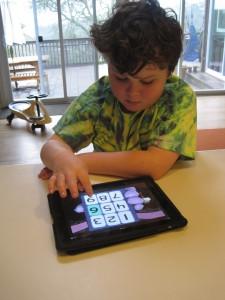
Muchos niños autistas tienen problemas para desarrollar habilidades sociales, pero a menudo les resulta más fácil con los juegos y la tecnología. Los niños autistas están utilizando los populares dispositivos de Apple, tocando las pantallas, que se adaptan a sus necesidades. Los padres comenzaron a notar que sus hijos autistas se sentían atraídos por la tecnología de pantalla táctil del IPAD, y la palabra se extendió rápidamente entre los padres acerca de este nuevo uso para el equipo.
Las computadoras han sido utilizadas por los niños autistas durante décadas. Pero los expertos dicen que la interfaz personalizable e intuitiva de las máquinas de Apple, junto con su portabilidad, ofrece la promesa más allá de los ordenadores relativamente voluminosos del pasado.
Otras compañías están creando aplicaciones similares para distintos dispositivos, tales como Droid de Motorola. Pero los expertos en autismo dicen que Apple es el líder - por ahora.Toda las escuelas han comenzado a depender de la nueva tecnología. NJ.com informa que cada niño en la Academia de Reed, una escuela sin fines de lucro en Garfield para alumnos autistas, tiene un iPod Touch. Dos docenas de estudiantes de la Academia Reed, de edades comprendidas entre 3 a 14, llevar a cabo sus días independientes- pero vuelve constantemente a sus pantallas táctiles con sus profesores.
La próxima meta es enseñar a los estudiantes a traer sus herramientas de alta tecnología al mundo, Reed, profesor de la Academia Kelli De Rosa dijo NJ.com. La ventaja del dispositivo, dijo, es que en realidad podría ayudar a los niños autistas encajar con sus compañeros que tienen los mismos dispositivos.
Hay docenas de programas promocionados por varios expertos en la comunidad de autismo, algunos de los cuales cuentan historias; otros, que trabajan en el vocabulario y otros que simplemente entretienen.


Sin embargo, los expertos también advierten de las tecnologías de pantalla táctil no son una "bala mágica". Aunque el estudiante Marc Rader jugó su primer videojuego en una semana colocando las manos sobre su IPAD, aún tiene dificultades de motricidad fina y dificultad para enfocar y su tutor Marcos Mautone pasa horas adaptando aplicaciones y software para sus estudiantes. También debe ayudar a que Marc toque las partes correctas de la pantalla y desplazarse por los menús.
Según sfweekly.com, el IPAD no es perfecto para los niños con autismo. Por un lado, la batería incorporada no dura para siempre. A veces hay fallos inexplicables de software que pueden bloquear el sistema. La mayoría de problemas podría ser su durabilidad: una rabieta , y se puede romper la pantalla. Algunos en el espectro autista tienen falta de destreza manual o, simplemente, no son capaces de aprender a usar un ordenador.
Apple destaca los posibles usos del IPAD y del  iPod Touch para las personas con problemas de motricidad o del habla en su página web.


miércoles, 4 de mayo de 2011

How Are Mac & PC People Different?

How are Mac & PC people different?
(infographic)
Mashable.com

In an infographic that’s bound to cause arguments and perhaps fistfights, researchers at Hunch placed data from about 700,000 of its website visitors onto a deep illustration that shows just how different users of Macs and PCs are.
They came up with interesting correlations between users’ chosen computing platforms and their demographics 
and personalities, as well as tastes in food, fashion and media.
Did it sort out like a comparison between Tea Party members and liberals? Are PC users geeks and Mac users hipsters, in keeping with common stereotypes? Almost. Mac users are more educated, eat more hummus, prefer modern art over impressionist art, and are 21% more likely than PC users to say that two random people are more alike than different.
Dive into the infographic below (feel free to click the graphic for an enlargement), full of insights and data, drawn from a huge sample. Of course, there are exceptions to every trend. Please let us know in the comments if you think its data is accurate or not.

viernes, 8 de abril de 2011

How does the IPad changes or challenges society in a political, social and an economical way?

How does the IPad changes or challenges society in a political, social and an economical way?

By Apple.MacOs Review Center. April 8, 2011.
How does the ipad changes or challenges society in a political, social, economical way? In addition, how does the ipad relate to the 3 disciplines of Psychology, Sociology, and Anthropology? Thanks.
Well, politically, the iPad won't have much of an impact, other than potentially (although however unlikely) getting people to read the news more on it.
1302264033 63 How does the IPad changes or challenges society in a political, social and an economical way?
Socially, the iPad, again, won't change anything. Tablet computers have been around for a long time, and it is pretty expensive for what it is. Challenges, on the other hand are different. the iPad was introduced as an expensive, new, and unneeded toy in an economically unstable time. People personally have to decide whether they can afford it, or whether they actually want it. In fact, for the most part, the only reason people buy Apple products is because it is an Apple product, regardless of quality.
Economically, it is going through it's boom stage right now. Money will go from consumers to Apple, which will pay off the debt of making the device, and then turn up some profit. Stores will often gain little-to-no profit from these devices, so it won't make a huge splash, especially in the long-term. as stated before, people need to decide whether they can afford it or not, and I suppose that's the only real challenge that can come about in an economic sense.
Psychology, Sociology, and Anthropology are essentially the same thing, with three different groups of people. Psychology refers to the individual, Sociology meaning a group of individuals in a society, and Anthropology being culture at large. Thusly, all three of them can be answered with one line of reasoning. It relates to them in saying that people love to chase brand names, which means they have a connection with the company. Forming a connection with a company means that they are needy, and enjoy connections. what that boils down to is that people have a growing need for relationships, be it with actual people, or even with a faceless entity like Apple. also, the brand-name thing really embodies capitalism as a whole, but that's a whole different story. More importantly, the iPad really introduces the concept of instant gratification to us, yet again. People don't want to have a collection of books that they have to look through, or actually even turn the pages anymore. They want a one-paged book that can give you the definition of a word at the touch. on that matter, also, people want to remain ignorant, using nothing but their hands to control things, without even a simple understanding of how a touch screen works.
Sorry if that sounded rant-like, and hope that helps, with your homework I assume!
You may have a better luck in getting answers if you post it under the "Social Sciences" forums.
There is a lot of hoopla, but tablet-based PCs have been around for a while and life still goes on as usual.
Ignore the punters. Most of the changes will social, but meaningful social impact will change politics.
The problem with computers and software design right now is that it is still controlled by people who oddly value complexity and opacity, simply because many of the tools used to create devices are themselves complex and opaque. Yet the overwhelming majority of people who use computers do not care, not do they have to care, about CPU speeds, RAM, backside bus speeds, serial ports or CMOS batteries. It's simply irrelevant what the specs of the hardware are to people who simply want to create and/or consume digital media, be it art, entertainment, or ideas.
The iPad is the first true multimedia device designed expressly to be used by people with little or no technical knowledge. And the technology obsessed can jump up and down all they want about tech specs and tinkering and other esoterica, but the fact of the matter is that no one has to know anything about an automatic transmissions to get the kids to school, drive daily to work or assist in the construction of a building. There will always be a requirement for specialised knowledge, and those people will always be around to design, repair and maintain technology. But millions of people go about important work everyday and they have absolutely no requirement whatsoever to understand or be able to repair and/or modify the automatic transmission, and they should not be required to do so.
Yet for 20 years many of the purveyors of technological progress have been incapable of producing powerful technology that is also simple to use because they have spent little or no time to approach development from a usability standpoint.
Except for Apple. And once people begin to see the power of technology that anyone can use, they will migrate towards other technologies that put ease of use over meaningless tech specs and port overload. Think of how many people using standard PCs have almost magical beliefs about hardware because of the temperamental nature of the technology, and how this limits their thinking with regards to the application of technology. Is it any wonder that their are people still filling out pay stubs and sales sheets by hand when they don't trust the technology that's forced upon them, with a set of arcane and pointless rules only required because the technology is purposely designed to be arcane?
“Potential. Promise. Hope. that, if anything, is the real magic of it. In the meantime, it's off to a pretty good start.”
Do you remember the iMac? the first one? It was the first indication that Apple was back under Steve Jobs’ control. It heralded something new for Apple, and something new for personal computing. not the colours, eventually they went away. And it wasn’t what it had for specs, it’s what it was missing: a floppy, and serial ports. Think how long it took for the industry to get rid of that junk. up until last year we could still get Dell servers with PS2 ports. More than 10 years after Jobs showed the way, motherboards were cluttered with the detritus of dead technologies. all in the interest of not upsetting anyone.
The attacks on the iMac’s lack of a floppy (a technology outdated and all but useless even then) were shrill and ridiculous then. how do they look now with gigabit network connections and 16 gig USB sticks that fit on a keychain?
But where this ties in with the iPad is this: that first iMac was using a Powerbook motherboard. Was the iMac a Hail Mary? Even in retrospect it seems like it. And how much development, hardware design coding was saved by using essentially off the shelf parts? Probably quite a bit. But it didn’t matter, because the iMac was not a new piece of hardware so much as a new concept of the home computer. that of the computer as an appliance, as many writers on tech blogs and elsewhere have discussed, some with praise, some with disgust. the iMac got custom hardware and it began it’s evolution to the glass and aluminum beauty we can buy today. But it never changed from that original concept. Plug it in, turn it on. And with Bluetooth, and WiFi, you were down to one plug.
So now we have the iPad. And what is it, essentially? It’s a large iPod Touch. Is there anywhere in computing and software design where the principles of evolution are so eloquently expressed? take what works, expand on it, and ruthlessly cleave away that which no longer serves a purpose. Apple forced the rapid adoption of USB. It will probably force its demise, and force the wider adoption of wireless technologies. And as one online pundit already stated, much of the violent opposition (some anti-iPad articles practically seethe, and they hadn’t even so much as seen one!) to the iPad is nothing less than future shock. are we even capable of imagining what the PC landscape might look like without Apple? I certainly can’t, but I know we’d be even further behind without Jobs dragging us kicking and screaming
"IPAD" impact on political, social and economical ways is insubstantial outside a few rich cities of the US (elsewhere, even less). even in these cities, the effects would be pretty minimal considering theconomicic climate. the people really affected will be the macheads, some rich kids and young professionals (man-kids), about 10% of the population of the richer cities in the US. 
In more specific terms, the effects may be like this – 
Psychology: a new class of Ipad "haves" and have-nots", with con-comittant use of the Ipad as an object of social power and snobbery. the distance between people who can afford useless **** versus those who lack basic necessities (like a job) will widen.
Social: all the hoopla about the Ipad in the media sounds like it is a "real" harbinger of change. However, even the Ipod/ iphone really did not have any large lasting effect in the society. the Ipad is even more of a meaningless gizmo in broader social terms.
Anthropology: Seriously?