Mostrando entradas con la etiqueta Digital. Mostrar todas las entradas

martes, 7 de mayo de 2013

Various Cause Effects Of Video Games Psychology Essay


The most successful aspect of video games is that they provide a huge amount of human interaction through imagery and audio, thus encouraging the player to think and act quickly(Wolf, 2001, p15). This aspect makes video games different from any other forms of non-interactive media like television or radio. Video games give clear instructions about actions to be performed to reach particular levels in the game and instils a level of confidence and spirit of victory in its players. They also serve academic purposes and can be utilised as a powerful medium for educating children and youth in a very interesting and powerful manner. For example, video games involving driving can be used as a medium to teach players the traffic rules and penalties imposed if the rules are violated. Puzzle based video games give valuable practice lessons of time management, helps to sharpen specific skills needed to succeed in the game, encourages critical analysis and thought and improves cognitive abilities (Wolf, 2001, p17; Seller, 2006, p20).

Social

Video games have a part in influencing the social behaviour of young players especially children. The interactive gaming gives a virtual environment involving the player and his opponent which is essentially the computer system. In addition to promoting a level of healthy competition among players, the penalties imposed help to give due respect to fellow participants and encourages sportsman spirit to a great extent. Games which involve military contents can help to inculcate patriotism in youngsters as they are made to believe that they are protecting their country from rival attacks. Though there has been criticisms regarding the effect of video games in sparking criminal behaviour among youth, Jenkins (n.d.) observes that the hostile factors contributing to these acts are coming from unsound minds and disrupted families rather than interactive media. In fact, James Gee’s work highlights the benefits of using video games as effective media for logical problem solving and continuous improvement, thus improving the qualitative skills (Gee, 2001).

Psychological

Apart from providing relaxation and enjoyment, video games boost the player’s confidence level and raises curiosity as in most games, each level is exciting and cannot be seen unless the players pass all the previous stages. In children, the level of psychological development obtained leads to sharpening of memory and logical skills, increased mental development and simulation, making them tougher to face the challenges of the real world.


Vices

Contrary to the popular belief that video game players are just youngsters, Entertainment Software Association(ESA) has shown that 49% of game players are in the age range of 18-49 while the demographic statistics give 52% male and 48% female players (ESA, 2009, p3). The revenue obtained by video game sales in US was $11M in 2008 with Wii console games at the top according to NPD statistics (ESA, 2009, p10).

Though the video game industry has flourished and sales figures have been accelerating over the last few decades, a lot of negative publicity has affected the popularity of interactive games to a large extent. Though there are many pros, the bad effects are so obvious and derogatory that they outweigh the advantages to a large extent.


Medical

The increasing popularity of video games is making more and more youngsters spend considerable amount of time and money in front of the gaming console or computer which has harmful medical effects arising due to addiction (Gunter, 1998, p31). The addiction can lead to childhood obesity as children will find no time for outdoor games which are healthy and provides relaxation and exercise to brain, mind and body. The strain caused by continuous exposure to harmful radiation from television affects a significant number of youngsters by ending up having problems with their eyes. The adult players are even more in danger as the addiction causes a change in lifestyle which trigger a variety of fatal illnesses from high cholesterol to heart attacks in addition to causing spinal alignment problems due to wrong posture.


Psychological

Most of the video games depict violence and the motto is to kill and succeed. Young minds are particularly interested in games involving violent attacks, abusive language and homicide. Different researches have been conducted in psychological aspects due to violent video games. Anderson et al. (2007, p12-39, p40-60) has described about the different kinds of aggressive behaviour exhibited by children based on which an aggression model is created. 

The effects of violence can arise from thefts for buying video games to thrills obtained from imitation of the shootings and attacks on innocent subjects. Continuous exposure to violent media has a profound influence on the mental balance of the young player, giving a very wrong impression that ‘killing is winning’.


Social

Recent reports have shown that an average time spent by a child playing console, arcade or home video games is almost 11-13 hours/week (Gentile, 2004, p1; Olson et al.,2007, p1). It means that they get little time for social interactions, academic reading and outdoor games. 

Decrease in peer association hinders development of social etiquettes, family ties and character. The social and emotional commitments are disrupted by over indulgence in interactive media leading to a set of humans devoid of emotions, respect or self-esteem. The increasing amount of violence and destruction involved in most games and the lonely atmosphere provided acts as detrimental to good social conduct. Stromberg (n.d.) has shown that almost 50% of popular games depict either fantasy or human violence to the extent that they encourage players to become less caring and friendly. According to Gentile & Anderson (2003, p131-152), the tendency of aggressive behaviour is affected by repeated game play which often reward the players for violence.


Critical Analysis

Wirth et al. (2003) has given that the virtual environment created by video games is essential to establish a spatial presence. But the impression of world as given by games has very little relation with the original real circumstances or actions. The violence and plan of action depicted in these scenarios, if practised in actual circumstances give horrendous repercussions for both the doer and the society. Some researches show video game learning as better to classroom learning in terms of memory retention (Moreno & Meyer, 2000, p724) but it does not in any way substitute the knowledge obtained from books, classrooms or other interactive learning techniques but just complements them.

The reason for success of video games has been described as the level of “active control” involved (Greenfield, 1984, p102). Active control often enables the player to decide on the course of action to be taken to fight the circumstances which gives them an uneven control and pseudo confidence that may urge them to enact similarly in a real situation. Moreover, the points gained during shooting or killing tends to glorify the violence depicted in games. The addiction to video games often leads to fits of anger and rows between the children and parents. The first rehabilitation centre for teenagers addicted to video games has been set up in London following the urge of parents (Taylor, 2010, p9).

Parents have expressed concerns on the influence on video games on the psychological and social behaviour of children (Gunter, 1998, p35). Most video games have parental control through which the type, intensity and mode of play can be controlled by parents. But recent research has shown that only one-fifth of the parents are exercising their control over purchase of video games, with 55% of stores educating them on ratings (Walsh et al. 2003).
Lee et al. (2009, p562) have put forward that the technological aspect has an influence on violent psychological behaviour in a way that a game played using less sophisticated graphics and audio do less harm. But here also, time is the deciding factor as continuous exposure to the virtual world even in low resolution graphics can cause psychological imbalance and health problems.

Even though clear correlation between violent shooting attacks by teenagers and interactive gaming has not been established in all cases, the increase in vocal abuse and insensitiveness towards crime itself are appalling. American Health Association’s research has given results stating that time spend by teenagers belonging to lower socio-economic status playing games was almost five fold than those of their educated and rich counterparts (ScienceDaily, 2008). This shows that education, and not money is the judging factor for use of technology.


Read more: http://www.ukessays.com/

miércoles, 18 de abril de 2012

Pixel Logic: How the Next 10 Years Will Reinvent Your Life


Pixel Logic: How the Next 10 Years Will Reinvent Your Life.

Russel Smith & Michael Foster. Huff Post Tech. 17/04/2012.
As a culture, we are living in an age of digital and cultural reinvention. The world will look back upon the two decades before and after the millennium as a fascinating time to be alive, and we get to experience it firsthand. What's driving the changes we're all experiencing? The main factor is technology. Current technology can already process our experiences faster than we can think about them. Whether we welcome it or not, it's unavoidable, and greater digital acceleration will happen.
All around us, the future is unevenly spread out in expanding digital cities, and dense pockets within these cities -- and in other parts of the world, dollops of the future have been squeezed out more sparingly, in small towns and distant regions barely on the digital map.
Fluid Identities and Connecting to the Universe Next Door
Human identities change greatly over the course of a lifetime, and the near future asks us to reinvent ourselves many more times -- with each reinvention based on a mixture of internal adaptations, individual desires, and external cultural forces.
Time travel or teleportation aren't on the near horizon, but scientists are inching closer to finding proof of life on distant planets. While the theory of living in a multiverse, where other universes exist next door (unseen) and connect to our universe isn't close to being proven, it is now in the cultural zeitgeist as a theory to consider. The TV program Fringe presented us with the challenges involved in having a funhouse mirror universe right next door, especially if your doppelganger had your face and your job. And of course, having a similar hair color, so it's easy to dye-to-match, helps when one must take over another's identity in an alternate universe.
Novelty, Fractal Patterns, and Quantum Physics
The exposure to moments of novelty will increase, until humans adapt to this ongoing pattern of hyper-contextualized-awareness. The world of hyper-meaning will become standard fare, and carrying on hyper-connected games and multi-sensory artistic experiences will become a part of one's daily life. A segment of each day could be centered around connecting to the world of fractals and going on a hyper-dimension mini-vacation, which might be similar to taking a walk inside a Jackson Pollock or Willem de Kooning painting.
Computers will become more sensitive to modeling and finding patterns, and quantum computing will help people make the leap to connecting seemingly unrelated fields such as: poetry, economics, biology and politics. By getting closer to the experience of serendipity in computing and farther away from predictability, the easier it will become for the human mind to increase its understanding of complex systems.
Fully Immersed in a Gaming Universe
The gaming culture has become more interactive, more realistic, and will eventually become more fully immersive. One can easily picture gamers entering a pod (perhaps in the shape of the human form), or a room devoted exclusively to the world of the game. Advances in motion technology and voice capture will refine the multiple layers, lives, and selves one can inhabit and interact with inside the game.
The early 1990s dream of virtual reality was delayed, but it has stayed on track to becoming a reality by making gaming culture mainstream culture. When the military aims to recruit young people with superior hand-eye coordination and a sharp mind, they now search for able-bodied recruits who have spent countless hours merged with a gaming console, and find just the skills and high-tech adaptability required for facing life and death in situations that call for immediate decision-making capabilities, since this is the focal point of a vast majority of games.
The Point System Paints a Bull's-eye on Your Heart
Have you been getting enough sleep lately? No? Sorry, that's going to cost you some points. Had an orange and some whole grain cereal for breakfast? Points added. We're on the verge of the health care industry meets Moneyball. And in the near future, your health statistic could be updated on a weekly or hourly basis, and payments on your monthly premium could fluctuate like the stock market.
An unhealthy lifestyle will affect the points you accumulate, and if your numbers fall below a set level, you could be dropped off the charts, as far as major health insurance providers are concerned. Forget Powerball, the real lottery system will be your ability to pay for a ticket to get in and stay in to a health care system that truly has your best interests at heart, as long as you subscribe to a heart-healthy diet.
Over the next decade, these ideas, trends and systems will increasingly affect how our society shifts and evolves.

jueves, 15 de marzo de 2012

La leyenda virtual de los nativos digitales

La leyenda virtual de los nativos digitales.


elquintopoder.cl 01/2012. Por Gemma Lluch
Internet debería ser un puente entre generaciones, transformarse en un espacio donde tejer conversaciones, donde compartir saberes. Y para eso saber leer, interpretar los textos, es imprescindible.

¿Cuántas veces hemos leído o hemos oído hablar de los “nativos digitales”? El término lo propone el investigador norteamericano Marc Prensky en 2001 para referirse a las personas que nacen ya en un mundo donde las tecnologías digitales son “normales”. 

La popularización de la expresión, el uso indiscriminado del concepto, ha generado una leyenda virtual que se ha alimentado de afirmaciones como por ejemplo: “¡Nunca podré usar bien el ordenador porque soy mayor, yo no soy un nativo digital!”, “Facebook está hecho para los nativos digitales”, “mi hijo sí es nativo digital y puede leer en Internet, yo nunca lo conseguiré, no hace falta ni intentarlo”.

¿Qué significan estas afirmaciones? Se ha extendido la idea de que el uso de todo lo que tiene que ver con Internet es fácil para los adolescentes y casi prohibido para los adultos.

El problema es que hablar todavía de “nativos digitales” aleja a muchas personas de Internet, obstaculiza las posibles ganas de leer en la pantalla y, como consecuencia, muchos de ellos abandonan a los hijos en la soledad multitudinaria de Internet con la idea equivocada de que ellos sí que saben.

Pero muchas veces la realidad es tozuda y cambia incluso las leyendas urbanas. Compartimos dos ejemplos que rebaten esta manera de pensar.

El primer ejemplo: podemos acceder a algunas de las propuestas que lleva a cabo el programa BiblioRedes y veremos personas de todas las edades, de diferentes generaciones, leyendo en las pantallas o utilizando los blogs o las wikis de Internet.

El segundo ejemplo lo podemos encontrar en  la evolución de entornos similares: ¿qué ha ocurrido con los juegos audiovisuales? Hasta hace un tiempo los adolescentes parecían ser los únicos dueños del ocio audiovisual. Los únicos que tenían el mando de los juegos. Pero hace ya unos años que los adultos también se enganchan a los videojuegos.

La creación de juegos diferentes, las ganas de divertirse, la posibilidad de jugar en familia o con los amigos han sido responsables de la ampliación del perfil de los usuarios, de la entrada de jugadores de todas las edades y condición. 

Un ejemplo de lo que queremos compartir está perfectamente sintetizado en un minuto: hace dos o tres años, el Ministerio de Educación de Argentina emitía este anuncio por la televisión.

Imagino su sonrisa si lo acaba de ver. Vamos a analizarlo: la profesora hace una pregunta y para contestarla el niño necesita unos conocimientos previos que no tiene. Aunque él está seguro que no necesita nada más que escribir la palabra en un buscador de Internet y sin leer, sin elegir, la respuesta llega inmediatamente. 

Pero lo que ocurre es muy diferente de lo que esperaba Lucas: cuando la maestra pregunta por Castelli el niño le responde con la información que le ha aparecido en primer lugar: Castelli es una ciudad.

La maestra, sorprendida, le pregunta cómo ha hecho la redacción y le responde satisfecho que con Internet. “Vuelve a buscar y que te ayuden mamá y papá”. Pero ufano, le responde: “Ellos no saben leer de Internet”.  

Lucas conoce la leyenda virtual sobre los nativos digitales. Pero se equivoca: la imagen final muestra como el niño y el padre miran la pantalla: “Busca Juan José Castelli, prócer argentino…”. 

Y el anuncio acaba con un eslogan que no podemos olvidar: “Cuando tu hijo navega por Internet, la mejor brújula eres tú”.

Usar, entrar, leer en Internet no tiene que ver con la edad, tiene que ver con la curiosidad, con las ganas de saber y de divertirse. Saber hacerlo tiene que ver también con el sentido común. Y si no sabemos algo, como siempre hacemos, preguntamos. La ayuda está cerca: nuestro hijo, los alumnos, los compañeros o la lectura en la red de los muchos tutoriales que aparecen.

Ellos nos pueden ayudar a entender cómo funciona Facebook, Twitter o Twitter, a buscar la información que necesitamos,  a comprar un buen libro, a encontrar blogs interesantes para leer… Nosotros les aportamos un poco de sentido común para saber qué podemos compartir, qué leemos o qué escribimos.

Leer en la pantalla puede ser una forma de compartir saberes, lecturas y conversaciones y ninguna leyenda virtual mil veces repetida, y a veces sin sentido, como esa sobre el nativo digital, puede ser una excusa para no pasarlo bien entre la cantidad y la diversificación de lecturas que las pantallas proponen.

* Gemma Lluch es Doctora en Filología Hispánica y profesora de la Universidad de Valencia (España)

lunes, 9 de enero de 2012

¿Pasar horas en Facebook puede ayudar a los niños a ser más empáticos?


¿Pasar horas en Facebook puede ayudar a los niños a ser más empáticos?


1129facebookEn medio del mar de mensajes que los estudiantes universitarios escriben en sus páginas de Facebook, los sociólogos ven algo más: El tiempo que se pasa en línea podría ayudar a la gente a aprender a ser más empáticos y hacer más amigos en la vida real.
Cada vez más estudios indican que el uso generalizado de los mensajes de texto, correo electrónico y las redes sociales tiene beneficios sociales. Estos estudios disputan la imagen de los jóvenes sentados solos frente a su computadora o siendo acosados en Internet.
Varias investigaciones recientes han revelado que la comunicación digital puede llevar a más o mejores amistades en línea y fuera de Internet, mayor franqueza, más rápida intimidad en las relaciones y creciente sentimiento de pertenencia, además de las ventajas prácticas como ampliar el círculo de contactos.
En general, la tecnología parece mejorar las relaciones en el mundo real, dice Nancy Baym, profesora de Estudios de Comunicación en la Universidad de Kansas en Lawrence. Una razón es que la gente utiliza la comunicación digital en un principio para interactuar con personas que son cercanas fuera de Internet, no con extraños. La comunicación estrecha los vínculos entre ellos, descubrieron la Dra. Baym y sus colegas en un estudio publicado en la revista Information, Communication & Society en 2009.
Algunos estudios muestran que esta forma de relacionarse en Internet podría ayudar en particular a la gente tímida o ansiosa en entornos sociales. Estos investigadores se centraron en el impacto psicológico de una intensiva comunicación social en Internet, no en la función que tiene en las reuniones públicas.
En un estudio de la Universidad de Nueva York, los estudiantes se calificaron a sí mismos como socialmente ansiosos o no ansiosos, los participantes fueron asignados al azar a interactuar en grupos de tres de personas, tanto en persona o en una sala de chat por Internet. Los estudiantes ansiosos informaron de mayor timidez e incomodidad que los no ansiosos en los grupos cara a cara. En la sala de chat, sin embargo, dijeron que se sintieron menos timidez, más cómodos y mejor aceptados por sus pares.
En un estudio de seguimiento, los investigadores dividieron de nuevo al azar a estudiantes con baja y alta ansiedad en grupos de cuatro personas para que interactuasen de nuevo en la sala de chat y cara a cara. Los participantes socialmente ansiosos tenían más probabilidad de tomar decisiones y liderar el grupo cuando estaban en la sala de chat que cara a cara con otras personas. Otros miembros del grupo dijeron que los participantes ansiosos les resultaban más agradables y extrovertidos cuando la relación ocurría en línea. Cara a cara, los participantes no ansiosos eran considerados los líderes.
La comunicación frecuente en Internet podría servir para practicar las interacciones sociales en persona, según Larry Rosen, profesor de Psicología de la Universidad del Estado de California en Domínguez Hills.
El Dr. Rosen y su equipo tenían especial curiosidad sobre la empatía, porque muy frecuentemente se comunica de forma no verbal a través de las expresiones de la cara y el leguaje corporal. De manera informal, los investigadores escanearon docenas de perfiles en Facebook, en busca de comentarios que hacían personas y las respuestas a ellos que parecían mostrar comprensión de los sentimientos del autor original del comentario, como mensajes de apoyo a un amigo que decía que su madre sería operada al día siguiente.
Estos mensajes sugirieron que la empatía en verdad se podía reconocer y comunicar a través del lenguaje escrito y en Internet. Esto inspiró a los investigadores a estudiar cómo la misma circunstancia afecta la expresión de empatía en la vida real.
En un estudio presentado a principios de este mes en la conferencia anual de la Asociación Psicológica Estadounidense (APA, por sus siglas en inglés) en Washington, se preguntó a 1.283 personas de 18 a 30 años en una serie de cuestionarios cuánto tiempo pasaban en Internet, y el grado de empatía con los amigos en línea y fuera de Internet.
A partir de las respuestas, se descubrió que cuánto más tiempo pasaban los estudiantes en Facebook, más empatía tenían en Internet y fuera de la Red.
Como sucede en cualquier investigación reciente, estos hallazgos preliminares deben ser repetidos en estudios futuros, especialmente porque los datos entregados voluntariamente pueden modificarse si los participantes recuerdan erróneamente sus sentimientos.
Por otra parte, algunos de los aspectos negativos de la comunicación en línea podrían no estar tan extendidos como se teme, según investigaciones. Aunque el abuso, o matoneo en línea es una preocupación, el matoneo en persona es mucho más común.
En un estudio de 3.777 adolescentes, casi 45% de ellos informaron de algún grado de acoso escolar en el pasado año. De éstos, casi 40% dijo que fue en persona. Menos del 20% indicó que había ocurrido –solamente o además de otros métodos de acoso– en línea, por teléfono o mensaje de texto, dice Michele Ybarra, presidenta del grupo de investigación sin ánimo de lucro Internet Solutions for Kids Inc., que hizo el sondeo. Además, dos tercios de los niños que dicen haber sufrido acoso escolar en línea dijeron que no les resultó molesto, según un nuevo estudio de la Dra. Ybarra que espera será publicado pronto en la revista Pediatrics.
Y los jóvenes todavía tienen mucha más probabilidad de ver imágenes con contenido sexual o violencia en la televisión que en línea, dice Ybarra.

viernes, 18 de noviembre de 2011

G. Mills anima a usar los videojuegos para hacer más auténtica la educación


G. Mills anima a usar los videojuegos para hacer más auténtica la educación

EFE. ADN.ES
El reputado especialista británico en innovación en el aprendizaje Gareth Mills ha animado hoy a los profesionales de la enseñanza a usar los juegos de ordenador para hacer que el aprendizaje sea más auténtico y esté más conectado al mundo real.
El director asociado de FutureLab, entidad en la que Mills lidera los principales desarrollos en los planes de estudios de Inglaterra para que la juventud inglesa se prepare para la vida y el trabajo en el siglo XXI, ha participado en la segunda y última jornada de conferencias del Festival Fun & Serius Games, de videojuegos serios y de entretenimiento.
En su intervención sobre "La tecnología enfocada al aprendizaje", Mills ha señalado que los juegos de ordenador, respecto al diseño tradicional de la educación, tienen la ventaja de que sitúan al jugador ante "un problema real, que hay que resolver y que empuja al aprendizaje: tenemos que crear una población o rescatar a una persona o ganar una batalla".
"El videojuego -ha destacado- obliga al jugador a tomar decisiones, le hace ver, además, de forma inmediata las consecuencias que las mismas tienen y se adapta al jugador: si no avanza, el juego le ayuda y, si avanza rápidamente, le plantea más retos".
"La educación tiene que ver con los problemas de verdad, tiene que dar más respuestas y adaptarse al alumno, darle apoyos y plantearle retos", ha sentenciado.
Mills ha abogado también por cambiar el diseño de las aulas por uno más parecido a lo que son los juegos para ordenador "porque estos están diseñados para que el jugador tenga éxito y las aulas parece que están más diseñadas para clasificar a los alumnos".
Ha defendido también utilizar simuladores para medir los conocimientos de los alumnos en vez de las tradicionales herramientas de evaluación "que sólo nos indican lo que un alumno es capaz de recordar en la hora que dura el examen".
Ha animado a los profesionales de la educación "a utilizar también el lenguaje de los juegos de ordenador para ser más interesantes, de forma que la experiencia educativa sea más rica y mejore nuestro aprendizaje".
"Hay que convencer a los profesores de que, si trabajan así, van a ayudar a sus alumnos a desarrollar su pensamiento crítico, a que generen ideas innovadoras y a que mejoren sus habilidades lingüísticas", ha indicado por último.
Además de Mills, en la jornada de clausura de las conferencias sobre videjoeugos serios ha intervenido el español Carlos González Tardón, fundador de la consultoría de videojuegos People & Videogames, quien ha afirmado que "no hay videojuegos que no enseñe algo porque hasta con el juego mas tonto y banal que existe, se activan 10 zonas del cerebro, desde las más evolucionadas a las más reptilianas".
Ha asegurado que los videojuegos son "una herramienta extremadamente potente para la educación formal y también para educar en valores, que es lo que más nos esta costando hacer llegar a la juventud", por lo que ha defendido su utilización en la educación "de una forma correcta porque si se usan mal, se pueden cometer errores graves".
Tardón ha indicado, por último, que "la diferencia entre los videojuegos de ocio y los serios es que mientras los primeros cambian la forma de pensar y actuar del jugador mientras juega, los serios buscar hacerlo cuando ha dejado de jugar".

viernes, 11 de noviembre de 2011

Thomas Suarez - iPhone Application Developer. . .and 6th Grader


Thomas Suarez - iPhone Application Developer... and 6th Grader


Thomas Suarez is a 6th grade student at a middle school in the South Bay. Tom been fascinated by computers and technology since before kindergarten. Recently, he's been focused on the development of applications for the iPhone, and has established his own company, CarrotCorp. His most successful ap is one he terms "an anti-Justin-Bieber game" called "Bustin Jieber". "It's is a variation on the Whac-a-Mole theme," he explains.


In the spirit of ideas worth spreading, TED has created a program called TEDx. TEDx is a program of local, self-organized events that bring people together to share a TED-like experience. Our event is called TEDxManhattanBeach, where x = independently organized TED event. At our TEDxManhattanBeach event, TEDTalks video and live speakers will combine to spark deep discussion and connection in a small group. The TED Conference provides general guidance for the TEDx program, but individual TEDx events, including ours, are self-organized.

Cuando la Educación le Dice no a la Tecnología


Cuando la Educación le dice no a la Tecnología.
10/11/2011. Vuelodigital.
Un colegio privado de Sillicon Valley decidió no utilizar computadoras en sus clases de la escuela primaria para permitir que los niños desarrollen sus aptitudes sociales y emocionales de una manera más natural, antes de ingresar al mundo tecnológico. Paradoja de paradojas: a dicho establecimiento concurren hijos de empleados y dirigentes de empresas líderes en tecnología, como Google, Apple, Yahoo y Hewltt-Packard.

Se trata de la escuela Waldorf School of the Peninsula, la cual se maneja con la filosofía educativa del profesor Rudolf Steiner que pregona que el uso de la tecnología sólo es viable una vez que los alumnos estén listos para ello, y no, como se suele creer más conveniente, desde un principio en su desarrollo educativo. Esta teoría tiene casi un siglo de puesta en práctica.
Alan Eagle, de 50 años, cuyos hijos concurren al establecimiento de Sillicon Valley, aseveró “Rechazo fundamentalmente la noción de que se necesita de ayuda tecnológica en la gramática (…) La idea de que un app de iPad puede enseñarle de una manera más eficaz a mis hijos a leer o a aprender aritmética me parece ridícula.” Eagle tiene un título en Ciencias Informáticas de Darmouth y trabaja en Comunicaciones Ejecutivas de Google. Asegura que su hija que está en quinto grado no tiene ni la más mínima idea de cómo utilizar el buscador y su hijo, tres años más grande, recién está empezando a aprender. Otros padres están de acuerdo cuando Eagle afirma que “la tecnología tiene su tiempo y lugar”.
El gran miedo del colegio es que los niños dependan de las máquinas. El enfoque que implementaron para no ceder a su mayor temor no ha sido bien recibido en todos lados. Recientemente, en un artículo del diario New York Times, la directora de tecnología de la educación para la National School Boards Association, Ann Flynn, replicó que si los colegios tienen los medios y el dinero necesario para asegurarle a los niños diferentes herramientas pero no hacen uso de ellas, están engañándolos. El principio de la escuela es el de NO a las computadoras hasta los 12 años.

jueves, 10 de noviembre de 2011

Multiplatform E-Learning Systems and Technologies

Cover

Multiplatform E-Learning Systems and Technologies.

Mobile Devices for Ubiquitous ICT-Based Education

Multiplatform e-learning systems are emerging technologies that provide integrated learning content to various accessing devices.

Multiplatform E-Learning Systems and Technologies: Mobile Devices for Ubiquitous ICT-Based Educationaddresses technical challenges, design frameworks, and development experiences of the future that integrate multiple mobile devices into a single multiplatform e-learning system. With expert international contributions, this collection benefits researchers, academicians, and practitioners interested in this growing field.

martes, 8 de noviembre de 2011

Video gaming children 'more creative'


Video gaming children 'more creative'

Children who play video games are more creative than those who don't, according to a new study.

Children playing video games: UK to implement PEGI system for video games classification
Researchers at Michigan State University, in the United States, found that playing video games was linked to greater creativity, regardless of the type of game played.
Linda Jackson, the professor of psychology at Michigan State who led the research, said that the findings should encourage game designers to try to discover what it is about video games that stimulates creativity.
She said: "Once they do that, video games can be designed to optimize the development of creativity while retaining their entertainment values such that a new generation of video games will blur the distinction between education and entertainment."
Boys play more video games than girls, the study found, and they are more likely to prefer violent games or sport games, while girls tend to prefer games involving interaction.
The study tested almost 500 12-year-olds against the Torrance Tests of Creative Thinking, which examine problem-solving and story-telling skills.
While video games were linked to increased creativity, general computer use and the use of mobile phones and the internet do not lead to increased creativity, the researchers found.
Jackson added: "We are the first to look at creativity and technology use, finding that no other technologies except video games was positively related to creativity."
Researchers also found that children who play video games have better 'visual-spatial' skills, which are considered important in developing skills in science and engineering disciplines in later life.
The study, which has been published online, will appear next year in the journal Computers in Human Behaviour.

Relationships in the Age of Web 3.0


Relationships in the Age of Web 3.0

A.P.A. 119th Annual Convention. Washington D.C., August 4-7 2011

Gian C. Gonzaga, Ph.D
Relationships 3.0Dr. Gonzaga was introduced by Heather Patrick, Ph.D. (NIH). Dr. Gonzaga is the director of Research & Development for the online dating service, eHarmony, but will be addressing the nature of compatibility and sustained relationships in general. Considered an expert in the area of "relationship science", Dr. Gongaza will share with us some observations about "the changing face of relationships" and some of the findings which have emerged from his research into the dynamics and predictors of healthy, enduring relationships.

Dr. Gonzaga began with a disclaimer, namely his being "unconditionally biased" when it comes to eHarmony. He heads the laboratory research projects and believes in the findings of his and other studies. However, other than to describe his line of research into relationships, and provide some context, he assured us that this was not going to be a commercial pitch, and his talk today would be on "theoretical and scientific evidence" in support of his relationship research, as well as eHarmony's real-world (and laboratory) efficacy studies.

In the world of dating, especially...

"Technology is changing the way relationships are formed," 

Relationships don't just happen, nor do they last without some necessary ingredients. (As he avoids being a commercial, I'll now avoid referring to 'chemistry'.)

Dr. Gonzaga's research has led him to look not only at the matching process in terms of leading to an initial date, but at the elements of enduring and rewarding relationships: "the way they're maintained and the way they're improved."

To begin with, Gonzaga noted that 'Technology changes relationships' - it impacts on how relationships are (1) formed (2) maintained; and (3) researched.

In terms of where married couples first meet, a graph onscreen reveals an increasing trend upward, since 2008, towards meeting online (in general, along with another line showing the eHarmony numbers). Work and friends are big sources too, but like school, have trended down as online meetings trend up. Today there are all varieties of destinations and "platforms in technology" which allow applications to run. There is constant evolution.

A little web history

Web 1.0 - it was "driven around content that came from the top down"

Imagine: a guy goes into a music store and asks what they have. "Anything ever released." Once but a fantasy, along came iTunes. It happened.

Web 2.0 - Around 2003. "A big change. It was no longer top down. It's the era of Facebook. The era of YouTube." It leveled the field. It's 'open'. It's 'bottom up'. It's focused on relationships between individuals rather than delivering information.

Web 3.0 - Actually it is still forming, but has been evolving since 2000. "It's about open source and pliable interface. " It is both top down and bottom up. And it is a "web that learns". One of the best examples is Amazon.com. "It gives you recommendations based on your input." That, he said, is where eHarmony began, along with other user-tailored services, such as NetFlix.

From a relationship point of view, as a slide summarizes, Web 1.0 was all about information (e.g., Psych Info) while Web 2.0 allowed such things such as dating services offering "personalized introductions". And then there was Facebook, making it easy to make contacts and find friends. Web 3.0 allowed eHarmony to way to collaborate and to contribute to what he referred to as The Changing Landscape - in terms of the way one can form relationships, maintain a relationship, and also research relationships.

A little eHarmony History

Onscreen is the declaration: An Insight Started eHarmony: Many marriages face a significant handicap from the start.

Dr. Gonzaga explains: "A lot of marriages are to the wrong person!"

As it happens, his company founder was a clinical psychologist with 35 years experience of responding to patients' marital struggles. He saw the situation as one where he only came into the picture "after the relationship was ruined".

[There must be something real here! One of the world's most renowned social psychologists, 
Martin Seligman also has spoken - here, 4 hours ago! - about marriage therapy being thankless and ineffective: too little too late. Of course, in contrast there are 'positive' and active relationship styles and Seligman encourages using strengths and channeling the positive; Dr. Gonzaga's goal is to try to proactively 'match' compatible couples based on strong evidence.]

There are many reasons, Dr. Gonzaga continued, that people end up with the wrong partner. There are fewer opportunities to find a partner, and to get to know a partner. And people get married too quickly, and for the wrong reasons. For example: "People sacrifice long-term compatibility for short-term attraction"

From this formed the original idea for trying to improve the odds of compatibility. And although this may sound like an advertisement - Gonzaga joked that he's aware we've all been bombarded with ads featuring idyllic and ecstatic couples who met through eHarmony - the research which supports the concepts about compatibility is applicable to all relationships, particularly meeting and dating of course.
The original idea was that there are predictable things that couples share - that when they have things in common there's a better chance of compatibility. Shared values, shared ideals.

Also, "we like to be right... If others share our views, we like them. The more similar, the easier to understand each other: One of the basic components of building intimacy." You're similar.

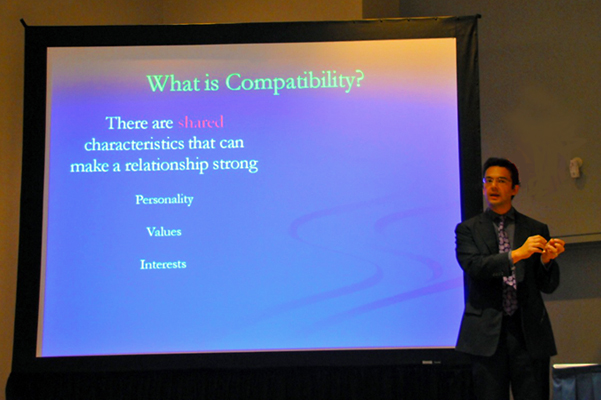
What is Compatibilty? 

( We are now seeing the slide you can see above. )

The eHarmony model of compatibility assumes:

"There are shared characteristics that can make a relationship strong" - notably personality, values and interests.

Conducting research on initial compatibly and long-term relationship [marriage] success can get "a little tricky".
To begin with, "you need to let people get married to see how it works. And, at the beginning of marriage everyone is happy." Only with time do we see underlying stressors and compatibility issues placing a relationship at greater risk. Of course, even in a great long-term relationship, conflict is inevitable - but it gets worked out, even if it can take an hour before figuring wht the conflict is about. Sometimes, over the years, misunderstanding can grow...

Dr. Gonzaga presented several on screen references to frame the history of compatibility research. First came the empirical evidence that "similarity between relationship partners predicts relationship quality" (Gaunt, 2006, Russel & Wells, 1991). Next we can see how similarity "provides consensual validation of attitudes and beliefs which promote attraction." (Byrne, 1971; LaFrance & Ickes, 1981). Finally, "Similarity promotes better understanding and effective communication between partners "(Burleson & Denton, 1992; Keltner & Kring, 1998). And it "coordinates a couple's responses responses to the environment". (Hatfield, Cacioppo, & Rapson, 1994; Kemper, 1991).

The list of references continues, underscoring how enduring couples are "more similar than average" and how they may set about to elect similar partners ("assortative mating") . And how "couples may converge, or become more alike over time." (e.g., Anderson, Keltner, & John, 2003).

An important note, big and bold onscreen: No study has prospectively investigated assortative mating in psychological characteristics
Gonzago noted that he takes comfort in eHarmony's low [known] divorce rate (even if nobody can 'prove' the key to long-lasting love).

With that Dr. Gonzago presented three recent studies, on (1) Personality matching (2) Proximal Processes; and (3) the Potentiation Effect

Study #1 

Prior to eHarmony, said Gonzago, nobody else had focused on personality characteristics.

Four hundred seventeen married couples who met via eHarmony.com and later married participated in this study. At the time of assessment, they'd been married an average of 32 months (range 26-56 months). Apologizing again and understanding we are seeing an awful lot of their 'deliriously happy couples' in advertisements these days, he noted that they now have helped bring together 40,000 couples.

To assess 'relationship satisfaction' eHarmony used what they found to be best, the Dyadic Assessment Scale (Spanier, 1976). Each couple completed the eHarmony relationship questionnare 3 times, assessing such things as Personality (e.g., warm, clever), Emotional tendencies (e.g., happy, anxious), and Interests (e.g., movies, shopping).

The results suggest that similarity can predict how satisfied one will be 3-4 years down the road.

[I do believe author Malcolm Gladwell has some thoughts on this as well, worth reading : Blink. It changed the conceptions of many psychologists! He cited research demonstrating that we can predict within only minutes whether couples are likely to be together years in the future.]

eHarmony has extensive data on match choices and their research affirms that "people tend to pick partners more similar to themselves." Do couples 'assort'? "We all tend to be alike" and may share a 'stereotyped personality". But again, what might predict long-term compatibility?

Gonzago has become convinced that "similarity is the lynch pin". Citing a study by Anderson, Keltner et al, 2003, he noted the adaptive function served by social interactions, and how for example "validation is best communicated directly... and how understanding is most relevant during discussions We know how our intensity during arguments is greater than in neutral discussions. What fuels this social interaction effect? Two possible reasons for this effect were identified:

* The Proximal Process: "Similarity in broad traits promotes similarity in interactive experience"

* Potentiation: "Similarity in broad traits enhances the positive effects of good relationship skills"


Study #2:
Similarity in Personality and Emotions in Married Couples (Gonzaga, Campos, & Bradbury, 2007)


Now we look at one of the venerable topics within personality theory: traits. We know from mountains of research that traits influence emotion and that variations can be seen between different groups, for example extroverts being more prone to exhibit positive affect.

This second study involved 172 married couples. The question was: Are couples similar in personality? In emotional experience? What they found is that "personalities were more alike than was their emotional similarity. Yet there were some qualitative aspects too, and the question was raised as to whether emotional similarity may be a 'mediating factor' in a triangle, between personality similarity and relationship satisfaction. Overall it was found that "relationship satisfaction is positively related to similarity".


The Proximal Process Model 

Similarity in broad traits predicts similarity in emotional quality in the moment 
  • Traits influence emotional experience 

    • Extroversion predicts positive affect
    • Neuroticism predicts negative affect
  • Emotions facilitate smooth social interactions

    • Communicate important messages about internal states
    • Evoke coordinated emotional responses from a partner
    • Elicit behaviors from partner to adjust to environmental conditions
  • Social Interactions act as building blocks for relationships (Gonzaga et al., 2006; Keltner et. al, 1998)


Study #3:
Social Interactions and Relationship Functioning in Married Couples (Setrakian & Gonzaga, in prep)


According to the Potentiation Model, relationships move from early connection through shared personality and interest factors - similarity - to an emotional connection which is mutually pleasurable, and then... how do shared social interactions grow into building blocks for lasting relationships?


Potentiation Model:

Similarity in broad traits predicts similarity in emotions
  • Emotions facilitate smooth social interactions 

    • Communicate important messages about internal states
    • Evoke coordinated emotional responses from a partner
    • Elicit behaviors from partner to adjust to environmental conditions
  • Social Interactions act as building blocks for relationships (Gonzaga et al., 2006; Keltner et. al, 1998) 

Increased understanding should enhance the effect of good social skills


Here we approach the foundation-building for healthy and happy long-term relationships. How to harness the shared personality/temperament factors and use our emotional and social skills to maintain the relationship:

Two hundred married couples, first marriage no children, wife under age 35, minimum 10th grade education, greater L.A. area.

Time's almost up, and these methods are hard to explain quickly (and now!) but...

Couples have a discussion under one of two conditions, social support vs. capitalization - experienced respectively as either supportive (Partner provided comfort) or using "Capitalization" (partner responded enthusiasticallly towards my good event - again exactly as Seligman just described - as the 'active/supportive' communication.)

This was a controlled laboratory study, though it was pointed out that "Lab ideas don't always work in the field".
Their results were analyzed through the filter of whether similarity, which we know to be a big factor, can moderate the perceived 'responsiveness effect' - that is the impact of capitalization, conflict resolution, and support elicitation. Their findings were described as 'robust though with mixed results in mediating the main factor, similarity.

CONCLUSIONS:

"Similarity", Gonzaga said, "doesn't make you a better partner. On the other hand, does it moderate attitudes? Yes. In males."

We know that Responsiveness matters in social interactions, that Similarity does not predict improved responsiveness, and that Similarity moderates the effect of responsiveness in males (but not females)."

In sum:

*Similarity is a powerful predictor of relationship success

* There are two potential routes: proximal process and potentiation

* Social interactions are critical in how similarity effects relationships

* Relationships deepen through increased understanding

* Partner selection is important because convergence is minimal.

And one more thing - oops, time is up! - Quickly then: Use the web as a tool!

-- Technology provided a platform for the application of basic research, BUT
-- The ideas that work in the laboratory don't always work in the field
-- The type of system he promotes is 1) Robust 2) Scalable 3) Palatable

Finally: "Technology can help facilitate a new era of research"

No doubt!

For me, anyway the 'takeaway' is: Similarity is a key factor in easy 'understanding' and resonating/reflecting similar feeling [tone], and revving up pleasure with shared activities and interests. Basic personality compatibility is the starting point, a foundation. Proximal process is about our personality 'similarity' basically, how alike we are and how we can use our collective attitudes and attributes to enjoy situations when together. Once a relationship is growing more intimate, the Potentiation Process begins.

It's no longer just about personalities matching on 'broad traits' at first, but also how they potentiate - bring out - the mutual joy. (or not) With broad similarity and shared world views, it is easier to 'be yourself' because you're feeling understood and veering towards that state of thinking in terms of 'we' very easily, as there is ongoing connection at several levels, emotionally. That's the perfect scenario. A well-functioning, happy couple is similar in personality and mutually reinforce the good feelings of emotional and personal connectedness, across situations. And that is my synopsis and take-away. YMMV. ['your mileage may vary']

I'll bet you weren't expecting to hear terms like proximal and potentiation in a talk about relationships and Love! But this may be the real thing. The new language of love. The pherenome of explanations as to why we initially attract, connect, and maintain healthy relationships. 

Social Media Users In Love: Romance Update [INFOGRAPHIC]


Social Media Users In Love: Romance Update [INFOGRAPHIC]


How do you meet people you’d like to get to know better? How do you treat each other once you’re together? Social media turns out to be a great accelerator for exposing you to potential mates, but does that change the basic way people interact with each other?
The infographic and research experts at Lab42 set out to take the pulse of today’s relationship hunters as well as established lovers, conducting a survey between Oct. 27 and Oct. 30 where they asked 500 social network users over age 18 some rather personal questions about meeting people, cheating, communication and more.
Is your romantic life similar to that of most other social networkers, or do you play the game your own way? Find out by checking out the fresh results of this infographic: